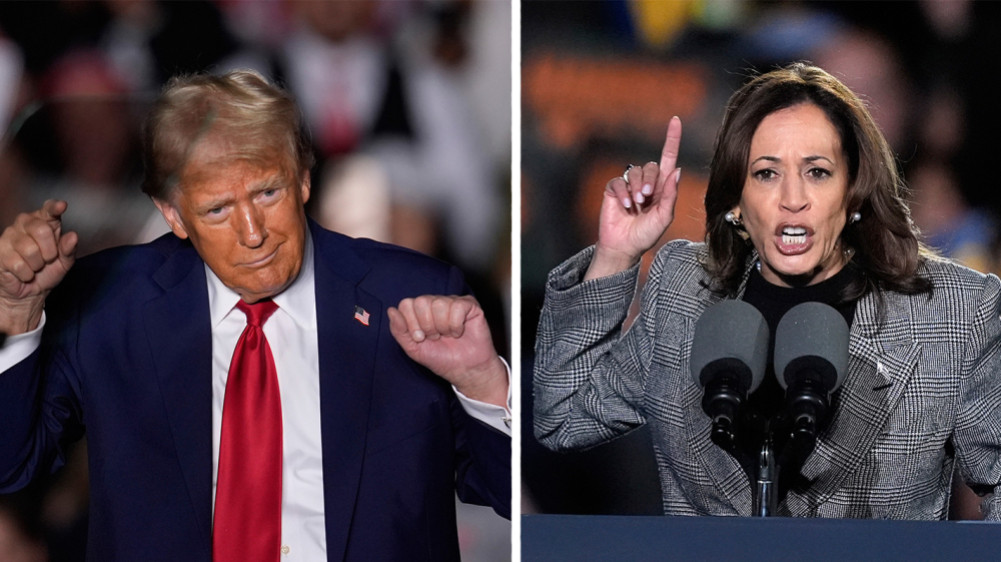
In the race to become the first woman president of the United States through Tuesday's election, while Trump is in the race to enter the White House for a second term, an ABC News poll conducted a week before the election showed that 48.1 percent of voters support Harris and 46.7 percent of voters support Trump, while 5.2 percent of voters are still in favor. undecided
We use Google Cloud Translation Services. Google requires we provide the following disclaimer relating to use of this service:
This service may contain translations powered by Google. Google disclaims all warranties related to the translations, expressed or implied, including any warranties of accuracy, reliability, and any implied warranties of merchantability, fitness for a particular purpose, and noninfringement.
There is only one week left for the US presidential election. Vice President Kamala Harris on behalf of the Democratic Party and former President Donald Trump on behalf of the Republican Party are candidates in the presidential election to be held on Tuesday, November 5. Initially, it was seen that there would be a competition between Trump and President Joe Biden, the candidates of the previous election.
But Biden withdrew from the election field on July 21 after being criticized for not being able to take on the next task due to his age. With his exit, the Democratic Party selected Harris as the official candidate.
Harris is in the race to become America's first female president. But to prevent him from entering the White House for a second term, Trump has worked hard even at an advanced age. With the entry of Harris into the electoral field, it seemed almost impossible for the 78-year-old Trump to defeat Harris, who is 18 years younger than him. But gradually Trump has improved the political race. In the weeks leading up to the campaign, voter support for Harris was higher than for Biden. By the end of August, she had maintained a lead of about four percent. But with the beginning of September, there has been some improvement in Trump's condition.
There was an election debate between the two candidates on September 10. Harris dominated Trump in the debate, which was watched by 70 million people live on television. But even after the debate, there was no significant change in the condition of both the candidates. Recent polls have shown that this presidential election will be as competitive as ever. According to recent polls, Harris is slightly ahead of Trump. A poll conducted by ABC News showed that 48.1 percent would vote for Harris. Polls show that Trump has already gathered the support of 46.7 percent of voters. According to the
 poll, 5.2 percent of voters are still undecided. The support of such voters is seen as important for the victory of both candidates. In a simple calculation, it can be estimated that the candidate who can satisfy the majority of voters out of 5.2 percent will be able to enter the White House for four years. But in the US presidential election, the candidate who gets the most votes is not always elected. If a candidate wins the election by a very small margin in some states, he is likely to be elected president even if the overall vote is low across the country. In 2016, Donald Trump was elected president even though he received almost 3 million fewer votes than Hillary Clinton. Similarly, in 2000, George W. Bush, who was elected as the President of the Republican Party, received five million votes less than the Democratic candidate, Al Gore.
In the US, the Electoral College, a system based on the Electoral College, determines the election results. For the 50 US states, the Electoral College vote is determined by population. The state of California has the most electoral votes at 54. Less populous Wyoming, Alaska, North Dakota and Washington DC have three electoral votes each. To be elected as the President of the United States, 270 out of 538 electoral votes must be obtained. There are 535 electoral votes in 50 states and 3 electoral votes with the federal capital District of Columbia.
 Electoral votes are determined for states, so voters vote for state-level contests rather than nationally. This means that the vote given by the electorate does not go directly to the candidates for electoral votes. The Electoral College, held a few weeks after the election, chooses the President and Vice President.
Political parties select their supporters or party officers as electoral officers before the election. A candidate who receives at least 270 Electoral College votes is elected President. Along with that, the person selected by the President as the vice presidential candidate is also automatically elected. Electors in principle get to vote for the candidate of their choice. But in practice, the electors tend to support the candidate who gets more popular votes in their state.
Voters who vote for the candidate who gets the most votes in the state are called traitors. In 2016, 7 members of the electoral body voted for the candidate who got the least number of votes in the state. But their vote had no effect on the final result. In some states, such unfaithful electors are fined or prosecuted.
 If the electoral votes of the two candidates are equal, the lower house of the US Parliament chooses the president from among the three candidates with the highest number of electoral votes. A president has been elected only once in the United States through such a process. In the 1824 presidential election, the Electoral College was divided among four candidates, with no one receiving a majority. Then the lower house elected John Quincy Adams as president.
There is a provision that the candidate who gets the most votes in other than two states will get all the electoral college votes specified for that state. The states of Maine and Nebraska have adopted a more complex system that reflects the popular vote in US congressional and state elections. Due to which the electoral votes of those states may be divided. There are 50 states in the US. Most states traditionally vote mostly for one party in presidential elections. Such states are known as 'blue' and 'red' states. States favoring the Democratic party candidate are called 'blue' states and states favoring the Republican candidate are called 'red' states.
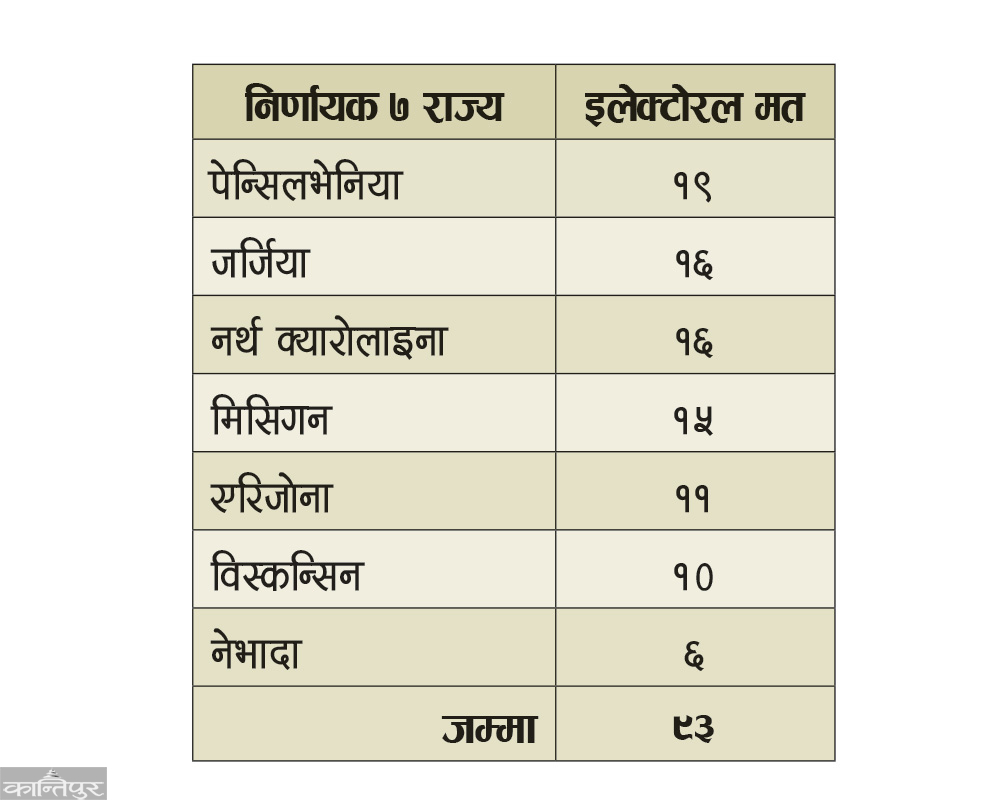
Only a few states have contests between candidates in every election. It is the state itself that lowers the overall election results. These states are called 'battleground states' or 'swing states'. In this year's election, 7 states where Harris and Trump are in fierce competition are considered 'battleground states'. The list includes Pennsylvania, Georgia, North Carolina, Michigan, Arizona, Wisconsin and Nevada.
19 in Pennsylvania, 16 in Georgia, 16 in North Carolina, 15 in Michigan, 11 in Arizona, 10 in Wisconsin and 6 in Nevada have a total of 93 electoral votes in these seven states. According to opinion polls, no candidate has been able to maintain a clear and decisive lead in all these seven states so far. Five of these states were won by Trump and two by Harris. According to the survey, the difference between the two candidates in these states is very small. Because of this, it has not been decided which candidate will win in these 7 states.
If you look at the August polls, there is always no candidate leading in these states. For the past few weeks, Trump has been ahead by a small margin in most of these states. According to a poll conducted by ABC News on Tuesday, Republican candidate Trump is ahead by 1.9% in Arizona, 1.5% in Georgia, 0.2% in Nevada, 1.3% in North Carolina, and 0.3% in Pennsylvania. Harris leads in Michigan by 0.5 percentage points. Both candidates are expected to get equal votes in Wisconsin.
Before Trump's victory in 2016, the states of Pennsylvania, Michigan and Wisconsin were known as strongholds of the Democratic Party. In 2020, Joe Biden again managed to establish Democratic influence in those states. On this basis, polls show that Harris will win if he swings the vote in these states. It is almost the same for Trump to become president. That is why both the candidates are focusing their attention on 'swing states'.
 On November 5, American voters elect the country's 47th president, as well as representatives at the federal, state and local levels. Voters in all 50 states are electing 435 members of the House of Representatives, the lower house of the federal parliament. The number of representatives in the lower house for each state is determined on the basis of population. There are currently 220 Republicans and 212 Democratic members in the House of Representatives.
Likewise, 33 members of the 100-member Upper House Senate are also being elected in the elections to be held on Tuesday. In the Senate, two members are elected from each state. The Senate currently has 49 Republicans, 47 Democrats, and 4 Democratic independents. Senate races in Montana, Wisconsin, Ohio, Nevada, Pennsylvania, Michigan, Arizona and Texas are expected to be very competitive. Out of these eight, currently 7 members are from the Democratic Party.
In America, the President of the Senate is the Vice President. He presides over the sessions of the Senate and casts the deciding vote. In addition to passing the bill, the Senate must approve the appointment of cabinet members, the Supreme Court and other federal judges and ambassadors appointed by the president.
Similarly, voters in 11 states and two territories are electing governors. New governors are being elected in American Samoa, Delaware, Indiana, Missouri, New Hampshire, North Carolina, North Dakota, Puerto Rico, Utah, Vermont, Washington and West Virginia.
-