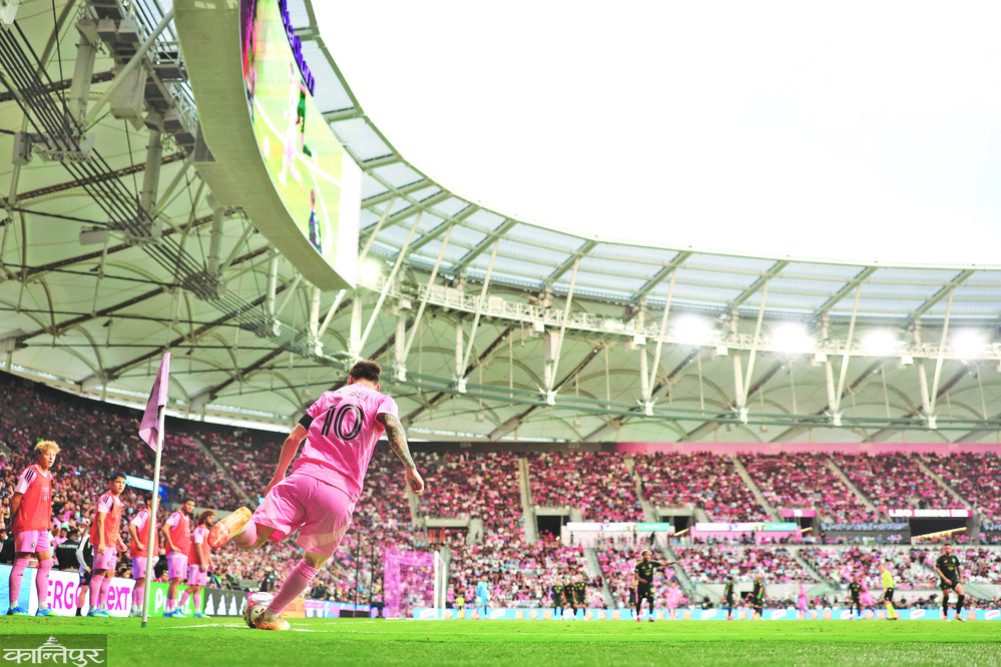
Will hosting the 2026 World Cup boost soccer in North America? Over a dozen Major League Soccer stadiums have been built in the last decade, including Miami's Nu Stadium.
We use Google Cloud Translation Services. Google requires we provide the following disclaimer relating to use of this service:
This service may contain translations powered by Google. Google disclaims all warranties related to the translations, expressed or implied, including any warranties of accuracy, reliability, and any implied warranties of merchantability, fitness for a particular purpose, and noninfringement.
North America is considered a region that has probably been largely untouched by world football. The foundation of football has been laid in this region for the last few decades, so will hosting the 2026 World Cup boost football in North America? About a dozen Major League Soccer stadiums have been built in the last decade. One of these is the Nu Stadium in Miami.
It is almost as if it is the new home of Lionel Messi. The enthusiasm for football here is immense. You have to go to the sports bar in Los Angeles, and you will find a huge number of supporters of the English Premier League, which takes place early in the morning. Many of them are Americans. Mia Hamm was a key player when the US won the Women's World Cup in the 90s. She is happy to see the number of people wearing the jersey of her favorite club in America has increased significantly.
She says, "When I first started playing football, it wasn't like this." Back then, there were only a few football fans, but now you have to go to Los Angeles, and most people you meet there know what's going on in world football.' Until recently, if you ask an American sports fan about their favorite sport, football would probably come in third place.
The top two are American football and basketball. By 2021, football will have overtaken basketball. Baseball is already far behind football. Thus, football's popularity in America also has economic implications. FIFA is expected to earn $11 million from this World Cup, after nothing. Football was already making money even before the World Cup started in America.
The amount of money raised by Major League Soccer, games involving the US national team, and television broadcasts of various major European leagues has already surpassed baseball. According to Opta, the number of live viewers of the US domestic leagues in the first week was 400,000. In 2024 alone, 12 million people went to stadiums to watch football, which will be second only to the English Premier League.
Players are not traded as expensively as in Europe, but Major League Soccer spent $336 million on new player signings last year alone. In North America, $11 billion has been invested in the construction of new stadiums and training grounds. Now New York City FC, Chicago Fire FC and New England Revolution are also in the process of building their own excellent stadiums.
In fact, the foundation of football in the United States was really laid after the 1994 World Cup. At that time, the United States hosted the World Cup, when football was new to the United States. But the number of viewers at that World Cup set a record, with 3.5 million spectators watching the game live. After that, the United States also tried its best to make its league football higher.
It was at that time that the US women's team not only won gold at the 1996 Olympics, but also won the World Cup on its home turf in 1999. This also made football popular with all kinds of spectators. Ham says, "While parents started playing football back then, their children have expanded their football even further."