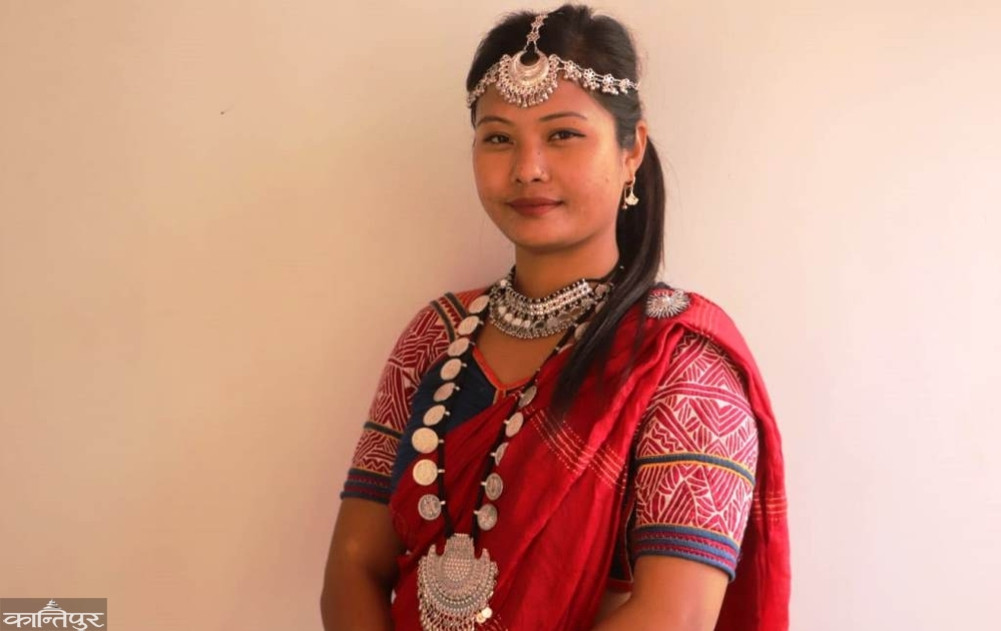
Karishma Katharia of Gauriganga Municipality-10, who got the opportunity to take on the role of principal at a school at the age of 23, entered politics through teaching and social service.
We use Google Cloud Translation Services. Google requires we provide the following disclaimer relating to use of this service:
This service may contain translations powered by Google. Google disclaims all warranties related to the translations, expressed or implied, including any warranties of accuracy, reliability, and any implied warranties of merchantability, fitness for a particular purpose, and noninfringement.
Karishma Katharia of Gauriganga Municipality-10 in Kailali has become a member of the House of Representatives on the proportional representation side from the National Independent Party. She is the first person from the Katharia community to reach the federal parliament.
Born in 2053 BS in a middle-class family, Karishma spent her childhood in a rural environment like other Tharu children. She completed her school education from Kshitij English Boarding School in Masuria and completed her secondary education from the local popular Secondary School. She graduated from Tikapur Multiple Campus in Management.
She had a burning desire to do something for the society since childhood. But the thought of entering politics never crossed her mind during her student life. Neither did her family have any political background. Before entering politics, Karishma spent about 6 years in the teaching profession. At the age of 23, she got the opportunity to take on the responsibility of the principal in a school. She led the school as the principal of Jyoti Basic School in Tikapur for 4 years.
Having gained teaching experience in both the private and community sectors, she said that it was while working as a principal that she got the opportunity to observe the real picture of society up close. ‘While running the school, I realized that the root of everything is connected to politics,’ she says. ‘That experience in the education sector inspired me to enter politics and reach the policy level.’
Along with teaching, she was also active in social service. She developed her youth leadership skills by joining JCIS. At the age of 26, she became the president of the Kisminiya Women's Agricultural Cooperative Society and embarked on a campaign to improve the economic condition of rural women.
These social works brought her directly into contact with the problems of the people. Karishma's formal political journey began with the 2079 general elections. Initially, she was associated with the Nagarik Unmukti Party (NAUPA). She also became a proportional candidate from the same party.
She joined it because it was a party that carried the rights and interests of the Tharu community. However, over time, she felt that the party leadership was not focused on the people's expectations and Tharu issues. She said, "When the leadership started focusing only on herself, forgetting the main agenda and rights of the Tharu community, it was not appropriate to stay in Naupa."
That dissatisfaction attracted her to the Rashtriya Swayamsevak Sangh (RSS). With good governance, transparency, and faith in the new generation, she not only joined the RSSS but also became a proportional candidate. As a result, today she is representing her community in the federal parliament.
Even within the Tharu community, the Katharia community is still lagging behind. Karishma's entry into parliament has given new hope to this community. The Tharu community has a population of over two million people across Nepal, which accounts for 6.7 percent of the country's total population. But she says that the community's access to the mainstream of the state is still weak. That is why Karishma says that her representation in Parliament is not just for presence but for results.
After starting her work as an MP, Karishma has a detailed roadmap for the upliftment of the Tharu community. She said that her goal is to end the oppression, discrimination and inequality that the Tharu community has been facing for centuries. Her political objective is to declare a Tharu Special Area and effectively implement the priority.
She has put forward the idea of linking the 'Badghar system' run by the Tharu village society with the legal structure of the state and giving official recognition to the Guruwa and Sudeni classes. For cultural identity, she has declared 'Dhikari Day' and set a goal to globalize Tharu cuisine and art.
Karishma's priorities towards health are clearer. She is particularly interested in 'sickle cell anemia', a hereditary health problem in the Tharu community. She has resolved to raise the agenda of its free treatment and a special relief package for the affected families prominently in Parliament.
In education, she has put forward the concept of 'Tharu Raithane Vidyalaya'. Another demand of hers is that Tharu children should be given education only in their mother tongue as they have a language problem. 'Our children should be able to learn in their own language.' She says, 'We should create an environment where they can be proud of their history.'
Similarly, for women empowerment, she has resolved to create employment through women's agricultural entrepreneurial cooperatives and ensure proportional representation of women in all state bodies.
In addition, she has emphasized scientific river management and immediate compensation for the long-term solution to the flood problem and wildlife-human conflict in the Terai.
Another important goal of hers is to take strong initiatives from the state level in distributing Lalpurza for the land rights of freed Kamaiyas and Kamlaris and to make the Lal Commission report public by accepting the Tikapur incident as a political movement. ‘The vote given to me by the people is not just a vote, it is an investment.’ In the next five years, I will work in a way that the people will feel the benefits of this vote,’ says Karishma. Karishma, who has reached parliament for the first time from the Katharia community, now plans to raise the issues of not only her community but also the entire Far West at the policy level.