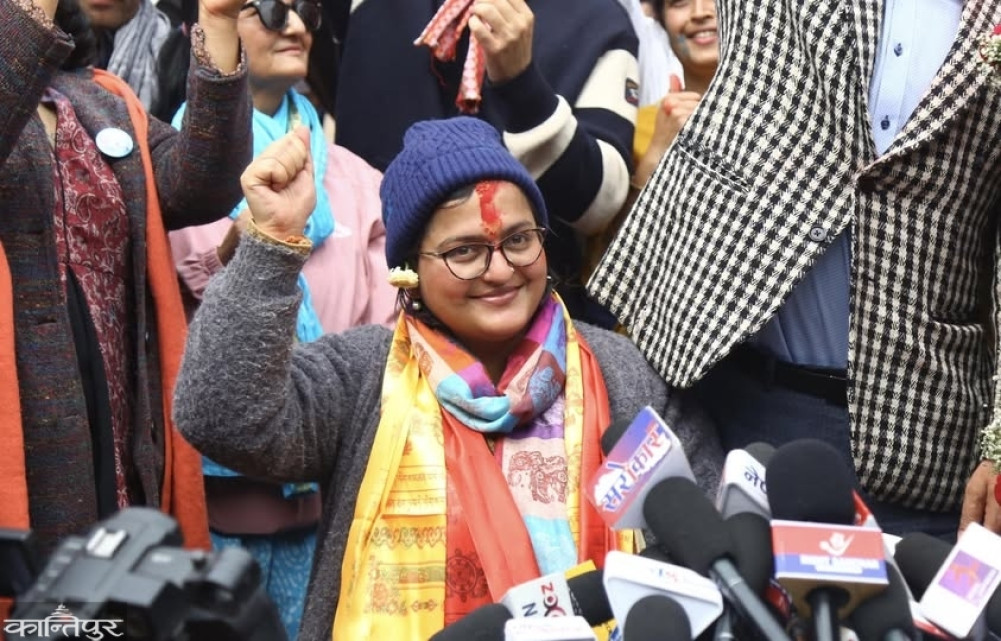
Six female candidates have won elections since 2064. The female MPs elected from Kathmandu Valley since 2064 are Hisila Yami, Suprabha Ghimire, Pampha Bhusal, Sobita Gautam, Toshima Karki, and Ranju Darshana.
We use Google Cloud Translation Services. Google requires we provide the following disclaimer relating to use of this service:
This service may contain translations powered by Google. Google disclaims all warranties related to the translations, expressed or implied, including any warranties of accuracy, reliability, and any implied warranties of merchantability, fitness for a particular purpose, and noninfringement.
While 14 female candidates from various parties have won across the country, only two women have been elected from two of the 15 seats in the Kathmandu Valley. Rashtriya Swayamsevak Sangh (RSS) Ranju Darshana and Toshima Karki have won from Kathmandu-1 and Lalitpur-3, respectively.
Similarly, if we look at the results of the 2079 BS election, only 2 female candidates won from Kathmandu Valley. Earlier too, Tosima Lalitpur-3 and Sobita Gautam had won from Kathmandu-2.
Fewer candidates, fewer elected
Parties field very few female candidates in every election. The Rashtriya Swayamsevak Sangh (RSS) fielded female candidates in 2 out of 15 constituencies in Kathmandu Valley. The NCP fielded 3 female candidates in Kathmandu Valley. The NCP fielded Menuka Bhandari from Kathmandu-1, Kalpana Sharma from Kathmandu-5 and Rupa Maharjan from Kathmandu-10.
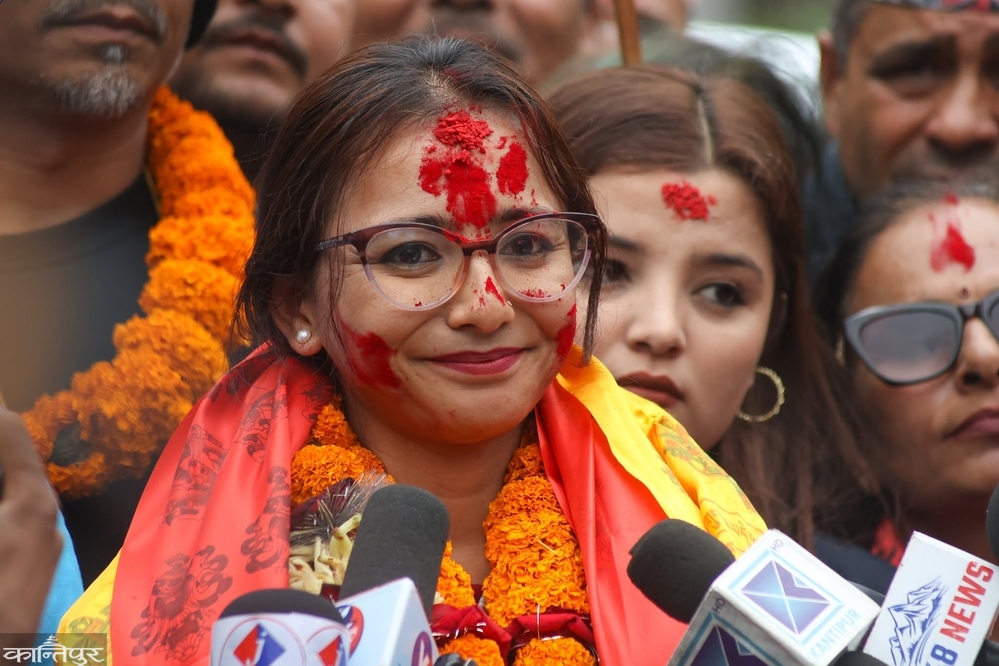
The Congress fielded Sapana Rajbhandari and Nanu Bastola from Kathmandu-9 and Kathmandu-10. The UML did not field any female candidates in Kathmandu.
If we look at the results of the 2064 BS election, 3 female candidates had won from Kathmandu. Suprabha Ghimire won from the Nepali Congress in Kathmandu constituency number-4. Similarly, Hisila Yami was elected from the CPN-Maoist from constituency number-7.
Pampha Bhusal was elected from Lalitpur-3 from the CPN-Maoist. In 2070, no female candidate won in the Kathmandu Valley. In 2074, Pampha Bhusal was elected from Lalitpur-3. Six female candidates have won in the elections since 2064. The female MPs elected from the Kathmandu Valley since 2064 are Hisila Yami, Suprabha Ghimire, Pampha Bhusal, Sobita Gautam, Toshima Karki and Ranju Darshana.
Considering ‘women as proportional’, it is directly less
According to women's rights activist Saru Joshi Shrestha, women have received less space in proportional representation than men because of the narrative that men directly, women proportional representation has been created. She says, 'Women are said to be brought in through proportional representation. Everything from expenses is considered,' she said, 'In Nepal, they are also much less than men in terms of access to party power relations.'
Saru says that a narrative has been created that even to reach 33 percent, let's give 8 or 10 percent from here, let's give it from other proportional representation. 'Even if we look at what happened after the constitution was made, it seems that the old parties did the same. It seems that the new parties have given more than the old parties,' she said, 'The parties themselves bring in women through proportional representation.' Women cannot work hard, and they do not have the financial resources and means to directly fight them, so there are very few candidates from big parties.’
‘The result of giving certain constituencies to men’
NCP leader Pampha Bhusal said that there were few women candidates in the election because big leaders did not leave them in winning places and did not want women to go to difficult places.
‘Big leaders do not leave them in places where victory is absolutely certain,’ she said, ‘Proportional representation will be acceptable.’ All parties seem to understand why they should take risks. The elections have become expensive. Women do not even have the resources. That is why there are few candidates.’
UML leader Binda Pandey is of the opinion that the old parties did not give priority to women. She says that the parties did not comply even though the Election Commission asked the parties to field at least one-third of their candidates. She said that the law itself should be improved to increase women's representation. She stressed that the draft of the Unified Election Act should be passed to ensure inclusive and proportional participation of women.
She said, "This draft has been in the Ministry of Home Affairs since Asad 2080. It would be better if it is passed before the upcoming local elections," she said, "The draft says at least one-third of women. That means 50 percent women should be given. If that is not the case, according to the spirit of the constitution, at least 40 percent women and 40 percent men should be mandatory, leaving the remaining 20 percent open for women, men, or gender minorities."