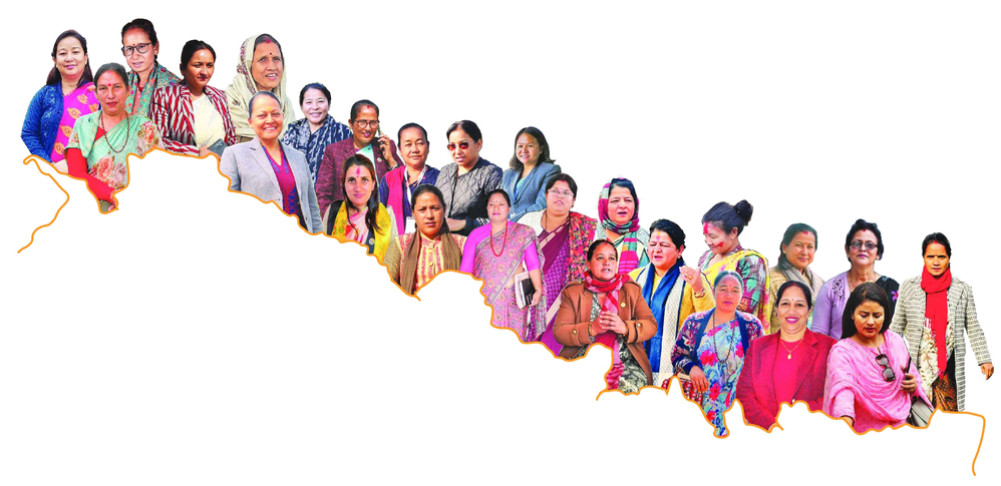
Women are in parliament, at the local level, and are visible in policy-making structures. Thousands have sacrificed for this, women have continuously struggled. Today, the ground on which we can stand and present our ideas confidently, and claim our rights, is not something that came easily.
We use Google Cloud Translation Services. Google requires we provide the following disclaimer relating to use of this service:
This service may contain translations powered by Google. Google disclaims all warranties related to the translations, expressed or implied, including any warranties of accuracy, reliability, and any implied warranties of merchantability, fitness for a particular purpose, and noninfringement.
The days of the people's movement of 2046 are still fresh in my memory. Among the thousands of voices calling for change on the streets, the presence of women was strong. They were shouting slogans, marching, protesting, and at risk. People were angry, enthusiastic, and had an unquenchable desire for change. At that time, young people like me, who were in their teens, believed that if democracy came, our lives, voices, and existence would be accepted by society and the state. The rule would not be over the people, but for the people.
I clearly remember that when the movement reached its peak across the country, the name of a woman was very much in the news, who had dared to wage fearless and unnatural resistance against the then royal regime and suffered barbaric torture in return. Perhaps she had become a symbol of rebellion at that time. Her name was Lakshmi Karki. One day, soon after democracy came, the news came that she would address a political meeting, and a crowd gathered to see her. I was also a part of that crowd. We were eager not only to hear her, but also to see the face of such a courageous woman. That moment made us realize that women also have the ability to not only challenge the government, but also lead the storm that will overthrow it.
I am equally thrilled today when I remember that moment in my teenage years. For women of my generation and those who had already become politically conscious, Lakshmi and the courageous women and men leaders like her who stood at the forefront of leadership were 'iconic', a standard of change, an inspiration to stand at the forefront against injustice. We, the youth of that time, saw democracy as a means of opening doors not only for regime change, but also for equality, respect, and participation in the decision-making process. The days around 2046 were not just days of political change, they were days of rebirth of the consciousness of ordinary women and girls like me at that time.
When I remember that scene today, I am forced to compare it with the current political environment. Even today, the youth are equally attracted and excited about the rebellious faces and new leadership. Just as the youth seem to be addicted to watching, listening to and following the famous young leaders of today, the same addiction was towards someone or someone at the milestones of every political change. But the question arises again – is our attraction towards the individual or are we in search of structural change? In 2046, we were on the streets dreaming of democracy, today we are still in search of good governance and honest leadership.
I am still thrilled today when I remember that moment in my teenage years. For women of my generation and those who had already become politically conscious, Lakshmi and the courageous women and men leaders like her who stood at the forefront of leadership were ‘iconic’, a standard for change, and an inspiration to stand at the forefront against injustice. After more than three decades, today I ask myself, where were we? And, where are we today? Where is the place of women and marginalized communities in all these changes?
The constitution of Nepal formed after 2046 laid the foundation for equality. The interim constitution of Nepal formed after the people’s movement of 2062/63 established inclusion as a political commitment. The constitution of Nepal promulgated in 2072 ensured at least 33 percent women’s representation. All these achievements are not small. Today, women are in parliament, at the local level, and are seen in policy-making structures. All these are the result of political changes over time. Thousands have sacrificed for this, women have continuously struggled. The ground on which we stand today and can confidently present our ideas and claim our rights is not something that was easily achieved. It would be an injustice to history to be decisive about the present without considering this issue.
Nepal's democratic journey cannot be understood without the context of the Maoist People's War. During the years of armed conflict, thousands of women carried guns, formed organizations, and participated in ideological debates. Most importantly, they led the front of the war by challenging the role of women as defined by patriarchal society. For many rural girls, that time was their first opportunity to stand in a public and political role. There are many aspects to be examined in the Maoist People's War, but it made women not just victims, but also agents of change. This is an aspect that the entire women's movement cannot deny. But unfortunately, after the peace process, the role of those women could not be included in mainstream politics. Many women who carried guns in the war were displaced, some returned to society with physical and mental trauma, where they were again questioned from a patriarchal perspective and rejected by their families and society. Their presence in the forefront of leadership remained minimal, while their contribution was incomparable in building the foundation of the movement, the same movement that led the country from autocracy to democracy and inclusive democracy.
Democracy is a way of life. I grew up in a rural society. I have experienced democracy not only in books, but also in my home courtyard, fairs, schools and streets. I have participated directly and indirectly in all these processes, such as the openness after 2046, the people's movement of 062/63, the debate on the new constitution. I have felt that the voices of women and marginalized groups are gradually becoming stronger in this long process. But at the same time, I have also researched, documented and experienced the lists of contempt, neglect, and exclusion. Even today, many girls are trafficked at school age. The incidents of violence, rape, and caste discrimination that occur every day are blatant before us. Thousands of citizens are trapped in the clutches of slavery in the name of foreign employment. Assets have been created, but their implementation is neglected everywhere, and access to justice is unequal. In a society rife with corruption and misrule, the gap between the haves and have-nots is widening day by day. Access to and control over power and resources is rotating like musical chairs between a certain class, caste, and gender, which is very painful and unacceptable.
Violence, discrimination, exclusion, and misrule that continue to exist in society are the ugly sides of democracy. In this era of increasing dominance of technology, online insecurity has created even more fear in society. Women and children, especially women in leadership positions, are feeling unsafe and humiliated in the online space. They are being distanced from ideological debate due to misogynistic and hateful behavior. The increasing number of these incidents in society shows that even though democracy has established political rights, social, cultural and structural transformation is incomplete. What is even more sad is that these issues are often always 'sidelined' as the main issues of elections or politics. While political parties are busy with the arithmetic of power, the issues of safety, respect, and economic justice of women and marginalized communities are not at the center of the debate.
However, it is unfair to make this journey from democracy to democracy only a story of disappointment. Today, women are elected from local to central levels, participate in the budget and planning processes, have partially acquired property rights as property, and have secured rights with various assets. All these achievements are the result of struggle. But the feminist perspective always forces us to think, is it sufficient and just ?
Did democracy give women only a place of presence or also decisive power ? In times of change, as women have stood as the backbone of the movement, why have they been sidelined in the results ?
Our life experience has shown that exclusion and power inequality are not just personal experiences, but structural problems . Therefore, the measurement of democracy should not be only through the constitution and elections, but also through the protection of the lives, self-respect, opportunities and decisive representation and lifestyle of women and neglected communities . Women are present, but how many are at the center of the real decision-making process ? The constitution gave rights, but did political parties practice democracy within their structures ? Therefore, the journey towards a just democracy is still incomplete . Our question now is not whether democracy has come or not, but for whose benefit this democracy is directed . In these days after the Gen-G rebellion, this question should be even more prominent, because for us it is an important basis for distinguishing between the new and the old. This will be shown not by words, likes and comments on social media, or applause from the crowd, but by behavior.
Nepal's democratic journey has given space to women, marginalized people, people with different genders (sexual identities), people with disabilities, other ethnic and religious minorities, and everyone, but the main question is how safe, effective, and transformative that space is. Today's debate should be about how just the democracy we are practicing is, rather than how much we have gained or taken or given. Democracy has opened the door, but the full entry of power, equality, and good governance through that door is still to come. Today, society is once again in search of change. The question is, are we just running after new faces, or are we building the foundation of a just democracy? The spirit of democracy is only strong when the voices of those who are marginalized, excluded, and marginalized from resources and access are heard in policy, not in symbols, seen in power, not in presence. Our democratic journey will be meaningful only when the rights and self-respect of the aforementioned communities become the main agenda and commitment of democracy. Let us believe that the forces that have emerged with the determination to change will make the essence of democracy felt in our lives.