In the 2079 elections, 2,411 candidates were nominated and in 2074, 1,944 candidates were nominated. This time, the number of candidates will be determined after the withdrawal of names and protest against the claims.
We use Google Cloud Translation Services. Google requires we provide the following disclaimer relating to use of this service:
This service may contain translations powered by Google. Google disclaims all warranties related to the translations, expressed or implied, including any warranties of accuracy, reliability, and any implied warranties of merchantability, fitness for a particular purpose, and noninfringement.
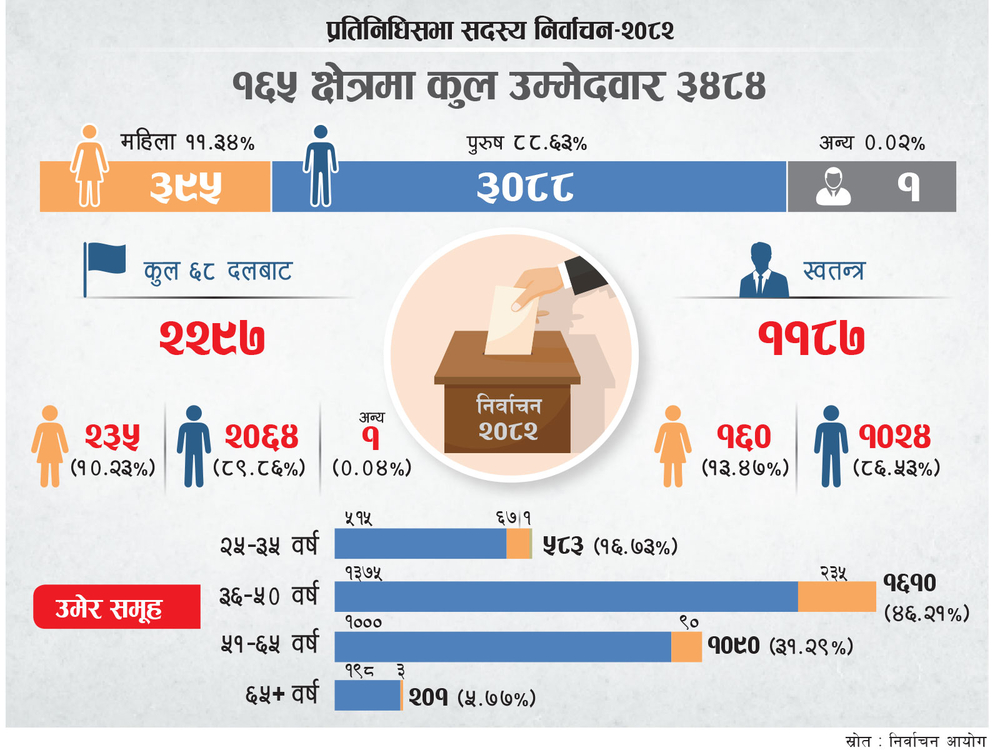
A total of 3,484 candidates have filed their candidacies in 165 constituencies for the upcoming House of Representatives elections. 2,297 candidates from 68 political parties and 1,187 candidates independently registered their nominations on Tuesday.
This time, there are more candidates than in the previous two elections to the House of Representatives. There were 2,411 candidates in the 2079 House of Representatives election and 1,944 in 2074. This time too, the number of candidates may decrease slightly due to withdrawal of names and opposition to claims.
The Election Commission has stated that out of the total candidates, 3,088 are men, 395 are women and one woman from other groups. The Samajwadi Party, which is inclusive of the gender minority community, has stated that six candidates have entered the contest on its behalf.
According to the commission, there are 583 candidates in the age group of 25-35, 1,610 in the age group of 36-50, 1,090 in the age group of 51-65 and 201 candidates above the age of 65. This time, there is no electoral alliance between the major political parties.
The Congress and the UML have filed their candidacies in all 165 constituencies. The NCP has fielded 164 candidates, the Rashtriya Swayamsevak Sangh (RSS) 163, the RPP 163, the NEMKIPA 121, the Shram Sanskriti Party (SSP) 109, the Ujjaya Nepal Party (UPS) 108, the Aam Janata Party (AAP) 102, the JSP Nepal (JSP) 95, the Pragatisheel Loktantrik Party (JNP) 92 and the Janamat Party (JNP) 61 constituencies.
Congress President Gagan Kumar Thapa has fielded candidates from Sarlahi-4, UML President KP Sharma Oli from Jhapa-5, the NCP President Pushpa Kamal Dahal from Rukum East, and the RSP President Rabi Lamichhane from Chitwan-2. Balendra Shah, who has been nominated by the RSP as the next prime minister, has reached Jhapa-5 to challenge former Prime Minister Oli. He has resigned from the post of mayor of Kathmandu Metropolitan City and entered the election contest.
JSP Nepal President Upendra Yadav is contesting from Saptari-3, Janamat President CK Raut from Saptari-2, and Ujjaya Nepal Party President Kulman Ghising is contesting from Kathmandu-3. Shram Sanskriti Party Chairman Harkaraj Rai has resigned from the post of mayor of Dharan Sub-metropolitan City and has filed his candidacy from Sunsari-1. Former Congress President and former Prime Minister Sher Bahadur Deuba is not a candidate this time. He had been winning from Dadeldhura in all parliamentary elections since 2048.
The highest number of candidates, 45, has filed their candidacies in Dhanusha-3. There are 125,927 voters in Dhanusha-3. The lowest number of candidates, 5, has filed their candidacies in Manang. There are 7,000 voters in Manang.
The candidates registered their candidacies at the office of the Returning Officer opened in the respective constituency. The time for nomination was fixed from 10 am to 5 pm. During that period, people who entered the premises of the Returning Officer's office were allowed to register their candidacies. In some constituencies, the applications and documents submitted by the candidates were verified even till evening.
According to the election program, a complaint can be filed against the candidates on Wednesday. The commission has stated that complaints should be filed with the office of the concerned election officer from 10 am to 3 pm. The list of candidates will be published on Thursday evening after investigating the complaint.
Candidates will be able to withdraw their names from 10 am to 1 pm on Friday. After that, the final list of candidates will be published on the same day and the election symbol will be given, informed commission spokesperson Narayan Prasad Bhattarai. The parties have already submitted the closed list for the proportional electoral system to the commission on 13 and 14 Poush. There are 57 parties in the competition for the proportional system.
After Tuesday's enthusiastic nomination, Prime Minister Sushila Karki has responded that an important milestone has been crossed. She has expressed gratitude to the political parties and candidates who filed nominations within the stipulated time frame. On the recommendation of Karki, who was appointed Prime Minister on 27 Bhadra after the Gen-G rebellion, President Ram Chandra Poudel dissolved the House of Representatives and announced the election. The government led by former Chief Justice Karki was assigned the main responsibility of holding elections to the House of Representatives.
A statement issued by Prime Minister Karki's secretariat on Tuesday evening stated that the government is working with full sincerity and strength to conduct the election in a peaceful, fair and credible environment. 'All our security mechanisms are operating with high alertness and professional morale,' Prime Minister Karki said, 'Now the confusion and uncertainty has ended in the country. The entire nation has entered the Mahakumbh of the election.'
Acting Chief Election Commissioner Ram Prasad Bhandari said that the time has come for voters to exercise their rights freely. 'All preparations for the election management have been completed. Now only the election process remains,' he told Kantipur.
'The world is watching Nepal's election'
 Ram Prasad Bhandari, Acting Chief Election Commissioner
How was the nomination of candidates?
It has been very encouraging and peaceful. It is seen that all parties have participated in the election. The number of candidates is also high. All parties, new and old, have participated in the election. Independent candidates have also filed their candidacies. There is enthusiasm for the election. Now the general voters will exercise their rights freely. The sole objective of the commission is to conduct the election in a fair, clean and fearless manner.
Amid various doubts that the election will not take place, candidacies have been registered for both proportional and direct. Do you see any challenge to the election now?
The phrase 'there will be no election' is no longer there. We were constantly busy preparing for the election. All work has been done as per the scheduled election program. Voters, candidates, and political parties have all started the election.
There is about one and a half months left until the February 21 election. Doesn't this long period increase the expenses incurred by the candidates in their campaign?
The commission has set the campaigning period. Candidates can campaign only from February 4 to 18. The election code of conduct clearly states what can and cannot be done in campaigning. The spending limit has also been set. Candidates should campaign within that. Once the final list of candidates arrives and they receive the election symbol, they will be able to meet voters, go door-to-door, and seek their opinions. But to hold public meetings, seminars, and rallies, they will have to wait until March 4-18. Campaigning is not allowed during the silent period.
Where are the election preparations?
Preparations for election management have been completed. Now only the election process remains. The printing of ballot papers for the proportional representation side is underway. The printing of ballot papers for the direct election side will begin after the final list of candidates arrives. After that, the ballot papers will be transported.
There are always questions about the commission regarding the code of conduct. It is said that there are cases of violation, but the commission does not take action. What do you have to say about this?
Strict adherence to the code of conduct is observed. Action is taken against violators. If a complaint is received with evidence, an investigation is conducted, an explanation is sought, and action is taken after completing the legal process. Violation of the code of conduct is not allowed. We urge candidates, political parties, and all stakeholders to fully abide by the code of conduct and remain within the parameters of discipline. Everyone must contribute to making the election free, fair, fearless, competitive, and credible. The world is watching Nepal's election. The message that Nepal has conducted the election properly must reach the world.

