It may not be possible to completely stop the 'brain drain', as it is a natural process for people to seek opportunities in the era of globalization, but the state must take serious steps to at least end forced migration abroad.
We use Google Cloud Translation Services. Google requires we provide the following disclaimer relating to use of this service:
This service may contain translations powered by Google. Google disclaims all warranties related to the translations, expressed or implied, including any warranties of accuracy, reliability, and any implied warranties of merchantability, fitness for a particular purpose, and noninfringement.
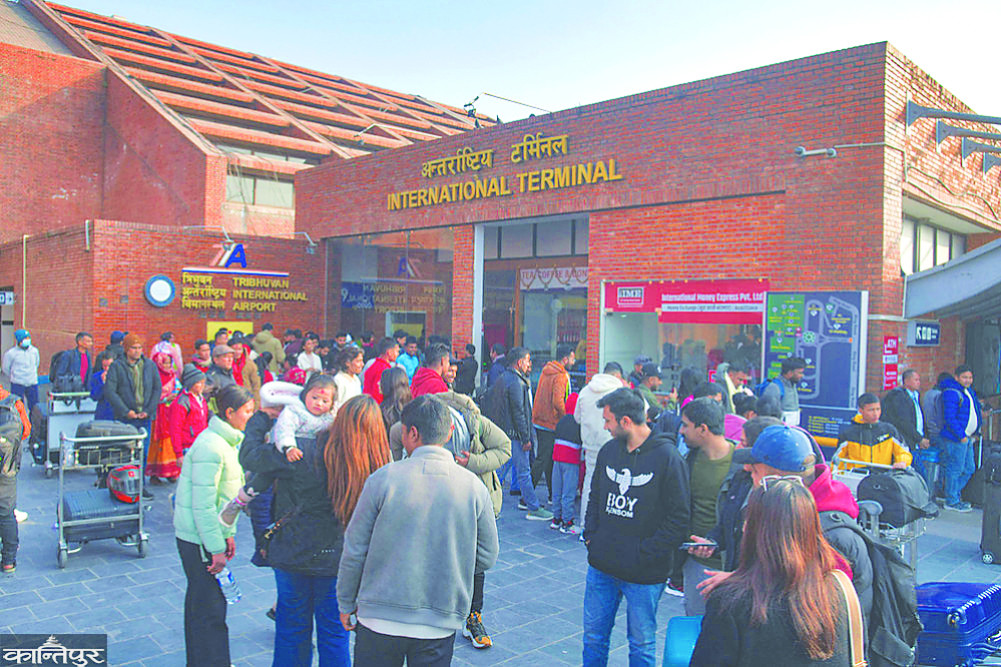
Tribhuvan International Airport is no longer just a place for passengers to come and go, it has now become a living mirror of the dreams, struggles, disappointments and declining faith of Nepali youth . As an employee working at the airport myself, I see thousands of Nepali youth going abroad every day . Some have dreams of a bright future in their eyes, others have the pain of leaving home on their faces. Some are in line to go abroad on student visas, some are leaving for the Gulf countries on labor visas .
Every morning, the crowd at the international departure hall of the airport increases . The scenes of parents hugging their children and saying goodbye have become common . Some elderly parents hug their children with tears in their eyes .
‘Brain drain’ or talent exodus has now become a serious national problem in Nepal . Especially educated youth, skilled manpower and energetic students are going abroad in large numbers . This is not just a process of seeking personal opportunities, but also a sign of the weakening of faith in opportunities, employment, quality education, and the future within this country.
As a person working at the airport, the scenes I see daily are very emotional and thought-provoking. There are crowds of young people standing in line since morning carrying luggage on trolleys. Most of them are between the ages of 18 and 30. Their faces have confidence, but somewhere inside, disappointment towards the country seems to be hidden.
According to the data of the NOC (No Objection Certificate) Branch under the Ministry of Education of the Government of Nepal, more than 112,000 Nepali students obtained NOC to study abroad in the fiscal year 2023/24 alone. Similarly, according to the Department of Foreign Employment, more than 839,000 Nepalis obtained labor permits for foreign employment in the fiscal year 2024/25.
What these data show is that the number of thousands of people leaving Nepal daily is continuously increasing. If we look at it on a daily average, around 300 students are getting permission to go abroad for studies every day and around 2,000 Nepalis are going abroad for employment.
Most of the youth who go on student visas say, ‘There is no future in studying in Nepal, there are no opportunities here, political instability has made life uncertain, and they do not get respect and income according to their hard work.’ The situation of the youth who go on worker visas is even more painful. Most of them have come from their villages after taking out loans. Some have mortgaged their land, some have taken loans from cooperatives. They go abroad not out of their dreams, but out of compulsion.
Practical education, research and modern technology-based studies are weak in many educational institutions in Nepal. That is why students want to go abroad in search of international-level education. It cannot be denied that foreign employment has made a huge contribution to Nepal’s economy. The lives of millions of families depend on money coming from abroad. But the question is, can the country become prosperous only on remittances? If all the skilled youth of the country go abroad, who will develop Nepal? Today, many excellent students in many universities in Nepal are preparing to go abroad after their studies. The number of skilled human resources such as engineers, doctors, nurses, IT specialists, researchers, scientists, chartered accountants and others is increasing. It is necessary to find an answer to the question of why this situation has come about.
There are not enough jobs for educated youth in Nepal. Even after obtaining a degree from a university, it is difficult for young people to find work according to their qualifications. Low salaries in the private sector, limited opportunities in the government sector and the impact of political access have increased frustration among the youth. Similarly, due to frequent government changes, policy instability and corruption, young people have stopped seeing a secure future within the country. The culture of working with access rather than talent has become another reason pushing young people abroad.
Practical education, research and modern technology-based studies are weak in many educational institutions in Nepal. That is why students want to go abroad in search of international-level education. Going abroad has now become a measure of success in Nepal. The tendency to respect people who have gone abroad more in rural areas has also attracted the youth to go abroad. On the other hand, even skilled manpower in Nepal does not get paid according to their skills. The youth are choosing abroad because the same work is paid many times more.
The impact of 'brain drain' is not only economic, but also social and emotional. Rural areas are becoming devoid of youth. Elderly parents are lonely. Many children are growing up without the love of their parents. The distance between husband and wife has increased. The problem of family breakdown is increasing in society.
Sometimes such scenes are seen at the airport, a mother is crying while saying goodbye to her son, a small child is holding his father's hand and saying 'don't go'. But poverty, unemployment and compulsion are overcoming those feelings.
Emotional speeches alone are not enough to stop the 'brain drain'. The state must make concrete policies and practical reforms.
To reduce the growing 'brain drain' in Nepal, the state should prioritize the expansion of employment-creating industries, technology and productive sectors. It is necessary to make the education system not just theoretical but practical, research-oriented and directly linked to employment. Concessional policies, financial support and incentives should be provided to attract youth to startups, innovation and entrepreneurship. In addition, if a system based on transparency, good governance and merit is implemented in the government sector, the youth's trust in the country can increase. A clear policy is needed to use the knowledge, skills and experience of skilled Nepalis who have returned from abroad in nation-building, and equal access to development and opportunities should be ensured from villages to cities. It may not be possible to completely stop the 'brain drain', as it is a natural process for people to seek opportunities in the era of globalization, but the state must take serious steps to at least end the situation of forced migration abroad.