The Nepal we want is one where not only Kathmandu but also Dolpa smiles and the impact of policies is clearly visible in people's lives, not on paper.
We use Google Cloud Translation Services. Google requires we provide the following disclaimer relating to use of this service:
This service may contain translations powered by Google. Google disclaims all warranties related to the translations, expressed or implied, including any warranties of accuracy, reliability, and any implied warranties of merchantability, fitness for a particular purpose, and noninfringement.
From the hubbub of Kathmandu, the hub of policy debate and decision-making, Nepal seems to be moving forward on a journey of change. After the Gen-G movement, there has been a new energy in public consciousness – asking questions, seeking answers and demanding accountability. This activism seen from social media to the streets is a positive sign of democratic consciousness. But amidst this enthusiasm, a fundamental question remains unanswered – is this change being felt equally outside Kathmandu? Or, is Nepal’s vast geography still limited to paper? The data also shows this disparity. A large share of healthcare, infrastructure, education and investment is still concentrated in urban areas, while per capita access is low in remote areas. There is also Nepal outside Kathmandu, where development is still limited to the struggle to meet basic needs and where the state’s presence is still stuck between hope and expectation.
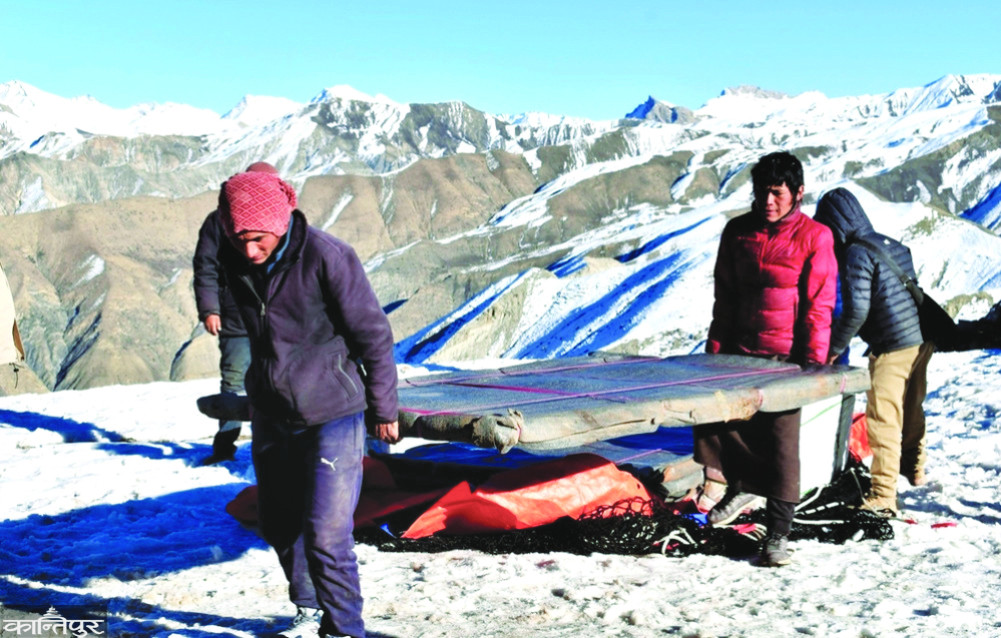
The situation in Dolpa, Karnali Province, especially in Dolpo Buddha, She-Phoksundo and Charkatangsong rural municipalities of Upper Dolpa, is a representative example of this reality. Having a hospital with only 15 beds in this district with a population of about 44,000, and the number of beds available per thousand population is much lower than the national average, is a sign of serious inequality. While the World Health Organization considers at least 3 beds per thousand population necessary, this ratio is extremely low in Dolpa. In this area, which is covered by snowfall for about 5-6 months of the year and road access is blocked, even ordinary patients turn into emergencies. The fact that the maternal mortality rate in Karnali Province is higher than the national average is also directly related to the lack of access to health. When even ordinary health problems become a question of life and death, then the claim of development is limited to slogans. In such a situation, a simple injury or obstetric complication creates the compulsion to go to Kathmandu, Nepalgunj or Surkhet by helicopter, spending lakhs of rupees. Currently, the cost of a helicopter rescue for a patient is between 8-10 lakh rupees, which is many times more than the average annual income of Nepal. This has turned health care into a facility available only for those who have access, not a right. Therefore, it is essential to establish at least a five-bed basic hospital in Upper Dolpa and provide emergency surgery services at the local level.
Is this change being felt equally outside Kathmandu ? Or, is Nepal's vast geography still limited to paper ? The data also shows this disparity. A large share of healthcare, infrastructure, education and investment is still concentrated in urban areas, while per capita access in remote areas is low. In addition, it is necessary to upgrade the district hospital from 15 beds to 25 beds and provide oxygen service, essential medicines, laboratory facilities, and MDGP, pediatric and gynecological specialists. As a temporary solution, if the helicopter service operated by the Nepal Army can be implemented at a concessional rate of about 50 percent compared to the private sector, it will provide great relief until alternative infrastructure is ready. But the long-term solution is to provide services at the local level. The use of technology can also reduce this gap. In the context of expanding internet access in Nepal, if the telemedicine system can be effectively implemented, patients in remote areas can easily get primary consultation . Various studies have shown that unnecessary referrals can be reduced by 30-40 percent through telemedicine, which saves both cost and time . But the problem is not limited to the lack of services, its root lies in policy weaknesses and implementation failures . Despite the significant share of the total budget allocated for capital expenditure in Nepal, its implementation rate has been limited to an average of 60-70 percent in recent years . In some years, it has been even lower . This indicates serious weaknesses in the scheme selection, procurement process and implementation capacity . Most policies are announced without a clear implementation mechanism, which pushes government agencies to implement them unprepared . This has continued the cycle of poor results despite good policies .
Its direct impact is seen in large infrastructure projects. The Melamchi Water Supply Project has been delayed for almost two decades, the continuous delay in the Hulaki Highway, and the doubling or tripling of costs in various hydropower projects are all clear examples of performance deficits. The problem is visible from the beginning - poor project selection, inadequate preparation, complex procurement processes, weak monitoring, political interference and administrative instability. Frequent transfers of staff and lack of institutional memory also disrupt continuity. As a result, delays are no longer the exception, but have become a systemic trend. On the other hand, the evaluation system is still cost-centric. The focus is on how much budget was spent, but the question of what results it produced remains secondary. Although the Auditor General's report points out irregularities worth billions of rupees every year, its effective implementation and weak reward-punishment system have not ensured accountability. The tradition of institutionalizing learning from successful and unsuccessful projects is weak, which leads to the cycle of repeating the same mistakes.
Partial reforms are no longer enough to solve such challenges. Comprehensive reforms are needed at all three levels: policy, process, and performance. A clear division of labor and an effective coordination mechanism should be developed between the federal, provincial, and local levels. A result-oriented budget system should be implemented and results should be prioritized over expenditure. A clear implementation framework, assignment of responsibilities, and measurable goals should be attached to each policy. In addition, a system should be established to encourage those who do good work and hold those who show weaknesses accountable by developing an administrative culture based on accountability.
Gen-G's energy also needs to be focused on structural reforms. Not only protesting and raising voices, but also focusing on policy debate, fact-based suggestions and long-term solutions. The role of pressure groups in a democracy is not only to express dissatisfaction, but also to show direction. In addition, it is now necessary to elevate the debate beyond service access and move it towards economic transformation. The time has come to prioritize a production-oriented economy, industrialization and export growth. In particular, policy commitment and implementation are necessary, with the goal of increasing the contribution of the manufacturing sector from about 5 percent to 10 percent of the gross domestic product. This can make a significant contribution to job creation, import substitution and economic stability. In addition, transparency, good governance and financial discipline are indispensable to get out of the grey list associated with international financial credibility.
Ultimately, as long as the state does not reach there, the meaning of development remains incomplete. The real measure of development is not on paper, but the change that is visible in the lives of citizens. Until the light of Singha Durbar reaches the darkness of Dolpa, development remains incomplete. When a mother in labor does not have to wait for a helicopter, when common diseases end, and when every citizen begins to feel the presence of the state. Only on that day will Nepal become truly inclusive and prosperous. The Nepal we want is one where not only Kathmandu, but also Dolpa smiles and the impact of policies is clearly visible in people's lives, not on paper.