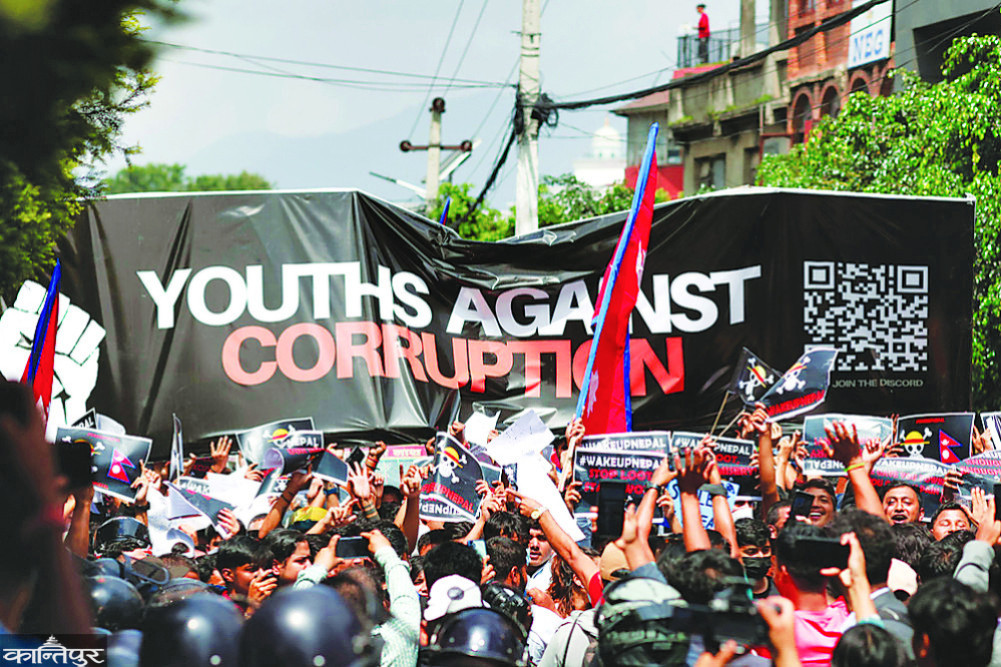
Change must come not only in individuals, but also in systems. It is necessary to understand the reality that change is not sustainable without structural reform.
We use Google Cloud Translation Services. Google requires we provide the following disclaimer relating to use of this service:
This service may contain translations powered by Google. Google disclaims all warranties related to the translations, expressed or implied, including any warranties of accuracy, reliability, and any implied warranties of merchantability, fitness for a particular purpose, and noninfringement.
In the elections created by the Gen-G rebellion, the Rashtriya Swayamsevak Sangh (RSS) won almost two-thirds of the seats. The people gave a clear message that the old politics were no longer acceptable.
What was even more surprising was that the Madhesh-centric parties could not win a single seat, which clearly indicates the decline in public trust in regional politics.
This was the conclusion of the long-term assessment made by the people. The old parties, despite repeated opportunities, could not provide good governance. They could not control corruption. They could not make the justice system independent. They could not make the state inclusive. Their politics became more power-centric and individual-centric than ideas. Individual-centric decisions dominated policy debate. This hindered institutional development.
In particular, the arrogance, lack of accountability and distance from the people at the leadership level weakened the political parties. The people began to feel that they were being used only as voters. After the elections, the feeling that they had no meaning became stronger. This psychology forced them to look for new options. The people now started looking for results, not just promises.
What to expect from the newly formed government? Is change possible only by replacing old faces with new ones? Change should come not only in individuals but also in the system. It is necessary to understand the reality that change is not sustainable without structural reforms.
The first challenge of the new government is to restore trust. The mandate given by the people is extraordinary, but with it the responsibility is also enormous. If this opportunity is wasted, the people's disappointment will deepen and the consequences may be more complex. It takes time to build trust, but even a moment is enough to lose it.
Running the state with good governance at the center is no longer an option, but a compulsion. Government agencies should be freed from political interference. The appointment process should be based on merit, not access. Only this can ensure administrative efficiency and impartiality.
Every decision, expenditure and policy of the state should be open to the public. It is necessary to make the right to information effective, strengthen the digital governance system and encourage public oversight. Only when the people can see and understand the activities of the state, can trust be built. The use of technology can make this process more effective.
The issue of social justice is even more serious. Nepal still has class, caste, gender and regional inequalities. Development opportunities are not distributed equally. Real change is not possible until the new government addresses these inequalities. Democracy remains incomplete without social justice.
Regions like Madhesh, Karnali, and the Far West are still lagging behind in development. Education, health, infrastructure, and employment opportunities there are extremely weak. Social justice means prioritizing these regions. Unless regional balance is maintained, national unity may also be weakened.
Similarly, it is necessary to ensure the representation and empowerment of Dalits, women, indigenous peoples, and backward communities. Not only through legal provisions. They should also be given equal opportunities practically. Inclusivity is not just a word, but should be seen in practice.
The old people and forces have a great contribution to changing the system. Their contribution cannot be denied. But another thing is also true that they could not institutionalize democracy. They could not develop a democratic culture. They could not maintain democracy even within the party.
They were reluctant to hand over leadership. They talked about zero tolerance for corruption, but in practice it was the opposite. They could not understand the expectations of the people. They could not change with the times. They could not give opportunities to the new generation. This is why they failed. History will remember not only their contributions, but also their weaknesses.
The new leadership should not repeat these mistakes. They should understand the reality that power is not permanent, and public trust can be permanent. The value of politics is service, not business. State resources should be used for public good, not for personal gain. Politics is meaningless without ethics and responsibility.
The new government should work with long-term thinking. Rather than making decisions that are immediately popular, attention should be paid to structural reforms. Deep reforms are needed in the education, health, agriculture, industry and technology sectors. In particular, it is extremely important to create opportunities for the youth in the country. Giving opportunities to the youth means giving the country a future. Making the justice system independent and effective is another important aspect. Until there is no trust in justice, there is no trust in the state. The law should be the same for everyone - even for those in power. Good governance is not possible without an end to impunity.
Ultimately, building a strong state is not the work of any one government alone. It is a continuous process, in which the government, civil society, the private sector and the general public all have a role to play. Sustainable change is not possible without collective efforts. If the new government fails to prioritize good governance, transparency and social justice, history may repeat itself. Nepal stands at a crucial juncture today. Either seize this opportunity to build a strong, inclusive and just state or fall back into the old cycle. The decision now belongs not only to the leaders in power, but to the entire nation.
(Yadav studies and researches the constitution, federalism, inclusivity, etc.)