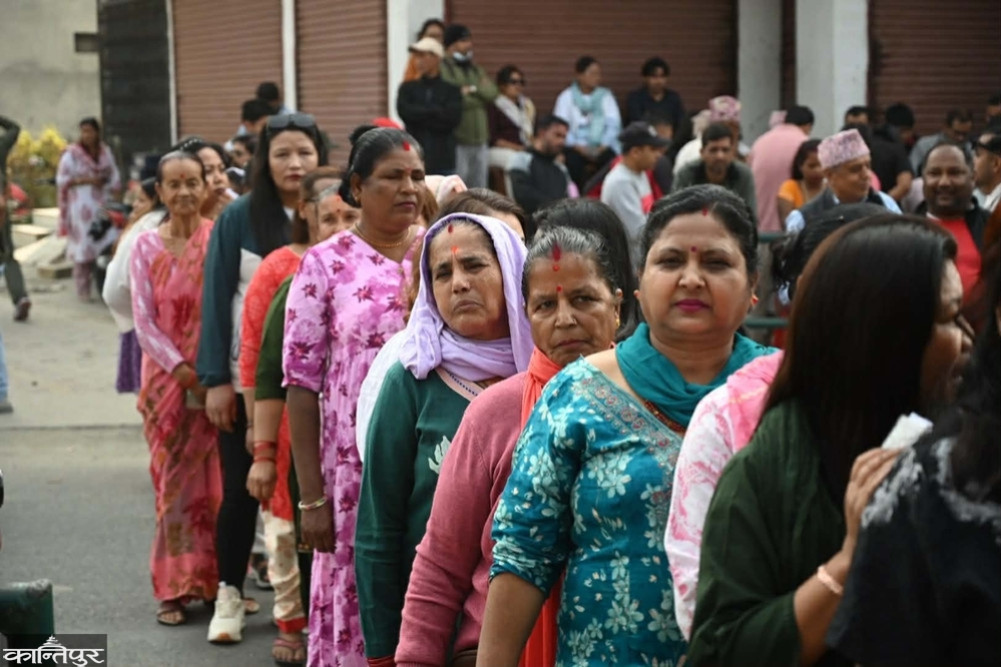
However, in the wave of change, some undesirable individuals have also emerged victorious, and some countries have been given the necessary and worthy power. Among those who have been left behind in this wave of change are not only the old but also some new, worthy and capable candidates.
We use Google Cloud Translation Services. Google requires we provide the following disclaimer relating to use of this service:
This service may contain translations powered by Google. Google disclaims all warranties related to the translations, expressed or implied, including any warranties of accuracy, reliability, and any implied warranties of merchantability, fitness for a particular purpose, and noninfringement.
The election results are very surprising and beyond imagination. Both the new and old political forces may not have expected such a vote result. However, it may also be that they did not see and experience the political changes of 2048 and 2062/63. The election results seem to have made the country a desert. The country itself has become a republic.
This wave of vote change shows that the Nepali people have become a bit emotional. The blood shed on 23 Bhadra and the country burned on 24 Bhadra had created disillusionment and disappointment among the people towards the old political parties. This has been represented at the ballot box. Nepal needed change. Although it was late, the people realized this change. And, they changed their votes.
However, it seems that some unwanted people have also won in the wave of change and some countries have also gained necessary and capable forces. Not only the old ones but also some new, qualified and capable candidates have been spared in this wave of change. In the end, in a democracy, public opinion is the best and sovereign. It can be believed that the elected representatives will practice good parliamentary practice and raise the issues of the people.
The wave of change has not only sent the Rashtriya Swayamsevak Sangh (RSS) and Balen to power, but has also burdened them with a huge burden of responsibility. The injustice, nepotism/grace-based politics, anarchy and injustice that the Nepali people have endured for years must be eliminated. Justice must be given to the young martyrs. A people-oriented, transparent and accountable government and governance system must be established. The country must be taken forward on the journey of development and prosperity. The people have given similar complex responsibilities to the next government. It is also the responsibility of the next government to strengthen the state by reconstructing the burnt Singha Durbar, Parliament Building, Supreme Court and other state structures and provide stability.
Those guilty of oppression against young children must be prosecuted. Those guilty of corruption under the guise of power must be prosecuted. Progress must be made in the education, health and infrastructure sectors of Nepal and changes must also be brought to the remote areas of Sudurpaschim, Madhesh and Karnali, which have been lagging behind so far. The economy should be improved by making industry, agriculture, tourism, information and technology, and water resources the backbone of the country's economy. The human development and corruption index should be improved. The government is also responsible for removing Nepal from the 'grey list' of the Financial Action Task Force (FATF), an international organization that monitors money laundering and terrorist activities. Then, foreign investment can be attracted. While maintaining balanced relations with its two large neighbors, strong diplomatic relations should be developed with all countries that Nepal has relations with. A balanced foreign policy should be adopted.
In the past, the reason why Nepal lagged behind in the race for development was not because Nepal lacked capacity, but because it could not properly utilize its capacity. Nepal has immense water resources, which should be utilized properly. Hydropower should not be used only in Nepal as green energy but should be exported to foreign countries. In addition, there are few effective industries in Nepal. Industries should be brought into operation with national and private investment.
The closed industries and factories should be brought back into operation and the raw materials in Nepal should be processed and emphasis should be placed on export-oriented industries. Information and technology, which is flourishing and occupies a large share in the Nepalese economy, should be developed as an important source of Nepalese economy. In order to make extensive development in the information and technology sector, it is necessary to include this subject in the curriculum of Nepal. Nepal is an agricultural country, a large population here depends on agriculture. But there is a subsistence and traditional agricultural system. Modernizing agriculture as well as developing a productive agricultural system is the current need of the country.
Due to the lack of effective laws in Nepal, citizens have not been able to use even the fundamental rights granted by the constitution. In addition, it is necessary to make laws to eradicate corruption, injustice and misrule. From the above-mentioned physical development to structural reforms, many laws should be amended, and new laws may also have to be made. Appropriate laws are necessary to implement the policies and principles of the state. Which are of great importance for the balanced role of the state.
It is necessary to formulate timely laws to implement the treaties and agreements that Nepal has signed and ratified. For example, there is a need for clear policies and laws to regulate social media, benefit from the rapid development in the field of information and technology, and regulate and safely use artificial intelligence (AI). Overall, the parliament should study, research, and discuss many laws and policies.
This mandate, which has now reached the ballot box through the streets and through it to the parliament, carries great hope and trust. This current change of vote is not just an emotional change of the blood that was shed on 23 Bhadra. It is the desire of the Nepalis for change. Earlier too, the people, fed up with the then regime and environment, gave a majority to change the face of the country, and similarly, a wave of change has been seen now too. The vote has come for the Rashtriya Swayamsevak Sangh (RSS). We have reached the current situation because many past hopes and encouraging mandates have not yielded the results that the people wanted.
But there is no room for the current mandate to fail. We have not been able to achieve development and prosperity according to the country's potential, having been entangled in the whirlwind of seven constitutional changes, various regime changes, power changes, and people's revolutions in seven decades. May the people not have to revolutionize on the streets again, may the country not burn again, and may the leaders who have received the mandate not be in a situation of hiding and running away, and may our representatives not be involved in corruption scandals again. I wish the next government success with the hope that the next government will act in accordance with the people's hopes and trust and do justice to this public opinion.