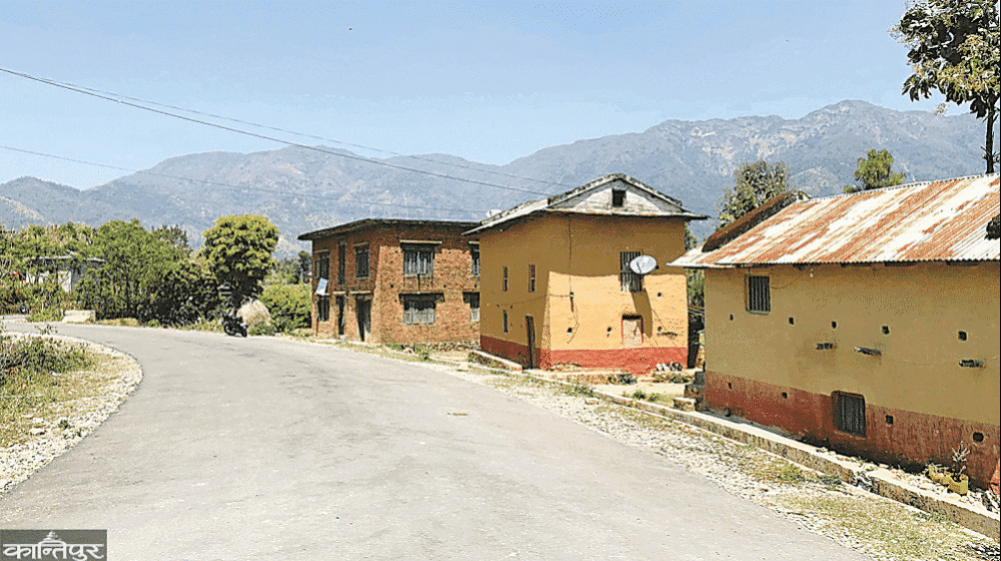
Even within the same constituency, when you hear about the problems of the lower and upper regions, it seems like they are two different worlds. Even within the same ward, the priorities of needs seem to be different according to community, gender, and class. In this sense, Nepal is not only a country with diverse culture and language, but also a very diverse society in the nature of problems.
We use Google Cloud Translation Services. Google requires we provide the following disclaimer relating to use of this service:
This service may contain translations powered by Google. Google disclaims all warranties related to the translations, expressed or implied, including any warranties of accuracy, reliability, and any implied warranties of merchantability, fitness for a particular purpose, and noninfringement.
The diversity of Nepal's geography and people's lives is not limited to the lines drawn on the map. This diversity is even more evident in the door-to-door campaigns carried out by candidates during elections, in the conversations they have with the public, and in the problems they hear. When comparing the election campaigns conducted in the flat fields of Jhapa in the east and the struggles that candidates have to go through to reach the hilly settlements of Bajura in the west, it is not difficult to understand how different Nepal is not only geographically, but also in terms of lifestyle and needs.
Even within the same constituency, when you hear the problems of the lower and upper regions, it seems that they are two different worlds. Even within the same ward, the priorities of needs appear to be different according to community, gender, and class. In this sense, Nepal is not only a country with a diversity of culture and language, but also a very diverse society in the nature of problems.
Nepal's electoral system has given citizens the right to nominate and vote very liberally. There is a provision for nominating candidates in any area. Citizens' democratic participation has been expanded. However, in urban areas, citizens can easily meet their representatives and lodge complaints. But for residents of remote hill or mountainous villages, seeing their representatives is sometimes like a celebration. Due to geographical remoteness, it takes a lot of effort to even reach the ballot box in some places during the election period. Therefore, candidates from hill and mountainous regions are forced to only touch some settlements superficially during the election campaign and return.
There is another side to this. Even in places like Kathmandu that are easy to reach and full of physical facilities, people's representatives are hesitant to reach the doorsteps of citizens. Even in places with convenient geography, if representatives cannot connect with the people, the essence of democracy becomes weak. It is natural to ask the question of what is the point of voting if the people cannot see, meet, and question their representatives.
One of the ironies of Nepal's political and social reality is that voices from different worlds are echoing within the same parliament building. Tomorrow, at one table in parliament, representatives from Kathmandu may be raising issues like abuse in public transport and mental health, while at another table, representatives from Achham or Bajura may be telling the story of pregnant women not even getting a good stretcher to reach a health post. While the quality of mid-day meals is being debated in a government school in Bhaktapur, news is being made public that there are no students in any school in Humla. This shows how development priorities and the nature of problems vary according to geography.
Our development demands are also guided by this diversity. While urban areas are debating mental health, lifestyle diseases and the quality of public services, rural Nepal is still struggling with a shortage of the basic medicine Citalopram. While Pokhara or Kaski are discussing new tourism models and smart city plans, residents of Gorkha's Chum Valley are worried about the high cost of chartering helicopters when they fall ill. While Janakpur is searching for a modern waste management system, the Musahar settlements of Rautahat are still demanding permanent residence and safe housing.
Issues of identity and existence also vary geographically. While tribal communities in the east are struggling for their cultural identity and rights, some tribal communities in the west are still going through a period of needing to prove their identity as Nepali citizens. Addressing such diverse and sometimes seemingly unrelated issues within a single political structure is the real challenge of representation.
The responsibility of today's public representatives is not limited to building roads, bridges, and schools. They will also have to address the challenges of the social and digital world along with physical infrastructure. With the expansion of the internet and technology, new types of crimes such as cybersecurity, online fraud, phishing, and digital privacy are on the rise. Effective laws and institutional arrangements are needed to control these problems.
Similarly, millions of Nepali youth are employed abroad. The remittances they send support the country's economy. But an environment has not been created where that money can be invested in productive sectors. The upcoming leadership must make a long-term plan to link remittances with entrepreneurship and production. It is also necessary to create a conducive environment for youth who want to do something while staying in the country. Job creation, promotion of entrepreneurship and ensuring fair wages for labor are the major challenges of today's leadership.
In addition, making arrangements to deliver social security benefits, health services and government facilities to households in remote areas is no less difficult. Although the federal structure has given authority to the local level, there are still many weaknesses in implementation. Unless service delivery is effective, the feeling of development cannot reach the citizens.
In fact, if a public representative sincerely tries to represent the citizens of his area, a five-year term may seem very short to him. Meeting the expectations of citizens from different geographies, different castes and different economic conditions is not an easy task. Just as the nature of the problems is different, the format and form of development also differ. Therefore, it is no longer possible to move forward by setting the same development standards for all places. The need to formulate development plans according to local needs and realities has increased.
The real test of federalism and democracy also begins here. The ability to address the needs of communities with diverse geographies, different ethnicities, and different life experiences within a single political structure is the criterion for the success of a state. Until every citizen feels that their problems have been heard and addressed, the possibility of everyone meeting at a single point of development remains weak.
Ultimately, elections are not just a formal process of voting. They are also a sign of the change sought by the new generation. The current democratic structure was built through the political movements of the past, the sacrifices of martyrs, and the struggles of the youth. Therefore, the upcoming leadership must show the courage to complete the unfinished plans of the past and solve the digital, social, and economic problems faced by the new generation.
If the state fails to address the expectations of citizens, there is a risk of increasing disappointment in society. Therefore, the responsibility of preserving democratic achievements and improving the living standards of citizens lies with the current leadership. The real meaning of development lies in being able to address both the 'mental health' of the city and the 'Citamol' of the village equally. Until the gap between these two worlds is reduced, the goal of inclusive and just development will remain incomplete.