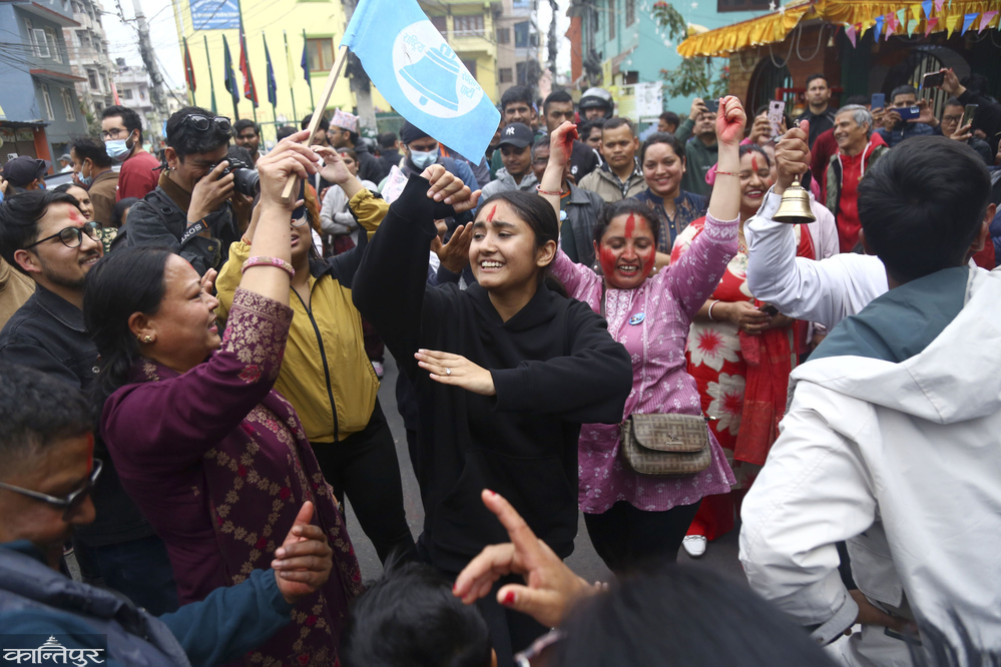
Now, both the UML and the Congress need to change their leadership style and make extensive improvements in their working methods. By embracing the essence of the Gen-G movement, the leadership of the old parties should give space to the youth and make them advisors.
We use Google Cloud Translation Services. Google requires we provide the following disclaimer relating to use of this service:
This service may contain translations powered by Google. Google disclaims all warranties related to the translations, expressed or implied, including any warranties of accuracy, reliability, and any implied warranties of merchantability, fitness for a particular purpose, and noninfringement.
In the election results that were peacefully held after the Gen-G uprising on 22 and 24 Bhadra, the people have punished the so-called old Congress, UML, RPP and NCP by keeping them in the opposition. The parties that have failed to understand the feelings and suffering of the youth despite coming to power repeatedly have been punished by the election with the active participation of the youth. This time, the people have blocked the path of more than two-thirds of the experienced leaders of the old parties to the parliament. On the other hand, the people have given an opportunity to the RSVP as a party that understands the essence and feelings of the Gen-G movement on 23 Bhadra and provides justice to the martyrs who passed away.
The hopes of the youth are focused on senior RSVP leader Balendra Shah (Balen). It is seen that now there will be a strong representation of Gen-G youth in the parliament. Similarly, there will be many experts. According to RSVP MP Swarnim Wagle, who is also an economist, Nepal is now in a position to utilize the 'demographic dividend'. The 2078 census showed that the population of the 16-40 age group is 12.412 million 173. As 42.56 percent of the country's total population is young, we are currently in a historically advantageous position. Rarely in history has a country had such an active population. However, Nepal's youth are forced to emigrate for various reasons.
Gen-G is also the 'Internet generation'. The youth of this age group understand the politics and political character of the country and abroad. They want to see something happening in the country. They want everything to run according to the rules, zero tolerance for corruption, and a public administration that runs on technology. But we have erred in this direction. It is interesting to political parties that when comparing Nepal in 2046 and Nepal in 2082, it seems that there has been development. But the reality is that development had to be felt. Still, 20.27 percent of Nepalis are below the poverty line. At the local level, this rate is even higher.
Representative examples of our development are the Fast Track and Butwal-Narayangadh road, whose construction period has been prolonged for a long time. Who wouldn't get angry when they hear that billions of rupees were involved in corruption in Pokhara International Airport and other projects? Did the bureaucracy and the parties understand this? Aren't the parties shamelessly presenting themselves in all the cases like the visit visa case, Yeti case, Omni case, Baluwatar land case, Budhi Gandaki case, Cantonment case, Bal Mandir case, Nepal Trust land case, cooperative fraud case, Bansbari land case, Giribandhu T case, Widebody case? Can we expect anything more from those who see the money found in Sher Bahadur Deuba's house as AI and consider it right? Citizens did not experience high political moral character and willpower from the old ones.
It is said that trillions of rupees have been exported from the IT sector now, youth can be attracted there. Youth can be employed as 'interns' to attract them to government services. There is a good opportunity in tourism. Good benefits can be taken from the Nepali diaspora abroad. A lot can be done in the field of sports to education. Hopefully, the new government pays attention to this.
Political will can create an atmosphere for Nepali youth abroad to return to the country and inspire hope. Only a stable and responsible government can create a working environment. During the Rana era, schools were not opened due to fear that if the people's children became educated and conscious, our rule would collapse, or even if they were opened, only the Rana family would study. Even the current rulers did not try to create plans and opportunities to keep the youth in the country, thinking that if the conscious youth went abroad, no one would question their rule and position.
The people felt that they had been betrayed by giving opportunities to the old ones repeatedly. In the 2074 elections, Oli and Prachanda came together. Later, they formed the NCP. They said 'Prosperous Nepal, Happy Nepalis'. But even with two-thirds power, they fell into internal conflict. After the constitution was made, the hope that the country would move towards prosperity was betrayed. The old parties divided all the institutions of the country into parties. They were not serious about good governance. They showed a power-oriented character. Like in other countries, in Nepal, the youth expect the House to discuss national and international issues, foreign and international policy, diaspora concerns, potential opportunities and risks posed by AI technology, climate change, youth concerns, factors hindering development, and law amendments, but here, the valuable time of the Parliament was wasted on speeches, obstruction of Parliament, and laughter. That is why the people were offended. That is why hope for the new party has increased.
The youth wanted the government to be ruthless towards corruption. While the media was examining examples of corruption, political parties showed reluctance to investigate it rigorously. If their people are involved, they resort to various tricks to protect them.
Service recipients are still forced to endure many hassles, anxiety, and frustration in government offices. Civil servants themselves are the ones who insult and humiliate service recipients. The youth who want to do something in the country are hindered by the slowness of government offices, the bigotry of middlemen, and the tendency to take bribes. No one paid attention to this. Even after the Gen-G uprising, the leadership of the then ruling partner UML, who could not understand the feelings and anger of the youth, had accused the youth uprising of being a terrorist and burning the country by comparing it to terrorism. The people have also punished the Congress for this.
Finally, now both the UML and the Congress must change their leadership style and make extensive improvements in their working methods. The leadership of the old parties should accept the essence of the Gen-G movement and give the youth a place and make themselves advisors.