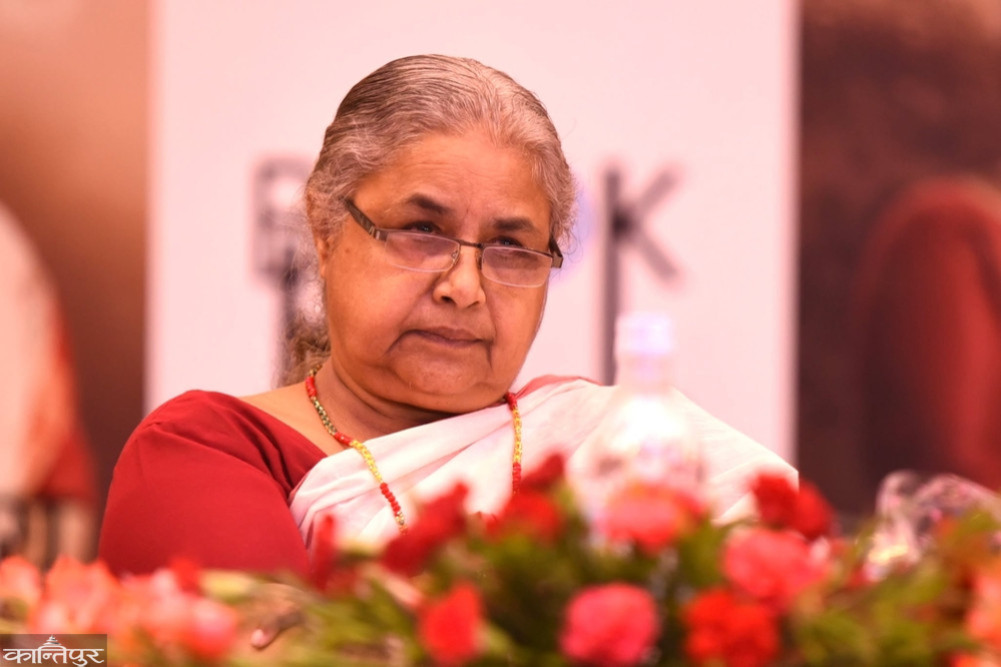
This thanks goes not only to the honorable Sushila Karki, but also to the leadership that kept the country stable during times of crisis and brought democracy to the polls.
We use Google Cloud Translation Services. Google requires we provide the following disclaimer relating to use of this service:
This service may contain translations powered by Google. Google disclaims all warranties related to the translations, expressed or implied, including any warranties of accuracy, reliability, and any implied warranties of merchantability, fitness for a particular purpose, and noninfringement.
As International Women's Day approaches, Nepal has witnessed a profound moment in democracy. This time, the House of Representatives election was not just another election, but a national effort to restore democracy to the hands of the people through crisis, discontent, and political transition. At the heart of this historic moment was an unusual but inspiring fact—the country was being led by a woman.
Amidst youth movements, political distrust, and institutional crisis, Nepal was led by Sushila Karki as an interim government. As a former Chief Justice, she was known for her judicial independence and moral courage. But as Prime Minister, her responsibility to stabilize the troubled political environment, keep the state machinery in order, and lead the country to fair elections was even more challenging.
Leading the country to elections amid political polarization, agitation, and discontent was no ordinary administrative task. It was a test of leadership, patience, and institutional trust. Under this leadership, Nepal concluded the House of Representatives election on Thursday.
There were 18,903,689 registered voters in this election, of which 9,663,358 were male and 9,240,131 were female voters. This fact also indicates that women are not just participants in democracy, they are also active citizens of the political process in almost equal numbers.
In this election, 3,406 candidates were in the running under the direct system, of which only about 388 were women—about 11 percent. But under the proportional system, out of 3,135 candidates, 1,772 were women and 1,363 were men. This shows that, although more than half of the population is women, women's political participation in direct political competition is still largely limited to proportional representation, but they are gradually moving forward in direct competition as well.
Running a government in a time of crisis and taking democracy to the polls was no ordinary administrative task. It was a test of leadership, patience, and institutional trust. But that day of democracy was not made only under the leadership of the Prime Minister or by the competition of candidates. There were thousands of voters, polling station staff, volunteers and security personnel across the country, many of whom were women.
At the Hadiya Baba polling station in Nepalgunj, Banke, polling officer Amrita KC conducted the voting process with her six-month-old daughter in her arms. That scene of democracy was not just an administrative duty. It was a wonderful combination of motherhood and civic responsibility. On the other hand, in Thawang, Rolpa, an elderly mother who could not walk crawled to the polling station and cast her vote. Even though her body did not support her, she exercised her democratic rights. Apart from these few examples, those invisible women who put democracy into practice from the polling station to the counting center are also characters in the same history.
Meanwhile, some inspiring stories have also been born. The campaign of Ranju Darshana, who stood in the election field while pregnant, is an example of that. Before her policies and views in the election debate, many questioned her motherhood - should she do politics or have children? But she won the election under the same circumstances. That victory is not only a personal achievement, but also an answer to the doubts raised about the public role of women.
Similarly, pre-elected mayors like Renu Dahal are still often referred to as ‘Prachanda’s daughter’. This tendency to prioritize family ties over her own leadership, administrative experience, and performance reveals a deep problem in Nepali political culture.
Similarly, former parliamentarian and youth leader Sobita Gautam and former minister Toshima Karki have also repeatedly faced personal comments on social media—in which their personal lives are questioned outside of policy debates. A comment written by actress and candidate Nisha Adhikari on social media makes this problem even clearer. She writes—When a woman tries to take the lead, society first scrutinizes her personal life, not her policies. Hate sometimes spreads not secretly, but openly and is generalized.
Some recent examples have further clarified this trend. In a public interview, a candidate suggested to a young female leader that she was not cut out for politics, saying, “It is better to find a handsome, black man and get married than to be a politician.” In another social media post, a pregnant leader was criticized for prioritizing her position over her own child out of “greed to become an MP.” These comments are not coincidental. They highlight a society that limits women to the realm of personal relationships and biological roles rather than political personalities.
From a sociological perspective, this problem is linked to patriarchal power structures. Nepal’s political power, decision-making processes, and party structures have long been controlled by men. In this way, women are seen as limited to the home, family, and motherhood rather than public leadership. When women challenge this structure and enter politics, they become not just candidates, but also characters who redefine social roles. This is why the criticism they receive is different. When a woman’s body, marriage, or motherhood, rather than her abilities, is made the subject of political debate, it is not criticism—it becomes an obstacle to public participation. In such a situation, women's political journey becomes a double struggle. On the one hand, they have to fight their competitors to win the election, and on the other hand, they have to prove to society that it is legitimate to be a woman in politics.
Therefore, it is not enough to limit today's election debate to just who won. The question of whether we are ready to accept women as political citizens is also a debate about political culture. Looking at Nepali democracy in the context of this year's International Women's Day, I would like to say a symbolic sentence - 'Thank you, Madam Prime Minister.'
This thanks is not only to the honorable Sushila Karki. It is for the leadership that kept the country stable during the crisis and brought democracy to the elections. This thanks goes to the 9,240,131 women voters registered in the election. This thanks goes to the 388 women candidates who stood in the election field. This thanks goes to the 1,772 proportional representation women candidates. This thanks goes to the thousands of women employees working at polling stations. And this thanks goes to every woman who is constantly struggling in politics, administration, and civil society. Because they are not just representatives of today. They are signs of the future—a future where women in Nepali politics will not be news, but a common reality.