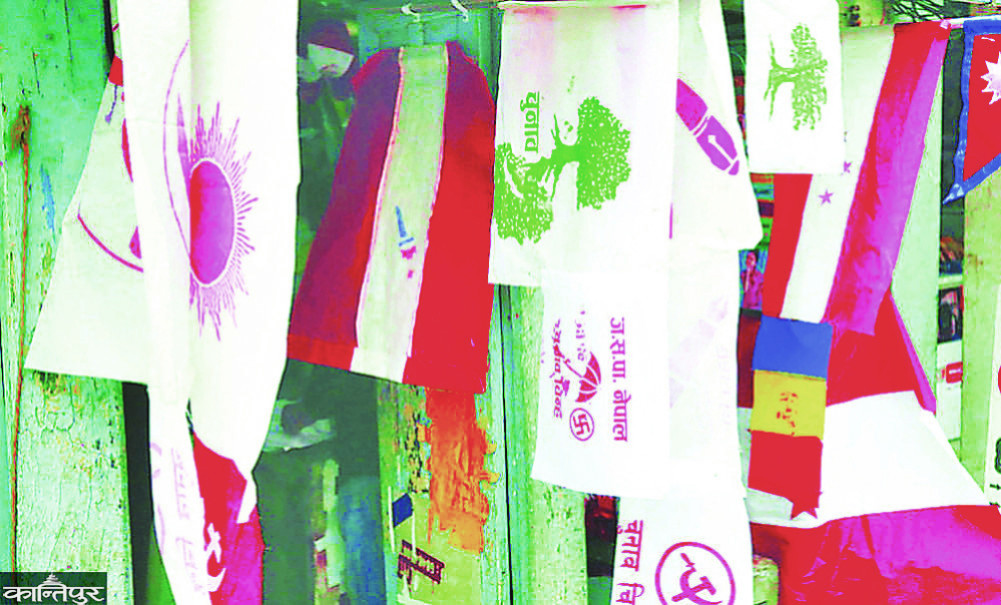
Points written in the manifesto such as smart cities, shipping, and industrial sectors have been limited to paper chatter due to lack of budget spending capacity.
We use Google Cloud Translation Services. Google requires we provide the following disclaimer relating to use of this service:
This service may contain translations powered by Google. Google disclaims all warranties related to the translations, expressed or implied, including any warranties of accuracy, reliability, and any implied warranties of merchantability, fitness for a particular purpose, and noninfringement.
With the start of the election season in Nepal, the party headquarters have been busy writing manifestos that cultivate dreams. However, the question is being raised among voters whether these manifestos are truly meant for implementation in this 2082 election or are they just misleading documents to deceive voters.
The major parties of Nepal had set a target of increasing the size of the economy to 100 trillion and doubling the per capita income in their 2079 manifesto. However, by the mid-term review of 2081/82, Nepal's gross domestic product was only about 57 trillion, according to which there is a huge gap of about 43 trillion between the parties' goals and reality.
The points written in the manifesto such as smart cities, ships and industrial sectors have been limited to paper chatter due to the lack of budget spending capacity. Even today, the situation where citizens have to walk for hours for ordinary medicines and wait for months to avail government services is making the slogan of Digital Nepal a mockery. What this delivery gap proves is that the parties have completely ignored the country's actual revenue capacity and the efficiency of the bureaucracy while making their manifestos.
Political parties put forward big and ambitious plans in their manifestos, but they always remain silent about the financial resources, technical manpower and timetable to complete those plans. The manifesto should focus on the ‘how’, not the ‘what’.
If a party promises to create millions of jobs in five years, what will it do in 100 days, what are the ‘short term’ and ‘long term’ goals for one and two years, how achievable/achievable/practical are those goals, a manifesto without a clear roadmap is just a piece of paper. The public should now learn to realistically assess the capabilities and jurisdiction of the leader and understand whether the issues he has spoken about fall within his purview or not? Or, are they just empty talk?
Another important issue is the legal liability of the manifesto. How can parties be held accountable when they do not fulfill the promises made in the manifesto? Emotionally, we all feel that the manifesto should be made ‘contractual’ and brought under the legal ambit.
Although its practical application may be complicated, it is essential to have some mechanism to ensure accountability. If a leader or party reneges on their promises, voters should be aware of calling them out, publicly asking for an explanation, and holding them accountable in the next election. The manifesto should not be seen as just an election slogan, but as an honest agreement made with the people.
International practices can also be learned to hold parties accountable for the promises made in the manifesto. While Bhutan's election law allows only promises that are in line with financial capacity, in the Netherlands an independent body verifies the financial facts of the party's plans. In Brazil and Mexico, there is a legal provision that the manifesto must be registered as a government action plan and that failure to implement it is considered a violation of the mandate. Nepal also needs a mechanism to ensure similar responsibility and accountability.
In past elections, plans for 20 years and impossible economic prosperity were written, but they were only confined to the wastebasket. The next generation is not satisfied with a list of 'what' to do, it needs a clear procedure and blueprint for 'how' to do it. The current manifesto must go beyond the scope of traditional physical development and address the challenges of the contemporary world.
For example, climate change is not just a word for us, but the pain of the Melamchi floods and the Mustang landslides. Therefore, it is not enough to write a formal sentence in the manifesto about protecting the environment. The current leadership must have a clear vision to protect Nepal's melting mountains and raise the issue of climate justice and compensation on the world stage.
Similarly, when it comes to technology, we must abandon the idea that using Facebook or closing TikTok is only development. The manifesto must include issues of AI, the gig economy, and digital security so that Nepali youth can compete with the world in their own country. Digital literacy and technology-based good governance are the minimum demands now.
The manifesto must fully embrace the Gen-G rebellion that took to the streets and the terms of the agreement they made with the government. Parties need to understand that today's voters are not sheep who can be influenced by waving a flag. This is a conscious generation that searches Google, fact checks, and votes only based on the past track record of the leader. If a party includes old faces, old styles, and things that encourage corruption in its manifesto, does not answer the question of 'how' in the manifesto, and does not account for past failures, then this election should confine such a party to the pages of history.
There are only about three weeks left to vote. This is the time for parties to be true and for the people to think. Much has been done in cultivating dreams. Now it is time to reap the harvest of results. At this historic juncture of 2082, the choice lies in the hands of the leaders whether to fill the manifesto with air or to account to the voters.