The candidates have already started meeting with voters. They are showing dreams that may or may not come true. They are promising development, building roads, bridges, etc.
We use Google Cloud Translation Services. Google requires we provide the following disclaimer relating to use of this service:
This service may contain translations powered by Google. Google disclaims all warranties related to the translations, expressed or implied, including any warranties of accuracy, reliability, and any implied warranties of merchantability, fitness for a particular purpose, and noninfringement.
After the then government was overthrown by the Gen-G movement on 23 and 24 Bhadra, a government was formed under the leadership of Sushila Karki on 27 Bhadra. The House of Representatives was dissolved immediately and the election date was set for 21 Falgun. Candidacy for the election has already been registered. Overall, the entire country is currently immersed in the Mahakumbh of elections.
Candidates have already started meeting voters. They are dreaming of possible or impossible things. They are promising to develop, build roads, build bridges, etc.
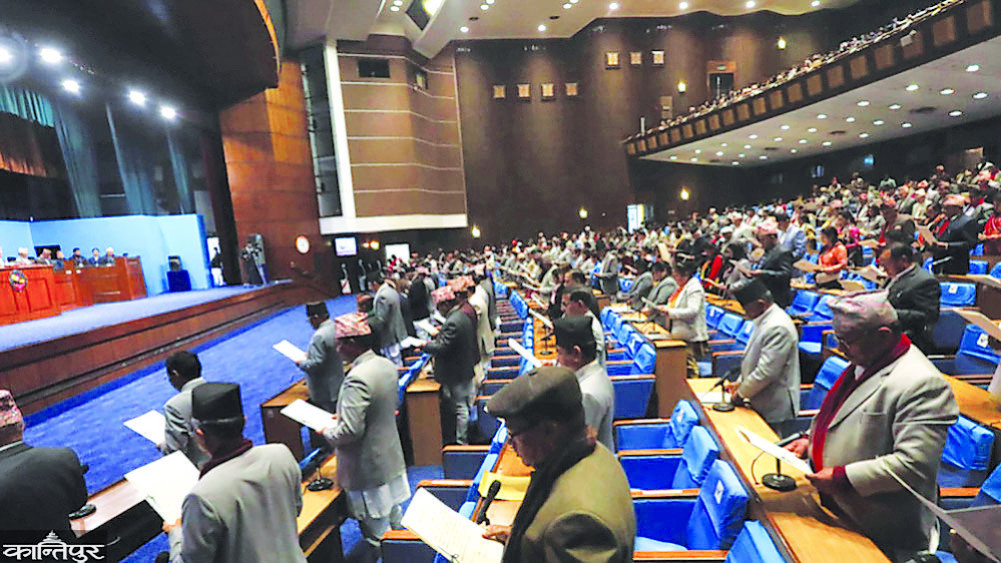
This article focuses on what exactly is the parliament and MPs? What are their functions, duties and rights? What are the responsibilities that MPs have to shoulder? Nepal is one of the countries that adopts a parliamentary system of government. The preamble and Article 2 of the Constitution of Nepal state that the sovereignty and state power of Nepal are vested in the people. This is exercised by the people's representatives elected through periodic elections. Our political system is a democratic republican system of government based on three levels of federalism: the union, the provinces and the local levels. Article 83 of the Constitution of Nepal states that there will be a National Assembly and a House of Representatives under the federal legislature, respectively.
The National Assembly has a total of 59 members, 8 elected from each province on the basis of inclusiveness and 3 nominated by the President on the recommendation of the Government of Nepal.
Similarly, in the House of Representatives, 165 people are elected through the first-past-the-post electoral system, i.e., voters directly vote for their chosen candidate, and 110 are elected through the proportional electoral system, i.e., voters vote for their preferred party. Thus, there are 275 members in the House of Representatives. This electoral system is called a mixed electoral system.
Role of Parliament
Parliament is an important institution that exercises the sovereignty of the people. It is responsible for important tasks such as determining policies and making laws in the system of governance. Issues such as representation, transparency, accessibility, accountable government, and effectiveness are the basic characteristics of the parliament in the parliamentary system of governance. Ensuring these basic characteristics, the constitution and law have given the following important functions under parliamentary monitoring to the parliament –
a. To formulate necessary laws and policies
b. To monitor whether the executive has effectively implemented the laws made by the parliament and to hold the executive accountable for the implementation of the laws
c. To form the government
d. Ensure the appointment of the right person to the right place/position through effective parliamentary hearings in various positions including constitutional bodies
e. The Constitution of Nepal monitors and examines the activities of the government and various government bodies and constitutional bodies through thematic committees within the parliament and makes them accountable to the citizens. 
Responsibilities of MPs
Members of the House of Representatives, i.e. MPs, should be accountable to the citizens. This role focuses on monitoring the legislature, the government, and representing the people. Playing a role in ensuring quality laws is an important task of MPs. The following responsibilities have been prescribed by the Constitution and law under these important tasks –
a. Regularly studying laws and policies and making necessary amendments to them
b. Taking initiatives for the formulation of new laws
c. Monitoring whether laws are in accordance with the constitution or not
d. Playing an effective role in timely and effective lawmaking
e. Ensuring that the rules and regulations made by the government under delegated authority are in accordance with the constitution and the law
f. To test the suitability of the people recommended by the government as judges, ambassadors and other constitutional body officials through parliamentary hearings. 
Therefore, to make the role of the parliamentarian effective, it is necessary for the parliamentarian to have an expected role in parliamentary monitoring to make the rule of law effective by ascertaining whether various constitutional bodies have used their powers as determined by law or not, whether they have misused their powers, and whether the rule of law has been ensured.
The work of building roads, bridges, and carrying out development work is not the work of the parliamentarians but of the government. The appropriate role and responsibilities have been determined for the parliamentarians in accordance with the constitution, law, and jurisprudential values. But it seems to us that they do development work from their budget. But that is not the work, duty, or right as per the constitution. Sometimes the budget is distributed in the name of the Parliamentary Development Fund, sometimes the Election Development Fund, sometimes the Local Development Partnership Program, sometimes the Constituency Infrastructure Development Program.
Regarding the issue of Rs 50 million per MP allocated in the budget for the fiscal year 2080/81, the Supreme Court had banned the spending of some specific people's representatives on personal preferences, explaining that it was not in line with the concept of planned development and the principles of good governance.
Looking at the past parliamentary experience, it seems that the Parliament itself and most of the MPs have not been able to effectively fulfill the mentioned role. Therefore, it is not appropriate to allow MPs to spend the money of the Parliamentary Development Fund. Instead, MPs should formulate the various laws necessary for the country in a timely manner. A legal framework should be provided to create an environment for the working of all three levels of government and to ensure the rights of citizens. This is the role that the future Parliament should play.
Instead of seeking unconstitutional rights for the Parliamentary Development Fund, the future MPs should focus on how to strengthen their role while remaining subordinate to the Constitution. Such work should be made a strong and appropriate basis for winning the hearts of voters.