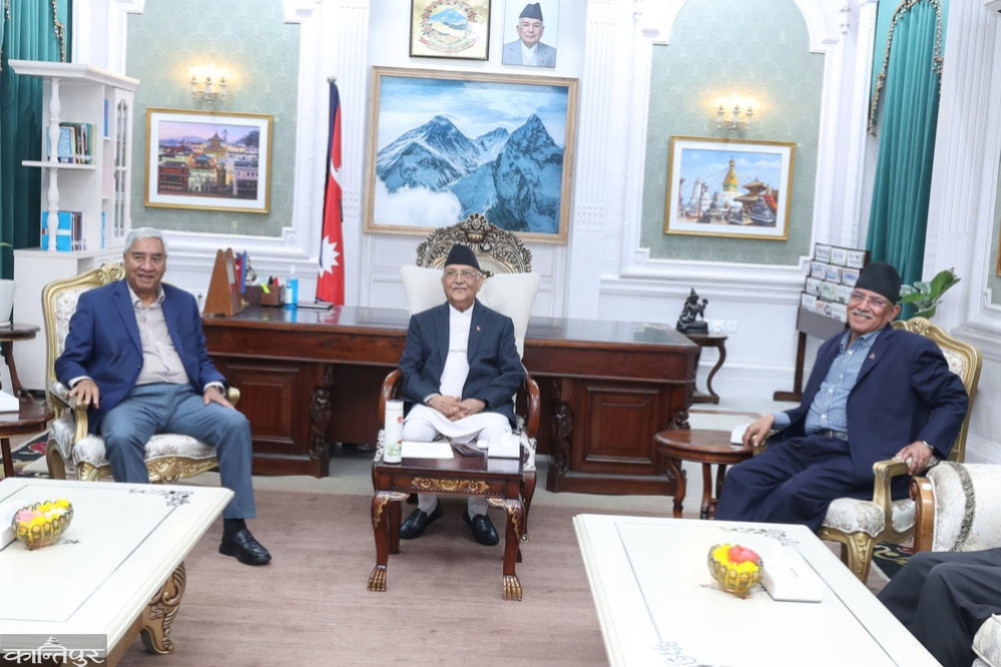
Oli is the same leader during whose prime ministership the state suffered the most serious political and moral losses in history.
We use Google Cloud Translation Services. Google requires we provide the following disclaimer relating to use of this service:
This service may contain translations powered by Google. Google disclaims all warranties related to the translations, expressed or implied, including any warranties of accuracy, reliability, and any implied warranties of merchantability, fitness for a particular purpose, and noninfringement.
The multi-party democratic practice has been in existence for more than three decades. For nearly a decade and a half after the 2046 People's Movement, the Congress, the UML, and then the Maoists (now the Nepali Communist Party) have been the pillars of the country's ruling and opposition politics.
Vishal Adhikari
The historical role of these parties cannot be denied when it comes to people's movements, armed conflict, constitution-making and federal system. However, over time, the internal democratic decay, leadership-centered political culture and institutional inertia seen within them have raised serious questions about the quality of Nepali democracy.
The recently concluded 11th General Convention of the UML has brought this problem to the surface again. Khadga Prasad Sharma Oli has been re-elected as the party chairman from the said General Convention. Oli is the same leader, during whose prime ministership the state had to bear the most serious political and moral losses in history. In particular, the extrajudicial repression by the state against students participating in the peaceful movement of 23 Bhadra has been recorded as a serious failure of democratic governance.
What is more serious is that Oli, as the then Prime Minister, does not seem to have borne even the minimum self-criticism, public apology or moral responsibility for the incident. His stances like evasion and avoidance, accusations and counter-accusations, and indecent arrogance are the products of a problematic psychology.
His expression that ‘if you don’t know how to give a statement, you will be shot’ is an example of this. His initiative to push society towards violence is not political civilization. He is a person who has served as the country’s chief executive four times, not an ordinary citizen. He is the head of the party who is striving to maintain the legacy of the CPN-UML.
In such a background, even when the voice of leadership generational change is being raised rapidly, the party ranks have reinstated the same face in the leadership, which clearly indicates how weak the state of internal democracy is within the UML. At a time when ideological renewal, new generation leadership development, and alternative political perspectives need to be institutionalized within the party, relying on the old leadership is a clear example of institutional inertia.
In this context, the internal situation of the Nepali Congress also seems to be no less challenging. The general convention is not being held. The Congress, infected with factions and sub-factions, seems to be moving forward amidst internal political discord. This shows how weak the democratic practice is within the party.
The essence of democracy is not limited to the electoral process alone. Its essence lies in the periodicity of office responsibilities, accountability, transparency, and healthy practice of criticism and self-criticism.
Established democracies around the world have rejected the concept that ‘one person can always be in leadership’, because it makes democracy control-oriented and limits political parties to ‘individual devotional songs’. Unfortunately, the major political parties in Nepal have not been able to put this basic theoretical orientation of democracy into practice.
The hesitation seen in the transfer of leadership, the power of the old generation and the intolerance towards the emergence of the new generation have made the parties ideologically weak. The tendency of the old leadership not to leave office even after proving its political incompetence time and again is becoming established as a common weakness in Nepali politics. This process has created a political culture that is more ‘individual’ than ‘party’, which has weakened the parties’ organizational strength, policy clarity, and long-term credibility.
A happy resumption of Nepali politics is possible only where a clear line of good governance, social justice, and prosperity can be drawn. The country cannot achieve meaningful results with the return of the older generation to leadership. The questions of democracy, morality, and accountability raised by the 23rd and 24th Bhadra movements remain relevant even today. The traditional political style has now become meaningless in moving forward with the essence of those questions. This is the reality that we need to understand as citizens.
The essence of democracy is continuous renewal – in ideas, policies, and leadership. Without regular generational transfer of leadership, transparency in internal practices, and a culture of criticism and self-criticism within the party, no political party can remain relevant in the long term in today’s democratic environment. In this regard, all established parties, from the Nepali Congress to the UML, must conduct a serious self-evaluation.
In addition, it is imperative that newly established parties, such as the Rashtriya Swayamsevak Sangh (RSS) and the Janmat Party, which have not yet been fully tested politically, exercise special caution to avoid repeating the same mistakes of the old parties. Leadership-centric politics, internal intolerance, and indifference to institutional democracy can also be fatal for new parties. Without improvement in the internal life of the party, improvement in Nepal's democracy is impossible.
Ultimately, going to the people in the upcoming elections with a clear thematic agenda to institutionalize the unprecedented achievements achieved by the Gen-G movement is the major political need of the day. The initiative of all parties is indispensable to bring the demands, issues, and consciousness of the Gen-G rebellion to the center of established political discourse. The practice of internal democracy and leadership transfer are no longer an optional proposition, but have become an indispensable national necessity for a strong democratic future for Nepal.