It has been consistently argued that victims of conflict and oppression should be given more attention and space than the powerful or oppressors. “When one side is clearly the victim of another’s atrocities, it is absurd to apply a strict 50/50 journalistic standard and must be impartial in favor of the victims,” says Fisk.
We use Google Cloud Translation Services. Google requires we provide the following disclaimer relating to use of this service:
This service may contain translations powered by Google. Google disclaims all warranties related to the translations, expressed or implied, including any warranties of accuracy, reliability, and any implied warranties of merchantability, fitness for a particular purpose, and noninfringement.
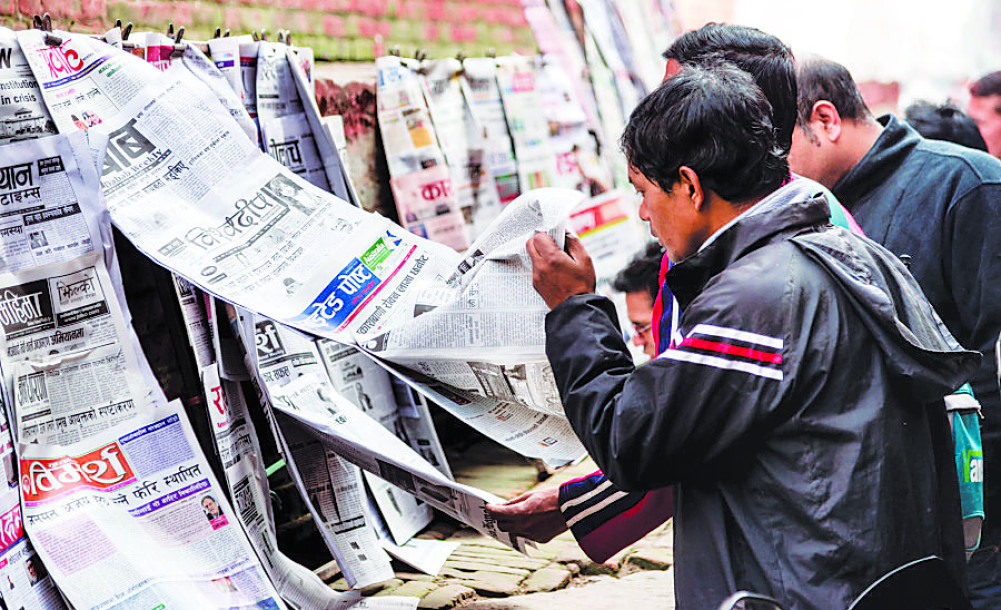
Journalists have the power to expose the oppressors more than politicians and lawyers. There is no public data on how much space and time Nepali media have given to the victims of the Gen-G uprising and their oppressors in their publications and broadcasts. Politicians, lawyers and journalists are expected to exercise due diligence regarding the victims.
Whether it is due to mutual interests or ignorance of the top leaders of political parties and journalists, it is clear what kind of headlines are being written. The main theme of this article is the need for true journalism to take the side of the victims, given the importance given to them by the news media.
A preliminary report by IFEX documented 35 incidents affecting 17 media houses during the Gen-G protests, indicating that the media infrastructure and reporting itself are under strain. In addition, the report noted that the media did not focus on the voices of the victims of the Gen-G uprising. In fact, even so far, the media seems to be emphasizing political bigwigs (the elite) rather than focusing deeply on the pain and experiences of the victims.
For example, in mainstream Nepali media outlets, personal interviews with political bigwigs (such as former Prime Minister Oli, Sher Bahadur Deuba, Pushpa Kamal Dahal ‘Prachanda’, party figures, police spokespersons) are widely quoted. Coverage of victims seems to be relatively limited and sporadic. Is this journalism born of ignorance or is it intentional? In any case, it seems that Nepali media needs serious introspection.
In the modern era of sensationalist headlines (especially on digital and social media), who cares about the rules of journalism? But credible journalism still aims for accuracy, context, and ethics. For example, how many journalists have interviewed and published neutral, factual, and trauma-sensitive questions about what the victims of the Gen-G uprising saw, how they were affected, and how the authorities or protesters reacted?
It could be a matter of investigation into who the media prioritized (and is prioritizing) between the victims and the oppressors. If the media continues to emphasize political bigwigs over the victims, as it has done so far, there is a risk that the voices of the victims will be silenced, an imbalance that can weaken public awareness of injustice and unwittingly help to resist the pace of social change.
Journalism is not football match reporting
Do Nepali journalists agree or not? It is impossible to say, but true journalism is not about giving equal voice to the oppressor and the victim, but rather about taking the side of the victim by giving them the importance they deserve. In this context, it is worth remembering the criteria of the famous British journalist Robert Fisk. Addressing journalists, Fisk said... ‘You must be neutral and impartial, but you must be impartial in favor of the victims. If you give equal time to the victims and the oppressors in reporting, just as you give equal importance to both sides of a football match, it is a bloody tragedy. Journalists are not advocating under the guise of reporting... Journalists should not treat the victims and the oppressors equally.’
Fisk has consistently argued that victims of conflict and oppression should be given more attention and space than the powerful or oppressors. ‘When one side is clearly the victim of the other’s atrocities, it is absurd to apply a rigid 50/50 journalistic standard and should be impartial in favor of the victims,’ says Fisk.
Robert Fisk’s book, The Great War for Civilization: The Conquest of the Middle East, 2005, is both a historical record and a moral critique, demonstrating a commitment to telling the truth, humanizing the victims, and challenging government narratives. Fisk spent his life as a journalist giving a voice to citizens and victims rather than to the elite. His meticulous research, deep historical context, and moral courage made him one of the most influential and morally inspiring reporters of his generation.
To be a journalist like Fisk is to be a witness to events. To do that, journalism must adopt professional ethics. Journalists should not sacrifice objectivity in the face of the suffering of those who pay the price of the oppressor on the streets of Kathmandu. Reporting on important events, holding power accountable, and focusing on the victims and helping them secure justice is journalism. Journalistic ethics refer to principles of right and wrong based on human welfare, reason, empathy, and social responsibility. It guides behavior by considering harm, fairness, justice, and the consequences of social actions.
How to balance news reporting?
In Nepal, as elsewhere, journalism has long been seen as a watchdog for the vulnerable against the voices and power of the voiceless. It is well known that the role of journalism is even more important in societies characterized by political instability, social inequality, and state or non-state oppression. Victim-centered journalism, which focuses on the experiences, voices, and rights of those who have suffered injustice, stands as, and should stand as, a powerful force against oppression.
In Nepal, which has a history of monarchy, civil war, political transition, and social movements, victim-centered journalism plays a crucial role in exposing abuses, challenging the powerful, and strengthening democracy. Victim-centered journalism prioritizes ordinary people over the stories of politically powerful people.
Rather than amplifying the official statements of those in power, government justifications, or prominent political voices, victim-centered journalism brings to the fore the realities of individuals and communities affected by violence, discrimination, or abuse of power. This approach does not abandon objectivity, but rather redefines journalistic balance. Neutrality does not mean remaining silent in the face of injustice. When oppressors control institutions, laws, or narratives, giving equal importance to victims and perpetrators can distort the truth. In such a context, ethical journalism demands an ethical perspective that recognizes the imbalance of power.
During the decade-long Maoist insurgency in Nepal (1996–2006), thousands of citizens were caught between state forces and rebel groups. Enforced disappearances, extrajudicial killings, torture, and displacement were widespread. For many years, victims (especially those from rural, poor, or marginalized backgrounds) were ignored by mainstream discourse. Journalists who documented the stories of families, widows, and displaced villagers of the disappeared helped preserve collective memory and later laid the groundwork for demands for truth and justice.
Even after the end of the civil war, Nepal continues to witness forms of structural oppression. Marginalized groups such as Dalits, indigenous communities, Madhesis, women, migrant workers and LGBTQ+ people often face systemic discrimination. Victim-centered journalism exposes how oppression is not always dramatic or violent but is embedded in everyday practices. It also exposes unequal access to education, the denial of civil rights, labor exploitation or gender-based violence. Journalism transforms abstract issues into human realities, making injustices harder to cover up.
The recent Gen-G protests further illustrate the relevance of victim-centered journalism. These movements, which have arisen from corruption, economic frustration, governance failures or social injustice, have sometimes been met with excessive force, arrests or intimidation. Journalists should focus on protest violence or property damage. However, when journalists focus solely on protest violence or property damage, they risk reinforcing the narrative of those in power. In contrast, victim-centered reporting asks sensitive questions: Who is injured? Who is silenced? Who bears the costs of state action? By documenting the injuries, detentions, and psychological trauma experienced by protesters and bystanders, journalism challenges oppressive responses and demands accountability.
Victim-centered journalism must be practiced responsibly. There is a fine line between amplifying the voices of victims and exploiting their suffering. Ethical journalism requires informed consent, sensitivity to trauma, protection of identity when necessary, and avoidance of sensationalism. In a society like Nepal, where the fear of reprisals is real (especially in rural areas or politically polarized environments), journalists must ensure that victims are not put at risk. The goal of victim-centered journalism is to empower victims, not re-victimize them.
Critics sometimes argue that victim-centered journalism is biased or activist in nature. However, such critics often ignore the reality that traditional journalism has historically supported those in power. For those who practice traditional journalism, authoritative sources (police, politicians, bureaucrats are easily accessible) are considered credible while victims are treated as untrustworthy. This imbalance is itself a form of bias.
Victim-centered journalism corrects the distortion by broadening the definition of credibility to include lived experience, eyewitness testimony, and community knowledge. In Nepal’s evolving media landscape, digital platforms and social media have amplified victim voices in unprecedented ways. Videos and citizen journalism have challenged state-controlled or elite-dominated narratives. This democratization of journalism creates the risk of misinformation, but it also puts pressure on mainstream media to take victims seriously.
Journalists now have a greater responsibility to verify, contextualize, and ethically frame victims rather than dismiss them. Ultimately, victim-centered journalism is essential for justice and democratic accountability. Perpetrators—whether the state or institutions, political elites, or powerful social groups—often rely on silence, fear, and control. Victim-centered journalism helps to break free from such silence, fear, and control.
Transitional justice in Nepal is incomplete, with many victims still awaiting recognition and reparations. In such a situation, victim-centered journalism is not just a professional choice but a moral obligation. By amplifying marginalized voices and exposing abuses of power, journalism serves the highest purpose of serving truth, dignity, and the public interest. Success will be measured by how courageously such journalism stands up in the future.
Victim-centered politics, law, and journalism
Law and journalism are intertwined in the pursuit of victim-centered justice. Current American journalism may not have done what it was expected to do. However, during the Montgomery Bus Boycott (1955–1956), journalists reported on the experiences of victims and exposed systemic injustices in African-American newspapers such as the Montgomery Advertiser and Jet Magazine, which reported on Rosa Parks’ arrest, raised public awareness, mobilized support, and pressured legal and political authorities toward social justice. The U.S. Supreme Court ruled that black-white segregation on buses was unconstitutional.
The Indian mainstream media is currently often criticized for its sensationalism, political alignment, and constant prioritization of state power over victim-centered reporting. European media reporting on war and peace is influenced by geopolitical and security pressures.
Law provides a formal framework for rights, accountability, and redress. Journalism acts as a public mechanism that exposes violations and demands institutional responses. Victim-centered journalism strengthens the rule of law by documenting lived experiences that are often excluded from the legal record, especially in societies characterized by power imbalances and structural inequalities. By focusing on the voices of victims, journalism helps translate abstract legal principles into human realities, reinforcing the moral purpose of the justice system.
In Nepal, where access to legal remedies is often limited by political influence, social stratification, or institutional delays, journalism can act as a bridge between victims and justice. Such journalism can expose legal guarantees and actual practices. For example, it can pressure state power to act, secure legal reform, and ensure accountability processes. Victim-centered journalism does not undermine objectivity, but rather re-establishes moral responsibility in the face of injustice. Law without factual clarity risks becoming ineffective, and journalism without a legal basis risks becoming ephemeral. The convergence of journalism and law in victim-centered justice ensures that suffering is not ignored or normalized, but is recognized as a matter of rights, dignity, and public concern.
Ultimately, the decision to engage in victim-centered journalism or not is entirely up to each journalist. The same is true for each politician and lawyer. When the voice of victims is ignored, the meaning of justice and accountability is lost. Be it a journalist, a politician, or a lawyer – it is everyone’s moral duty to prioritize victims and stand on the right side of the issue.
(Like the country's political, constitutional, industrial and social structures, the media sector also needs a deep review, self-examination and reform. The flood of 'misinformation' and 'disinformation' has made the sensitive role of credible, responsible and accountable journalism even more necessary. In this context, Kantipur has started a debate series to give special space to criticism, critique, review and suggestions. We are waiting for the participation of stakeholders and experts in an objective and responsible debate.)