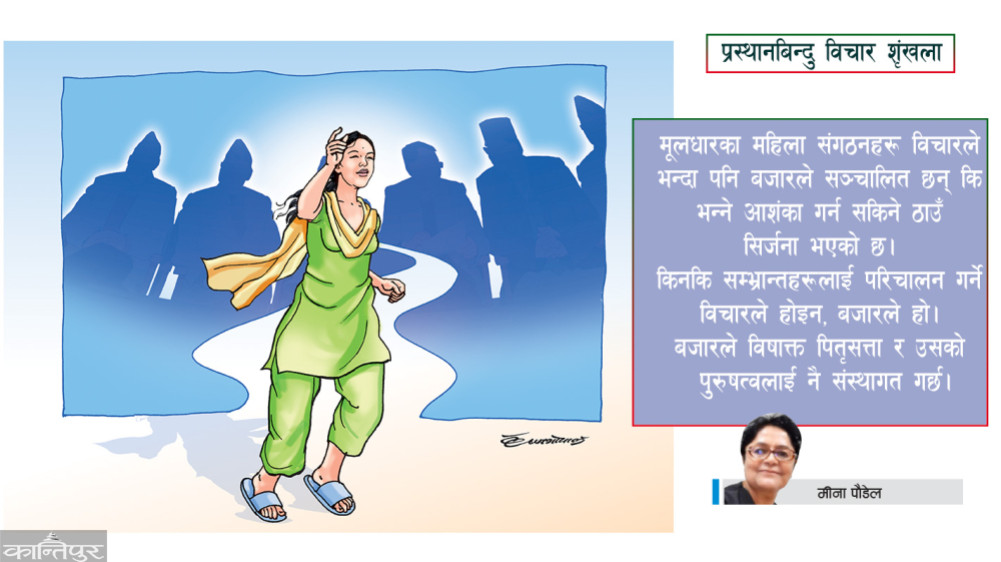
There are grounds for suspecting whether the women leaders of the later generation, who have created a militant identity within the party and are known as leaders and youths expected by the society, will also join themselves as partners in the vested interests of masculinity.
We use Google Cloud Translation Services. Google requires we provide the following disclaimer relating to use of this service:
This service may contain translations powered by Google. Google disclaims all warranties related to the translations, expressed or implied, including any warranties of accuracy, reliability, and any implied warranties of merchantability, fitness for a particular purpose, and noninfringement.
According to the famous feminist/sociologist Diane Richardson, the democratic society of the twenty-first century is the era of integrated institutionalization of the movements formed and reorganized in the previous century to address the issue of equality and rights with the acceptance of diversity.
She says, "The issue of women's liberation and its nature and trend should not be confined to political manifestos and academic theories, but should be connected with the daily life experiences of women and the meaning of difference and equality should be found in it."
Some time ago, when I met Richardson, I asked him to explain this remark further. Even after retiring from an active academic life, she continued to write, saying, 'Connecting with pleasure and finding meaning in it means that the society we live in is torn apart by discrimination. The issues of discrimination, the nature and the tendency are like blossoms in the cracks and crevices of that society and our movement should try to uproot them, although this work may be challenging for the next generation. To think about a unified movement by organizing social, cultural identity advocates, different gender identity advocates, anti-ethnicity, anti-colonial and anti-apartheid people who share issues and practices is also to challenge the existing monotonous method and process of knowledge and idea formation. Because, the method and process of creating knowledge and ideas is male-centered, targeted, controlled and defined, especially by the white male living in the colonial environment in his environment.
While studying the European society, his ideas and arguments regarding knowledge creation are put into the environment of Nepali society, what becomes more clear is that men are also male-centered, controlled and defined by a certain caste, culture, identity and class. An attempt has been made in this article to explore our current situation of institutionalizing this trend and process from one aspect.
When we say male-centered, targeted, controlled and defined, what we need to understand is that men here do not mean a person or a person or group born biologically male, but rather a toxic thinking, tendency and behavior that considers masculinity to be superior, all-powerful and pure. which is found in all gender identities. Men and women who experience discrimination and other different gender identities who are naturally nurtured with all kinds of facilities, respect and privileges, including social, cultural, economic and legal, available from all structures in society (family, neighbourhood/society, labor market and state) from conception to death. This narrow mindedness is comparatively more common among men.
And again there is no biological or intellectual reason for this happening. Yes, by planting the illusion of religion on the ground of this privilege, the society and culture have put more burden on the male. Men need to understand that it is also unfair to burden them with privilege. Because social and cultural understandings and definitions are socially man-made, not natural. Thoughts, tendencies and ideological currents and knowledge creation processes do not have gender or caste.
may be due to the long-term single ethnic, religious, cultural, gender and class-centered, controlled and defined thought and knowledge-building tendency institutionalized in the family, labor market and state structure as a ruling culture, spanning about eight decades and from the dark tunnel of the Rana. It is not difficult to understand that even in the revolutionary socialist and capitalist forces that led the country to the broad atmosphere of the republic, the old tendencies and customs are still found. Be it in the matter of social concern or in the context of keeping the household running, even more so in the matter of determining the direction of national politics and running the state, this is the status of the knowledge and thought formation method and process seen in our environment.
To make it more clear, Nepali society is not only unitary as mentioned above, but the characteristic ground of Nepali society is a society directed by patriarchy, which is filled with mixed chemicals of ethnicity, religion, gender and class. , the reality that the group also has consensus and partnership is not hidden. It seems equally important to address the positive environment created by the acceptance of diversity, but the challenging environment of opportunism that has arisen in the name of diversity. Because we have many examples of how inclusion, equal participation and representation of diversity are being interpreted, analyzed and used, that is the destruction of issue movement, questionable partnership and meaningful coexistence.
When talking about the context of world feminism, researchers, analysts and writers from the socialist side and the capitalist side, which is considered a bit progressive, say that among the gender achievements of the 20th century, the basis for women to speak in an organized manner is available, and the ability to hold their own has been developed. Similarly, those who have increased access financially by competing in the labor market and are able to sit at the decision-making table and make a position to intervene in decisions are also considered as achievements.
These contexts are the process of creating knowledge and ideas, through which the process leads to decision-making and ideas drive the organization. But what these researchers and authors express collective concern is that when women reach decision-making levels and institutionalize the aforementioned achievements in social, economic, political and legal/state structures, women do not have their own voice, decisions are not implemented, institutionalized or They find it in a state that is not given and silenced. According to
author Carrie Lynn, it's not that women leaders just don't work. According to him, this situation is a complex situation created due to differences in structural holes, variables and gaps as mentioned above. The women leadership either failed to understand that or they unknowingly joined the vested interests of masculinity and unwittingly transformed themselves not as co-travellers of co-existence, but as co-travelers of patriarchy. Because of that, they were satisfied with the position given by the patriarchy and remained silent. They are not a challenge to masculinity, but rather a vehicle because masculinity, as stated above, is a tendency, a character, which is found in all gender identities.
On the one hand, the institutionalization of narrow thinking under the pretext of reviving traditions like Nepal, the marketing of confused religious pretensions in the name of preserving culture, and the objectification of gender and identity in the name of moving towards modernity, on the one hand, there is a situation where the relevant organizational leadership is not saying anything about the various differences caused by these processes and trends. is found
Therefore, some women leaders have less sensitivity and interest in gender than some men. Some women leaders even stand against women's rights, that is a situation where masculinity dominates them. This is confirmed by listening, understanding and analyzing the leadership style of some of our specific bodies, their insensitivity to gender and other marginalized targeted violence and discrimination. We have many such examples.
A famous woman leader's narrow views about people with different gender identities in the federal parliament, the public statement of a more famous communist male leader in favor of the accused regarding rape, and the reference to the criminal's favor in the murder based on ethnicity are some recent examples. A more relevant example can be the commissions formed for community rights and social justice. Like – Commission for Women and Commission for Dalits. If the context of hearing, understanding and witnessing the experience of the victims is based, then the thinking, working style and tendency of the leadership of these bodies seem to target the interests of the patriarchy, not the victims. These are only a few representative examples, there are many more.
Even more worrying is the changing trend, character and thinking of the political parties and women's organizations that have led the political, social and cultural transformation. Because, their silence in recent years has no basis to say that it is only a coincidence and relative to time and environment. As much as the society is being deformed, various violence, crimes and their stateization are becoming more and more common and the voices of the relevant bodies are becoming more muted, why?
In order to understand the meaning of this silence, we have to go deeper than these trends and characters that are seen on the surface. That depth is the masculinity that thrives within the political party and its patriarchal character. Because, as stated above, the tendency to create single ethnic, religious, cultural, gender and class-centered, controlled and defined ideas and knowledge is not only in the state system, but also in our so-called transformative political leadership. The same leadership who thinks that constitutional provisions are fixed for their own convenience and to accumulate and institutionalize power and analyzes the interpretation of those provisions according to their convenience.
and accordingly either promote masculinity and find characters who agree to be partners with patriarchy or at least choose characters who do not challenge themselves accordingly. And thus those who may be partners of masculinity and patriarchy are also advocates of elite feminism in terms of class outside the party, who are in a position to financially influence the political leadership in terms of constitutional provisions. They also mislead influential women and men leaders within the party by creating confusion about the issue. Because in order to objectify the identity of gender and other marginalized groups, they change their character and tendencies according to whatever system and political leadership comes to power.
They are not so much interested in the positive change of the society, as they are interested in easily taking benefits from the state and marketing the issue in question. In the name of liberal democracy, market-oriented political culture is fertile for them. That is why Maria Mai and other socialist women experts argue that the third stage of the development of world feminism, which is thought to have started with the rapid expansion of market-controlled capitalism after 1990, is working with the aim of finding diversity in gender equality.
In terms of their argument, if we look back at the situation shortly after our 2046 political transition and especially after 2062/63, we see the growth of vested interest groups along with the peace process and the constitutional process, due to which mainstream women's organizations are gradually driven by the market rather than ideas. A place that can be suspected has been created. Because it's not ideas that mobilize elites, it's the market. Not surprisingly, the market institutionalizes toxic patriarchy and its masculinity. As the idea is weakening, the political leadership that believes in the masculinity model is not even a gender challenge!
The public statements of the leaders of women's organizations, their conversations and what we are seeing as an exception, if some women question or criticize the party leadership, the masculinity of the leadership is hurt and the patriarchy is attacked. Therefore, the leadership prohibits women's suggestions, arguments, analysis, questions and criticism in many ways, instead it tends to praise the elites.
Therefore, as the writer Carrie Lin said, there are grounds for suspecting that the women leaders of the last generation, who have created a combative identity within the party and are known as leaders and youth expected by the society, are also going to join themselves as partners of vested interests of masculinity. If this is the case, as the famous sociologist Diane said, connecting the movement with enjoyment and finding meaning in it, and uprooting the blossoms that have been created in the holes, cracks and crevices of the society that has been torn apart by discrimination, is the main question today.