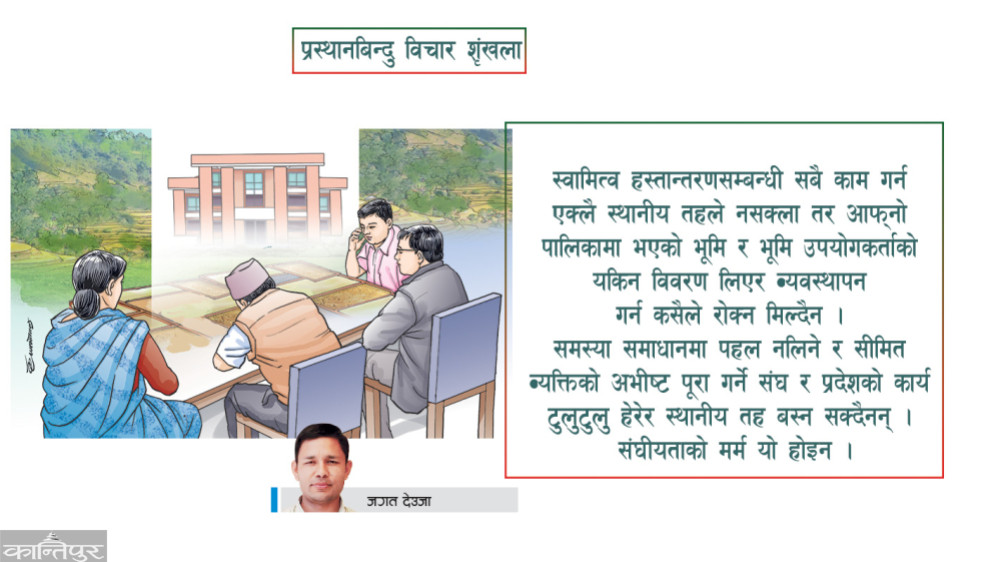
Common understanding and commitment among political parties on minimum issues is essential at all levels to solve land related problems.
We use Google Cloud Translation Services. Google requires we provide the following disclaimer relating to use of this service:
This service may contain translations powered by Google. Google disclaims all warranties related to the translations, expressed or implied, including any warranties of accuracy, reliability, and any implied warranties of merchantability, fitness for a particular purpose, and noninfringement.
Land ownership and land use issues have been raging in the country for decades. Moreover, new problems have been added in recent decades. Out of this, the management of landless Dalits, squatters and unorganized residents has become a major challenge. For four decades, the government has tried to address this challenge through various committees or commissions. But meaningful results have not been achieved.
With the implementation of the new constitution in 2076, the eighth amendment was made to the Land Act. In accordance with the Act, the land related problem resolution commission was established in March of the same year. In December 2077, the eighteenth amendment was made to the land regulations. In the constitution, squatter management is listed as a common right of all three levels of government.
The Land Commission made a procedure based on the provisions of the Constitution, the spirit and the amended Land Act so that all the three governments are responsible. Along with this, the local level accelerated the management of landless Dalits, landless squatters and unorganized residents.
With the change of government, the then land problem resolution commission was dissolved on July 19, 2078. Again, on August 25, the National Land Commission was formed. In 2080, the government changed again. The National Land Commission was dissolved on March 8. Due to the Supreme Court's interim order, the new commission could not be constituted. In this way, the process that has started has become blocked in a series of ways before it can gain momentum.
ing Commission has been dissolved and a new commission has not been formed, so there is confusion on how the local government will solve the problem of landless squatters. The local government has invested a lot in collecting, verifying, 'digitizing' the applications of the landless and unorganized residents and surveying the land. Disappointment is increasing in the community apart from the local government as the work that is being done is not able to speed up when the commission is dissolved after a change of government. Another commission will be formed within a few months, but it is not possible to say how long it will last.
It is necessary to find an alternative to such an endless fate. Even if the commission is disbanded, there is a need for an arrangement in which the local level can continue to function within the laws and regulations related to land. It is also possible. The Act empowers the Commission to make procedures for collection of taxes, provision of land, etc. In the act itself, the definition of landless squatters and unorganized residents has been defined, and the subject of which land can be provided and which cannot be provided is also mentioned. Where and how much land will be provided according to geography is in the regulations. As a result of this, it has become necessary to go to the option of working in coordination if the commission is formed, including all the procedures made by the past commissions and additional issues, and working in coordination.
If the work was done according to the spirit of federalism, all services related to land should have been received from the local level by now. The land administration is still under the sole control of the Union, making excuses such as the fact that capacity building at the local level will take time, and that services of a complex nature require more study and preparation. If you really want to take it to the local level, it is not difficult to do it using technology. By 'digitizing' all land related data and developing a suitable computerized system of land administration, all land related services can be arranged through the local level. For which it is enough to strengthen the system adopted by the Malpot and Napi offices.
In order to solve the problem of landless and unorganized residents, facilitation committees have been formed in almost all rural villages and municipalities. Facilitation committees are also at the ward level of the local level where the problem is more. Land service center has been established at the municipal level. Technical manpower and equipment are also becoming organized in these centers. Some local levels are moving forward by making laws or procedures related to local land.
The local level needs to formulate and implement at least the Local Land Act to address the issue of land ownership and land use for land management and the Land Contract Act for the proper use of government, river development, barren private land, institutional land, etc. By enacting these laws, the local level can record detailed information on landless, unorganized residents, groups deprived of land rights, availability of land, status of use, etc. Measurements can be performed.
Doing this means about 90 percent of the work is done. Most of the interested local levels have done the work of data collection and entry. Only a few have done the verification work. This is an important task. If a certified statement can be prepared, the addition of new landless and unorganized residents can be controlled. Even if the landowners cannot distribute the parcel immediately, the local government can focus on livelihood programs for the landless and give special concessions in education, health, employment, etc. Unorganized residents can also be brought under the ambit of property tax.
Even if the commission is not formed, how many landless people of their municipality are given land by the local level? How many will be transferred to the new place? Where to do it? How many unorganized residents can be given land? How many cannot be given? There is more homework to be done on these issues. If all these works are done, all local level work can be completed within 6 months of the formation of the commission.
It is everyone's desire that the Land Commission be established with sufficient authority and able to work confidently for the specified period. But looking at the past, nothing can be said. Therefore, not only the problem of landless and unorganized residents, but many other problems related to land, distribution of mohiani, Guthi, Swavasi, Venissa etc. The local level alone cannot do all the work related to the transfer of ownership, but no one can stop them from managing the land and land users in their municipality. The local level cannot sit and watch the work of the union and the province without taking initiative in solving the problem and fulfilling the wishes of limited people. This is not the essence of federalism.
Land management has both opportunities and challenges at the local level. Regarding land management, there is not much mentioned in the list of single rights of the local level, but the expansion of the subject mentioned in the list of the constitution and based on the Act, 2074, which was made to regulate the operation of local government, the local government can do a lot in relation to land management.
In addition to the management of landless and unorganized residents, local level leadership is also necessary in land use planning and implementation. The Land Use Act, 2076 can be considered as an important document in terms of localization of land management. In this, a special and important role of the local level has been ensured in matters such as land classification, land use area determination, land use area updating, land use implementation, land use plan formulation and implementation, protection and use of agricultural areas. The local level has been given the right to decide how to use the land within its geographical area, and for that, policy, legal and structural arrangements have been made so that the planning, policy determination and decision-making process are done at the local level.
It is possible to achieve tangible results in food security and poverty alleviation by bringing underutilized land into use. In relation to land reform, the local level cannot be limited to collecting land tax or collecting taxes as prescribed by the federal government, or distributing the land owner parts prepared by the federal government, and settling minor disputes.
Currently, the land surveying, kittakat and land naming or 'registration' work done by the district surveyor's office or the land reform and land delivery office can be considered satisfactory. The main issue is that the identification, distribution, restoration of rights and registration and various tasks of land management should be done by the local level.
Finally, the current complexities in land ownership and use and their resolution may have some legal obstacles, administrative disruptions, but it is also basically a matter of political decision. Common understanding and commitment among political parties on minimum issues is mandatory at all levels to solve land related problems.