It is necessary to make arrangements for the same climber who climbs Everest twice in the same year to get a permit both times. If only one year is allowed for climbing and proper management of sanitation, the process of snow melting of the mountains can be reduced to some extent. Mountains are protected from pollution.
We use Google Cloud Translation Services. Google requires we provide the following disclaimer relating to use of this service:
This service may contain translations powered by Google. Google disclaims all warranties related to the translations, expressed or implied, including any warranties of accuracy, reliability, and any implied warranties of merchantability, fitness for a particular purpose, and noninfringement.
On May 29, 1953, Edmund Hillary of New Zealand and Tenzing Norgay Sherpa, a Nepali citizen at the time, were the first to climb the summit of Mount Everest. Before and after them there was a scramble to climb Mount Everest. Three years after the Tenzing–Hilary success, the second team, Ernst Schmeide and Juerg Marmet of Switzerland, reached Thaplo on May 23, 1956, followed the next day by the third team with Adolf Rist of Switzerland.
Between June 5, 1921 and October 31, 1952, 15 unsuccessful climbers died before Tenzing-Hilary succeeded. Among them, the famous British-American climbers George Mallory and Andrew Irvine died at the fourth camp on June 9, 1924.
After Tenzing-Hilary, within a period of 71 years, by 2023, 8,272 climbers have reached the summit of Mount Everest. 580 of them are women climbers. As of 2023, there are 1,310 climbers who have not been successful in obtaining a climbing permit. Similarly, according to the Himalayan database, the number of people who lost their lives in the climbing route, Death Zone, Crevasse, Khonch, Icefall after and before the climb from 1921 June 5 to 2023 June 3 has reached 332. About 200 dead bodies are still scattered in the mountains.
The bench of Supreme Court judges Sapna Malla Pradhan and Sushmalata Mathema has issued an order in the name of the government on May 18 that 'to prevent pollution, bring down the dead bodies in the mountains and bury them far away from the base camp and fix the maximum number of climbers'. The division bench quoted the report of the Nepalese army and mentioned that there are more than 14,000 tons of garbage, including more than 200 dead bodies and human excreta, which have been excreted by the climbers. Despite the death of so many climbers, the desire and number of climbers to climb Mount Everest is increasing year by year. On March 18, 1923, Mallory was asked by a New York Times reporter, 'Why do you want to climb Everest?', he answered - 'Because it is there.' Since Everest is in Nepal, the world message was sent that one should come to Nepal to climb Everest. It has made Everest climbable. On May 29 this year, the government is going to celebrate the 'International Everest Day' at the foothill (base camp) of the highest peak Everest with Prime Minister Pushpa Kamal Dahal 'Prachanda' as the chief guest. The main purpose of which is to attract the attention of mountaineers of the world to Mount Everest.
It is not only about climbing the summit of Mt. Everest, but also about who will reach it more times. In this series, 54-year-old Kamirita Sherpa, who climbed Thaplo for the most times, broke her own record and managed to set a world record again by climbing it for the 29th time on May 12 and for the 30th time on May 22 this year. 46-year-old Pasangdawa Sherpa followed Kamirita and made the 27th successful ascent on May 22 last year. Pasang is looking at the stake sooner or later - to surpass Kamirita, if not to reach her level. For them, reaching the summit of Mount Everest is like going to 'Pani Pandhera'. Whether it is a healthy jog or an unhealthy one, reaching the summit of Mount Everest means conquering death and returning. This season, Phunjozhangmu Lama set the record for the shortest time (14 hours and 31 minutes) for a woman to reach the summit of Mount Everest. Angrita Sherpa, famous by the nickname 'Himcheetua', successfully climbed 10 times without oxygen.
Icefall doctors to climb from Everest Base Camp to the first camp on April 17 this year and 10 people, including Lhakpa Sherpa from Seven Summit Treks, roped up to the summit by May 10. This opened up the climbing path for climbers. As a result, on May 12, as the first team of this spring season, 71 people, including foreigners, made a successful ascent under the leadership of Kamirita. According to Chief Government Liaison Officer Khimlal Gautam, 268 people have taken Thaplo as of writing this article.
In the years leading up to the platinum jubilee of successful ascents, various climbers have set various records. Among such records, Japan's Junko Tabei became the first woman in the world to reach the summit of Mount Everest on 16 May 1975, while Pasanglhamu Sherpa became the first Nepali woman to reach the summit of Mount Everest on 23 April 1993. Unfortunately, on the way back, he slipped on an iceberg and died. Her husband Lhakpa Sonam Sherpa climbed Mt. Everest on 17 May 2023. On May 25, 2023, 17-year-old Nimarinji Sherpa set a world record by successfully climbing Everest and Lhotse within 10 hours. On 21 May 2004, Pemba Dorjee Sherpa set the record for the shortest summit by reaching the summit from base camp in 8 hours and 10 minutes. While Tenzing-Hilary took 5 weeks to reach the summit from the base camp. Thanks to advanced and sophisticated climbing equipment, experienced Sherpa guides and weather forecasting technology, Pemba was able to reach Thaplo quickly.
Nepal's chief surveyor survey officer Khimlal Gautam managed to set a surveyor's record by climbing Mount Everest for the first time in a civil servant team on May 18, 2011. He took Ravin Karki, another surveyor and surveyor, to climb Everest for the second time. And, on May 22, 2019, Thaplo recorded the height data of Mount Everest through satellite observation for one hour and 16 minutes. Also from China, a measurement was made on Chomolung (Mt. Everest) on 27 May 2020. After this, the new height of Everest is 8848.86 meters, the government of Nepal and China jointly announced the new height on December 8, 2020.
Former Gurkha soldier Hari Budhamgar climbed Mount Everest on May 19, 2022 with the help of an artificial leg. Xia Boyu, a 69-year-old Chinese citizen without both knees, achieved success in May 2018 in a bid to maintain the record. On May 25, 2001, blind American Eric Wiehnemeier climbed to the top of Mount Everest. American couple Scott Lehman and his wife Saina Ungar (both deaf in both ears) set a record by successfully climbing Mount Everest on May 22, 2023.
Moni Mulepati and Prem Dorjee set a new record by getting married on the summit of Everest on May 30, 2005. An ordinary climber has to spend half an hour at the summit of Everest. But Babuchiri Sherpa stayed in Thaplo for 21 hours without using oxygen. A 25-year-old Lakpa Tharke Sherpa spent 3 minutes half-naked (upper body) on Mt. Thaplo on May 24, 2006. Phurwatasi Sherpa and Ms. Chudin Sherpa reached the top of Mt. Thaplo twice in a week. Everest is usually climbed on the fourth or fifth day from base camp.
Increasing number of climbers
The number of climbing teams and climbers is increasing every year. In the spring of 2023, 479 climbers in 65 groups from 43 countries obtained permits. Among them, 103 were women and 376 were men. Most of them were American 163, Chinese 113, Indian 40, Australian 31, Canadian 21, Russian 20, UAE 18, Austrian 16, Nepali 16 and the rest were from various countries. Of the 479 who took out permits that year, 402 reached the summit. In 2022, 323 people from 44 groups took permits.
According to Rakesh Gurung, director of the tourism department, 414 people including 41 teams from 60 countries have taken permission to climb Mount Everest this year. 53 of them are women. This year, Pasanglhapu rural municipality has launched a high-altitude health clinic targeting hikers and mountaineers at Gorakkshep, the last station to stay before going to Everest base camp from May 1, 2024.
If the Nepalese icefall doctor does not make the way, if the Sherpas do not work as logistic helpers and guides, the fact is that foreign climbers will not be able to scale Mt. Everest under any circumstances. However, it is also said that they worked for the remuneration of their profession. Another aspect is that if foreign climbers do not come, the livelihood of the Nepali Sherpa community will not work.
The highest amount of royalty received by the government from Everest was 632 million in 2023. 57 crore has been received this year. There is a provision to keep 25/25 percent of the revenue royalty received by the local bodies and the state government and the remaining 50 percent to the federal government. For climbing Everest, foreigners have to pay 11,000 USD as royalty, while Nepalese have to pay a maximum of 75,000 rupees. The Department of Tourism, which permits climbing, takes a deposit of 500 to 4,000 US dollars to collect garbage after climbing. The amount is refunded after showing the waste management document. But many climbers have not come to get the money back.
Traffic jam
Mount Everest is stable, but cannot be climbed in twelve months. It has its own science and cycle. In the past, they climbed even in winter and autumn, although very few times. In recent years, that order has stopped. Vasantayam is the best season to climb Mount Everest. But even at this time, extreme challenges such as snowfall and wind speed around the peak become somewhat easier only on a limited few days in the month of May. After anxiously waiting for that day, the climbers reach the peak by weather analysis and calculations.
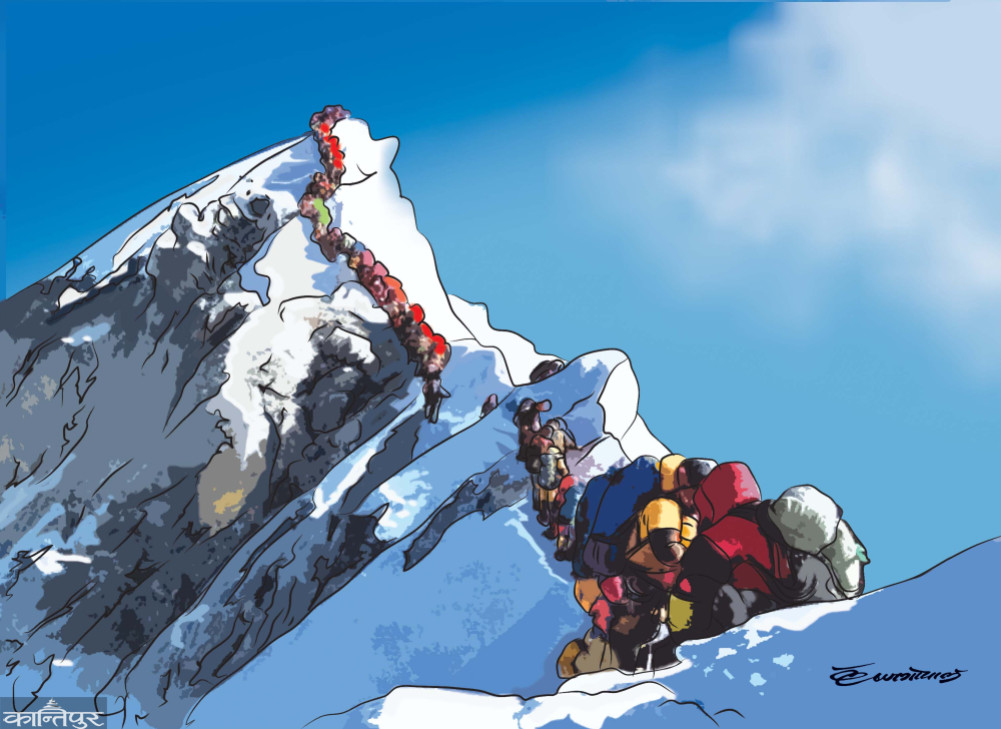
The summit jet stream, which at other times reaches speeds of up to 200 km/h, is diverted northwards, with winds of less than 30 km/h during the 'summit window' (short period). Such a window sometimes opens for a whole day or a day or two. Sometimes the weather changes for only two to four hours a day. Such windows are usually opened more than five-six times in the month of May. Therefore, when there is a wide window, most of them take advantage and start going up. Climbers try to get to the earlier window period as much as possible, as delaying sometimes risks missing the window in the later period. Under such circumstances, traffic jams are created. On May 17, 2023, 175 climbers reached the peak in one day. On May 23, 2015, there is a record of 354 climbers climbing Everest.
The 91-year-old Sherpa, the youngest surviving member of the 35-member team that succeeded Tenzing-Hilary, said in an interview to the media on March 3, 2024, that it would be better to reduce the number of climbers as the world's highest peak is littered and overcrowded. Now the peak is always crowded during the climbing season every year. Due to this, Kasingar and climbers in the mountains are immersed in
ing garbage piled up. Some climbers come with their faeces in their throats. It eventually flows down into the river near the base camp. It contaminates the river water in the lower coastal areas. In order to prevent such actions, one should let Everest rest for a year and collect garbage during that time. Nimanurbu Sherpa, president of the Nepal Mountaineering Association, says - 'We should study and consult with the stakeholders in this regard.'
Pemba Dorje Sherpa, who climbed the fastest Mt. Everest in 8 hours and 10 minutes on May 21, 2004, says four record-breaking climbers who carry banners and flags take pictures and throw the flags and banners there. They should be forced to bring such material to the basecamp. If you don't, you should take action. From base camp to camp 4 should be kept clean. Camps 2 to 4 are the most dirty. If we collect all the waste there, it would be 10-12 thousand tons. There is no garbage in the base camp, because it is cleaned there.'' The government should be alert and take necessary steps regarding the cleaning of mountain garbage.
now happens in the same season as climbing Mt. and picking up garbage. Climbers go forward and garbage pickers go back. After climbing for a year, if the team of the Nepalese army picks up the garbage, the dead bodies scattered all over the mountains can be taken down. Some tourism professionals, climbers themselves and even the government may not like this statement. It is said that the livelihood of businessmen was taken away, the income of local bodies and the government decreased. However, if such arrangements are made, the importance of Everest will also increase and the mountain environment can also be maintained.
epilogue
1. If the permission to climb Mount Everest is given one year and the cleaning of the mountains is stopped the next year, the process of melting the snow of the mountains can be reduced to some extent, although 'global warming' also plays a role. By doing this, the mountains can be avoided.
2. There should be a system for the same climber who climbs Everest twice in the same year to get a permit twice. Even the contact officer of the tourism department and the base camp may not know about the climber who is going to climb for the second time immediately. After achieving success, such climbers only get proper information when they come to ask for the recommendation of the officer.
3. Ascension begins at least 15 days earlier than now, if the weather is favorable in the spring month of Ascension Yam, many problems can be solved. It could add at least two to four summit windows and solve the traffic jam problem on Everest to some extent.
4. Some climbers believe that they can reach the summit by pushing or pulling several Sherpas as guides for money. Therefore, giving license to be a guide only to those who have the skill-training, experience, basic morals and code of ethics of a Himalayan guide can discourage the intention of climbing in such irregular ways.
5. There should be a provision to deploy a rescue team at the 4th base camp to help anyone in distress. In that process, an effective mechanism of communication between the tourism department, the base camp and the climbers is necessary.
6. Although the climber's clothing is equipped with electronic chips, every climber who climbs should be tracked by GPS technology. This helps to confirm whether the climb is successful or not. Even if there is an accidental death, it is easy to know immediately.
– Shrestha is a border explorer and advisor to the Nepal Mountaineering Association.