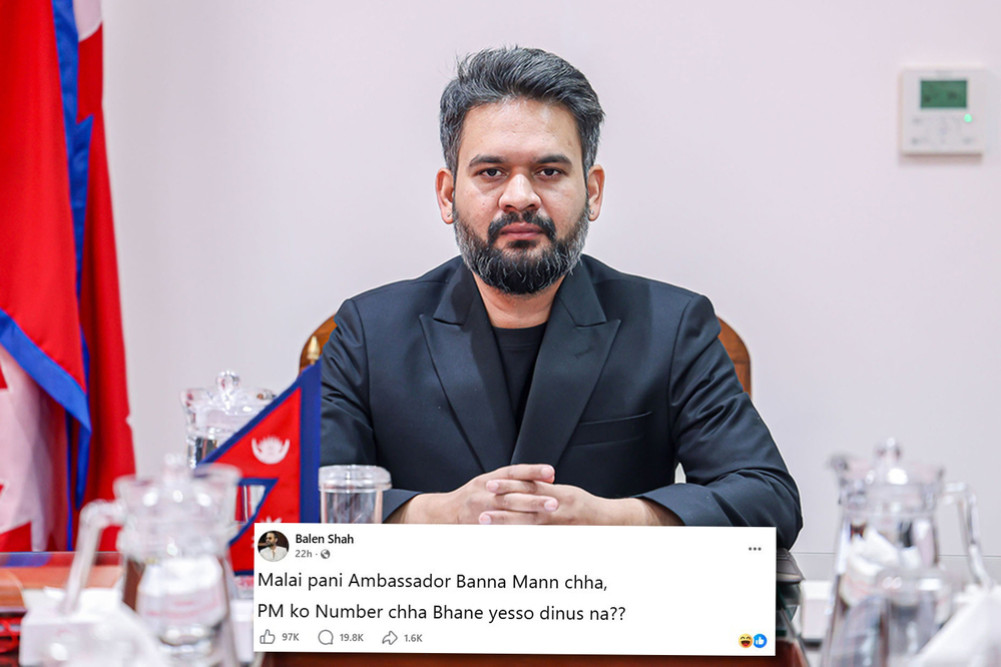
At a time when serious issues such as opposition to the ordinance, the problems of the displaced and landless, and the neglect of the marginalized lower classes in the budget are being debated, Prime Minister Balendra Shah's post appears to be an attempt to divert attention elsewhere.
We use Google Cloud Translation Services. Google requires we provide the following disclaimer relating to use of this service:
This service may contain translations powered by Google. Google disclaims all warranties related to the translations, expressed or implied, including any warranties of accuracy, reliability, and any implied warranties of merchantability, fitness for a particular purpose, and noninfringement.
A status posted by Prime Minister Balendra Shah on Facebook has sparked a debate on social media. Shah posted from his official Facebook account 'Balen Shah' at 10:15 pm on Saturday saying, 'I also want to become an ambassador, if you have the PM's number, can you give it to me??'. Ministers and MPs have commented jokingly on the post. Education Minister Sasmit Pokharel, who is also the government's spokesperson, wrote 'I will send you a message' in the comment. Similarly, House of Representatives member Tika Sangraula (Jwala Sangraula) wrote 'I have it but I won't give it', while Ranju Darshana also wrote in the comment, 'You cannot become a PM or an ambassador. Choose one first!' Last Thursday (Jestha 21), the police summoned and questioned Secretary Krishnahari Pushkar for sending a message to the Prime Minister. He was taken under control by the order of the Office of the Prime Minister and Council of Ministers on the charge of sending a message directly to Prime Minister Balendra Shah for personal gain, violating the 'chain of command'. Prime Minister Shah had made a satire on this issue. There is a debate on social media between the parties and the opposition regarding the Prime Minister's posting at night and the joking comments made by the people responsible for it.
Some leaders of the Gen-G movement have also commented on the Prime Minister's status. Gen-G leader Arnab Chaudhary has argued on social media by comparing the sarcastic attitude of former Prime Minister
KP Sharma Oli with that of
KP Oli. 'KP Oli during Ekta also used to tell proverbs, make jokes, be sarcastic, and even joke.' And people would laugh and say, "Wow, what do you know?" And supporters would run around to confirm that that proverb, that piece, that sarcasm, that joke was about building a country,' Chaudhary wrote on Facebook, '... A joke is funny, but who can say when and how?' Gen-G leader Tanuja Pandey said in a conversation with Kantipur that the Prime Minister could not distinguish between state affairs and personal affairs. 'He joked about very sensitive matters like choosing diplomats,' she said, 'That is not his personal matter, that is a matter of state affairs. It is sad that he could not distinguish that.' This status has not only been criticized, some have argued that the Prime Minister also has a personal life. Another Gen-G activist, Bhavana Raut, wrote on Facebook, arguing that the Prime Minister also has the right to his personal life and use Facebook, saying, 'We are used to seeing the faces of old leaders, so we find it strange when young leaders behave like humans. Leadership should be evaluated by his decisions and performance, not by his post on Saturday night.' Anjali Subedi, sharing Balendra's status, defended him. She wrote, 'The idea that the Prime Minister should not post like this on Saturday is a preconceived notion in itself. Chill. What the Prime Minister should not do is walk around with two faces, as many leaders in the world have done... Let's be happy. Let's be free. Let's be humane. Thank you.' In this incident, the former secretaries had opposed the arrest of the secretary based on the message he wrote. Meanwhile, the debate over the status of the Prime Minister has shifted to what the Prime Minister can and cannot write.
Gen-G leader Majid Ansari told Kantipur that the treatment of employees in this way has made a mockery of democracy. 'The police should not act according to the Prime Minister's mood, but according to the law, but the current treatment of employees seems to be making a mockery of democracy,' he says. 'The Prime Minister is misusing the police and insulting employees to divert serious public debate, which is just a strategy to confuse the people.'
Another Gen-G leader, Amit Urja, sarcastically argued that the Prime Minister has the ability to falsify the cases against him. 'He is an expert in social media and understands algorithms well, so he knows how to divert people's attention by bringing up new and popular issues to distract from old controversies,' Urja told Kantipur. 'He is adept at quickly changing the subject and diverting the issue so that no controversial issue can have a 'hangover' in the public mind for a long time.' Like Urja, Gen-G leader Tanuja Pandey also argues that the Prime Minister is capitalizing on the 'clouting culture.' 'Since the beginning, whenever an issue comes up and it becomes a little controversial, he posts something else to divert it,' she says. 'Our PM seems to be trying to capitalize on that clouting culture with great gusto.' (Clouting culture comes from the word clout chaser . Which means a critical term referring to a person who is extremely eager to gain fame, discussion or social influence (klout). Such people show closeness to famous people, create unnecessary controversies, or even engage in risky activities to get into the news, attract attention on social media, or make themselves known .)
This is not the first time that the Prime Minister has been the subject of debate on social media. The government's decision to bring an ordinance related to the Constitutional Council and cooperatives in the cabinet meeting held on April 14 was opposed.
The government had brought the ordinance by postponing the session of Parliament that had been called by the President on the recommendation of the Prime Minister himself. While there was opposition to it, saying that the ordinance was brought by circumventing Parliament, Prime Minister Shah wrote on his Facebook account 'Balen' on 9 At 10:24 am on May 2025 (Baishakh 26), he posted his photo .
Then his photo became a topic of discussion on social media. AI-generated photos like his spread across the networks . The social media, which was debating the ordinance, suddenly turned to Balendra's photo .
The next week, i.e. on May 16, 2026 (Jeshta 2), he posted a similar photo of him trying to eat 'cheese' in the same outfit from the same ID. And wrote in the caption, 'Say cheese, DDC's cheese'. In the comments, he himself wrote, 'DDC is Nepal Government's, bro sis'. This photo also became very popular on social media . After he posted this photo, the demand for Yak cheese increased by more than 30 percent
the next day as supermarkets and consumers rushed to buy the product. When this photo of the Prime Minister was circulating on the internet, there was a protest saying that the displaced women in the 'holding center' were not getting nutritious food.
Similarly, on the day of the budget speech, he posted at 9:54 pm
'Be confident' . 'To divert attention from the protest against the ordinance, the problems of the landless and the budget questions, sometimes new 'trends' are being introduced and sometimes the issue is being diverted by arresting employees,' Majid Ansari said, 'The public is being diverted from the debate in such a way that they do not get the opportunity to ask questions on important issues.'
Tanuja Pandey said that it is worrying that the debate is being diverted to the Prime Minister's joke in this way. 'People are getting more excited about this trivial matter than the real issue, this is a worrying issue,' she said, 'Instead of bringing up an important issue and providing clarification, this is probably his attention-seeking nature, otherwise this is completely unacceptable.' Similarly, Nepali Congress Youth Congress leader Gaurav Bhandari also argued that the debate in society has become individual-centered. 'When issues like inflation, employment, budget, economy and the future of the youth disappear from public debate and individual-centered disputes and reactions start to take center stage, there may be not only politics, but also a well-planned exercise of agenda setting,' he said, 'What are we being forced to think about, debate and respond to? Sometimes the most successful political strategy is not to answer the question, but to change the question itself.' Gen-G leader Chaudhary argues that there is not much difference between the current government and the previous government. ‘Those at the center of power were playing games to distract from the real issue in the past, and it seems that the current government is following the same path,’ he said, ‘It seems that they are ignoring the rule of law and showing off on the network. It seems that it is only covering up rather than focusing on solutions.’