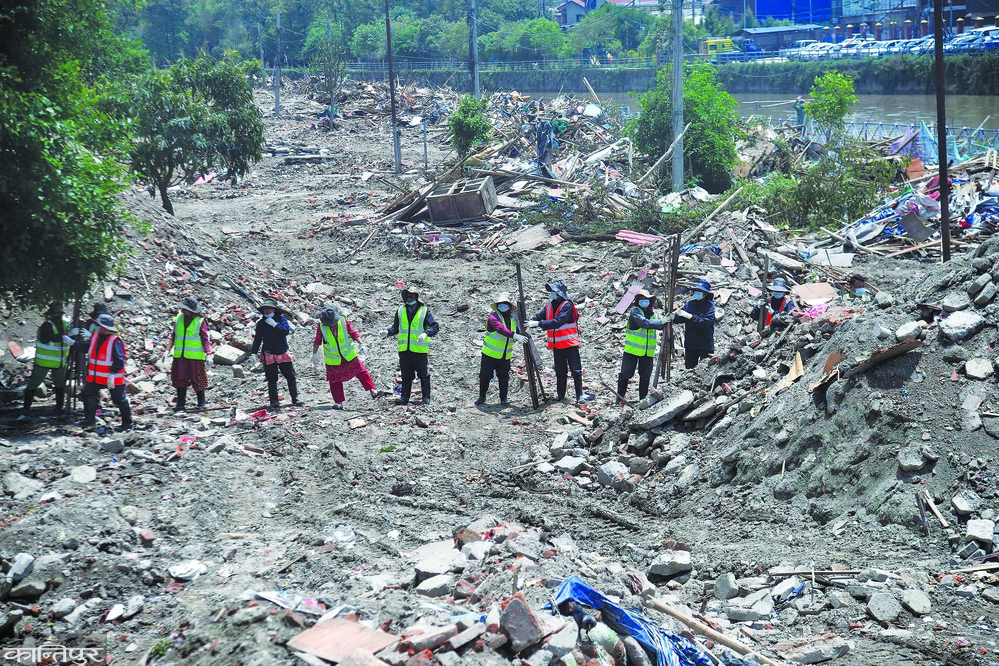
As the debate rages over the management of displaced squatters, another complex issue has emerged - environmental pollution caused by the remains of collapsed structures.
We use Google Cloud Translation Services. Google requires we provide the following disclaimer relating to use of this service:
This service may contain translations powered by Google. Google disclaims all warranties related to the translations, expressed or implied, including any warranties of accuracy, reliability, and any implied warranties of merchantability, fitness for a particular purpose, and noninfringement.
If you walk along the Bagmati, Manohara and Dhobikhola river corridors, you will see - small and large piles of concrete from demolished houses and the remains of demolished houses. While the debate is on the management of displaced squatters, another tricky issue has emerged - environmental pollution caused by the remains of demolished structures.
Waste management expert Ashish Khanal says that waste generated from demolished structures without proper classification, reuse and management systems can cause another environmental crisis.
The government has given the responsibility of waste management and coordination of future work to the empowered Bagmati Civilization Integrated Development Committee. According to the committee's sub-project director Uddhav Nepal, the government has planned to transform the demolished areas into 'beautiful gardens'. For that, soil will be poured over the rubble and made green. The committee also plans to build an embankment and drainage structure parallel to the river.
Spokesperson for the Ministry of Urban Development, Nawaraj Pyakurel, said that the first priority is to fill the riverbanks with rubble structures. But the ministry does not have data on the total amount of rubble generated. Due to this lack of data, many have doubts about how the committee will solve this problem. Urban planner Shrukh Khatiwada said, "Without understanding the amount and structure of rubble, transportation systems, storage sites, recycling capacity, management plans or environmental protection measures cannot be designed properly."
According to Khanal, on average, 8 to 10 tons of rubble are released from a demolished structure. During the displacement of squatter settlements, the government has demolished 2,687 structures, from which it can be easily estimated that tens of thousands of tons of waste have been generated.
According to environmentalists, the government's plan for such a large and complex nature of debris is flawed and unscientific. Environmental engineer Saksham Shrestha said that although using debris to restore low-lying areas is an effective way to reuse concrete waste, such materials are not safe for reuse in the current situation. He said that before reusing concrete waste, it should be tested and the impact it will have on the surrounding soil, groundwater sources and river structures should be taken into account.
Waste management expert Ashish Khanal said that although embankments built scientifically will help control floods, poor management can lead to more problems in the future.
Nepal, the committee's deputy project director, said that the committee is urging residents of the displaced settlements to remove their belongings from the demolished structures and that everything else will be 'managed'. But Tanuja Pandey, co-founder and chairperson of the climate justice campaign 'Harin Nepal', is concerned about such vague assurances from the government.
According to Pandey, Kathmandu has long been imposing its environmental burden on the economically weaker communities outside the city. She said, “The price of a rich city is always paid by the poorer settlements nearby.”
Stating that a decision will be made on which of the remaining debris can be reused and which can be thrown away, Nepal, the committee’s deputy project director, said, “All usable materials will be separated.” Despite this, it is not clear how the committee will begin the classification process.
Nepal said that some decisions have been made and that concrete materials will not be reused. But according to environmental engineer Saksham Shrestha, such materials can be reused to make road construction materials, prepare the base for laying pipes or build retaining walls. While iron can be completely reused without reducing its quality, wood can be used as furniture, mulch or biomass fuel. 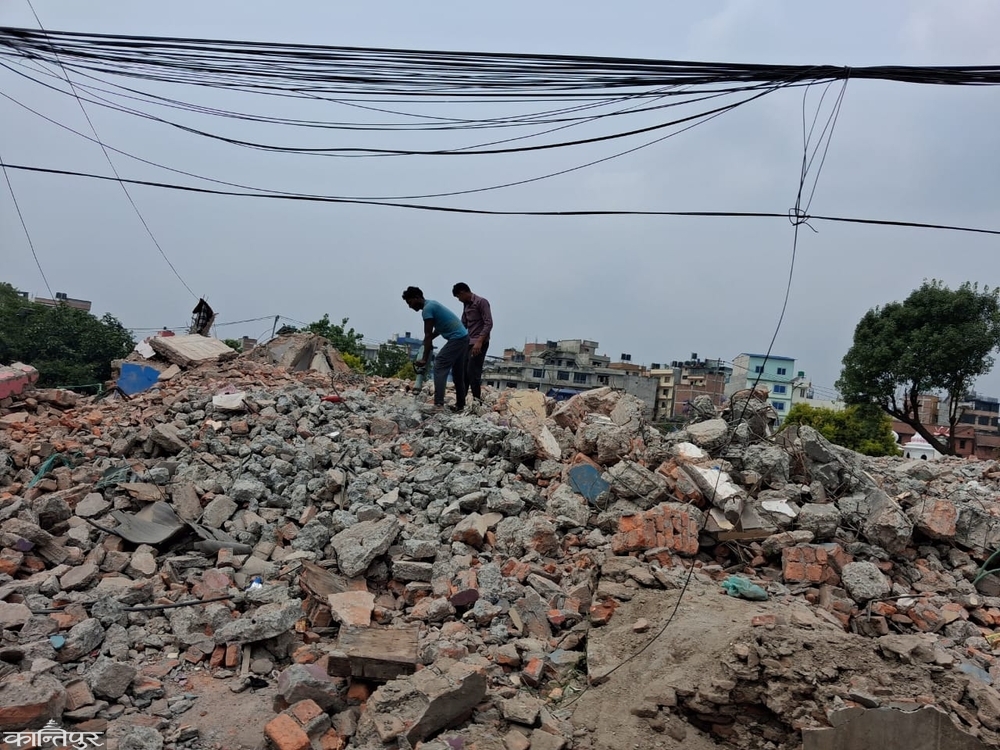
A 2024 study showed that more than 70 percent of rubble can be recovered and recycled. This is a standard adopted by the European Union. According to Khanal, countries such as Japan, Ukraine and South Korea are adopting a reuse system in reconstruction, converting rubble into roads and other construction materials. Urban planner Shrishi Khatiwada also agrees with Khanal. “There is a growing trend internationally towards ‘circular reconstruction’, which uses rubble as a recoverable resource,” she said.
Nepal has already suffered the consequences of poor rubble management. After the 2072 BS earthquake, the remains of collapsed buildings were dumped on riverbanks, scattered in open spaces and blocked roads for months. Thousands of tons of rubble ended up in landfills.
According to a study published in the Journal of Material Cycles and Waste Management
, about 2.17 million tons of building debris will still have to be managed by 2025. According to Pandey, the remnants of the earthquake can still be seen. Now, as large amounts of debris are piling up in the Kathmandu Valley again, Nepal is at increased risk of repeating the same mistake. But this time, the scenario is different - the 2072 earthquake was a natural disaster, while the current eviction campaign is planned. From an environmental perspective, experts believe that the government's approach was flawed from the start. According to waste management expert Ashish Khanal, an environmental impact assessment (EIE) should be carried out before a structure is demolished. Through the EIE, the materials inside the structure are identified and it is determined which materials can be reused, recycled and safely disposed of.
Second, the demolition process should have been planned and phased. According to Khanal, many countries are now adopting the ‘selective demolition’ method of separating materials during demolition, rather than separating them after the structure is completely demolished. He said, ‘You should not mix all the materials during demolition and then try to separate them later.’
But contrary to Khanal’s suggestion, the government has adopted the opposite approach. That is, the issue of which materials can be used after the structures are demolished is itself complicated.
Tanuja Pandey, an active member of the climate justice campaign, said, ‘But the committee is failing in this too.’ According to her, government officials are ignoring the full extent of what has been destroyed so far. During demolition, not only concrete and bricks are destroyed, but also materials inside the house - including batteries, electrical appliances and metal utensils. For example, batteries can contain heavy metals and high levels of mercury, which can pose a serious environmental risk if not properly separated and disposed of. She said, ‘The lack of proper planning after demolishing the entire settlement is a problem in itself.’
Locals of the displaced settlements have been digging through the demolished structures in recent days to find materials, such as bricks, iron rods or tiles and window frames. Khanal said that this method of searching for materials is risky and that the process is unorganized and uncontrolled, which has raised concerns about public health.
Both the committee’s deputy project director Uddhav Nepal and the spokesperson of the Ministry of Urban Development, Nawaraj Pyakurel, could not provide a clear health and safety strategy for removing the collapsed structures in the displaced areas. However, waste management expert Ashish Khanal says that the collapsed structures should not be removed without a health and safety strategy. He said that the practice of removing debris without any plan exposes local residents to dust and harmful substances and the lack of a system for how to protect themselves, how to control dust and transport the collected materials from there will pose a serious public health risk.
The monsoon is approaching. Environmentalists are concerned that if the collapsed debris is not removed in time, it could cause more problems in the river corridor. Khanal expressed his concern, "Once heavy rains begin, the debris will quickly flow into the river."
Urban planner Shirshikha Khatiwada is concerned that if the debris is used to fill the holes in the riverbanks as per the committee's proposed plan, the land's ability to absorb flood water will decrease. Khatiwada is concerned that if the flood plain is filled with mixed debris, the natural flood-absorbing capacity of the river will decrease. “Monsoon changes the entire landscape of risk,” she said. Government officials have said they are aware of the risks posed by the approaching monsoon. Urban Development Ministry spokesperson Nawaraj Pyakurel said they are working on “some designs and backup plans.” He declined to elaborate, saying the plans are not yet complete.
The problem of construction and demolition waste is not new. Kathmandu, along with other rapidly urbanizing cities, has been facing the problem for a long time.
A study published in the Journal of UTEC Engineering Management
found that the Kathmandu Valley generates about 28.5 million tons of construction and demolition waste daily. The total national volume is estimated to be 55 to 65 million tons.
Environmental engineer Saksham Shrestha says that whatever measures the government adopts, it should be properly documented—all details of how the waste was reused, how it was managed, and what its current condition is should be clear. He is optimistic that Nepal can effectively manage waste through proper documentation and skill development.