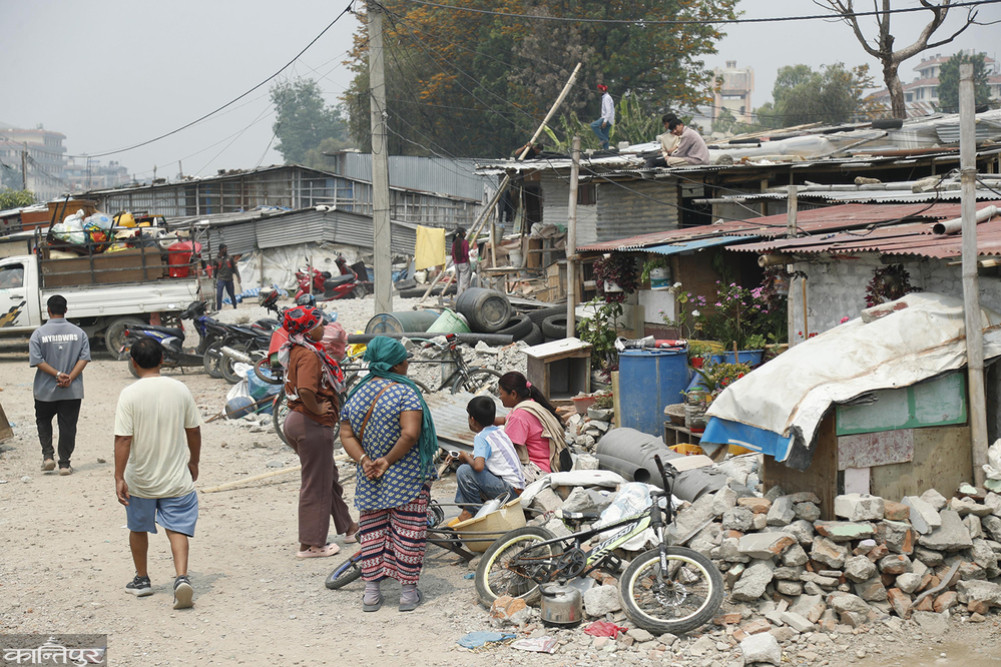
Security personnel have been mobilizing bulldozers to clear the riverbank slums in Thapathali, Gairigaun, and Manohara in Kathmandu since 6 am on Saturday.
We use Google Cloud Translation Services. Google requires we provide the following disclaimer relating to use of this service:
This service may contain translations powered by Google. Google disclaims all warranties related to the translations, expressed or implied, including any warranties of accuracy, reliability, and any implied warranties of merchantability, fitness for a particular purpose, and noninfringement.
Residents of the Sukumbasi settlement on the banks of the Bagmati River in Thapathali have been restless since Thursday evening. The residents who have been sheltering there for years have been deprived of sleep after the administration issued an 'urdi' through miking to vacate the settlement. They have become terrified and agitated, saying that the state is trying to force them to sit on the ground without a reliable alternative.
The fear brought by the state's latest move was clearly visible on the face of 33-year-old Jayakumar Tamang, who has been living in the same settlement for a long time. 'My father brought us here in 2063 BS, we considered this our home, now he suddenly asks us to leave, we don't know where to go, what to do,' Tamang told Kantipur on Friday, 'I haven't slept since the administration went through miking.'
Even though the government has assured us that the settlement will be vacated and that they will be housed in a lodge for the time being, the locals are not convinced. They complain that their joint family cannot fit in a cramped lodge or apartment. ‘The government has said that they will take them and put them in a lodge, but where? Which lodge will they put them in? Who will bear the expenses? I don’t know anything,’ Tamang added, ‘Our joint and large family cannot live in the Ranibari apartment, which is now called a bus.’
The government has pledged to accommodate all those who have been evacuated with minimum facilities in various places. The government is mobilizing security personnel and is launching a campaign to demolish houses and huts in the riverside slums of Thapathali, Gairigau and Manohara in Kathmandu from 6 am on Saturday. ‘If anyone obstructs, strict action will be taken as per the law,’ said Muktiram Rijal, Assistant Chief District Officer of Kathmandu. ‘The encroached land will be completely cleared by demolishing houses and huts, and all the people and families who have been evicted will be housed in various places designated by the government with minimum facilities.’
This is not the first incident of an attempt to remove the squatter settlement in Thapathali. Earlier, in November 2079, clashes and tension had erupted between the Metropolitan Police and locals throughout the day when a bulldozer was used in the settlement under the direction of the then Mayor of Kathmandu Metropolitan City, Balendra Shah (Balen).
‘This is the third time that they have come to intimidate and pressure us to sit in,’ Tamang said, ‘We are not occupying the land out of desire, we are here out of compulsion because we have nowhere else to go.’
Various human rights activists and the youth generation (Gen-G) have strongly opposed this move, saying that the government is trying to terrorize the landless by giving a short-term ultimatum. On Thursday, as soon as the police issued a notice to vacate the settlement through miking, a team of youth leaders including Raksha Bam, Amit Khanal, Majid Ansari, Uparjun Chamling and others reached Thapathali and reassured the locals.
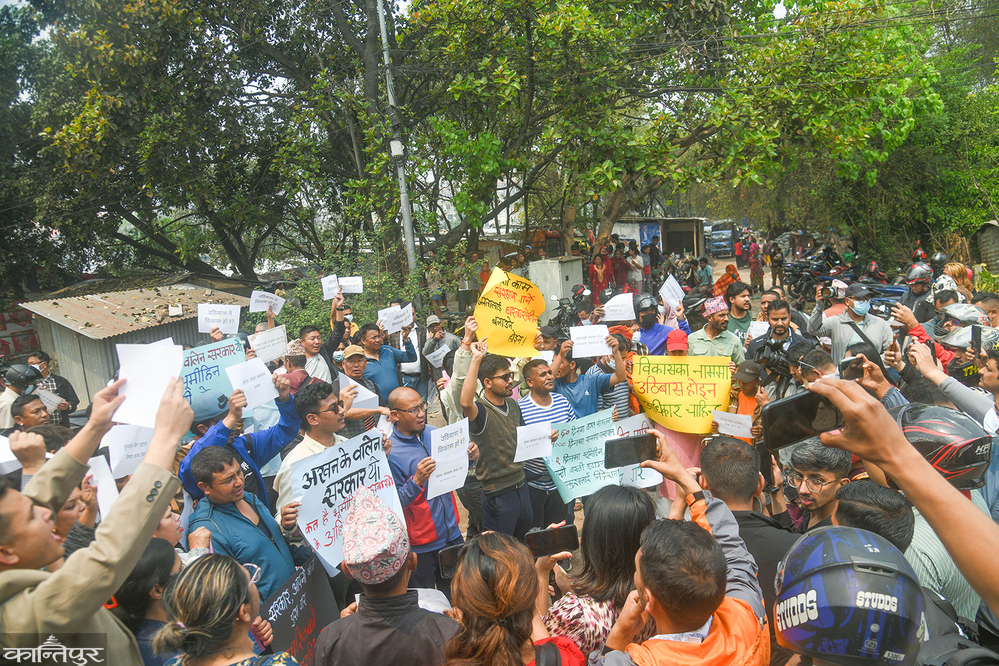
The United National Slum Dwellers Front, local residents and Gen-G leaders took to the streets since Friday morning. The participants in the demonstration, which started at 10 am, carried placards and warned the state. ‘Stop the squatter camp without alternatives!’, ‘Identify the real squatters!’, ‘Ensure the constitutional right to housing!’, ‘Stop the dozer terror!’, ‘The poor cannot be killed, cancel the squatter camp notice!’ were seen on the placards they carried.
After shouting slogans for some time in Thapathali, the protesters reached the central office of the Rashtriya Swayamsevak Sangh (RSS) in Banasthali. They reached there with the aim of putting pressure on the power balance and the leadership of the concerned ministries. ‘There was a heavy police presence there (at the RSVP office). During the protest, some people were getting angry and trying to commit some violent acts, but we kept it peaceful,’ said Zen-G leader Sanken Yampu Rai, who reached the RSVP office. ‘The United National Slum Dwellers Front has submitted a memorandum to the party representatives, and they have come with an assurance of taking positive initiatives.’
The youth leaders have been trying to draw the government’s attention by trending ‘3 Garibko Chameli’ (hashtag Garibko Chameli) on social media since Friday.
Although the state has said that it is trying to clear the settlements for beautification of the river banks and implementation of standards, rights activists believe that the problem has worsened due to the lack of proper management and long-term planning.
Now it is not a dozer, government desks should be established to address complaints, the state should not create a situation where people pick them up today and leave them stranded on the streets tomorrow: Rijan Rana Magar Gen-G leader Rijan Rana Magar argues that all squatters should not be put in the same basket. ‘The situation where people in the settlements should always be terrified and scared should end, I am not insisting that we need settlements in the river, but it should be clear what the government’s management policy and immediate program are,’ he said, ‘Different packages should be prepared for landless squatters, landless Dalits, unorganized settlers and displaced landless people based on their conditions.’
We do not object to the removal from the river banks, but their human rights and dignity must be protected in this process: Majid Ansari Another youth leader, Majid Ansari, comments that the government’s steps are immature. ‘How fair is it to say that we will remove them tomorrow but vacate them overnight? The government should have given a clear blueprint of where to evacuate them,’ says Ansari. ‘We have no objection to removing them from the riverbank, but their human rights and dignity must be protected in this process.’
The state should not use dozers to terrorize people and demolish huts in an inhumane manner while they are still inside, we are against it: Raksha Bam Rights activist Raksha Bam said that proper management of squatters is a matter of major concern. ‘Our main concern is where to take them and how to manage the slums,’ said Bam, ‘The state should not use dozers to terrorize and demolish huts while people are inside in an inhumane manner. We are against that.’
The youth are demanding that instead of sending dozers to the slums in the future, the government should set up a desk to solve the problem. ‘No more dozers, government desks should be set up there to collect data and address complaints,’ said Rana Magar, ‘The state should not create a situation where people are picked up today and left stranded on the streets tomorrow. For a long-term solution, it is absolutely necessary to identify the citizens and come up with a ‘full phase planning’.’
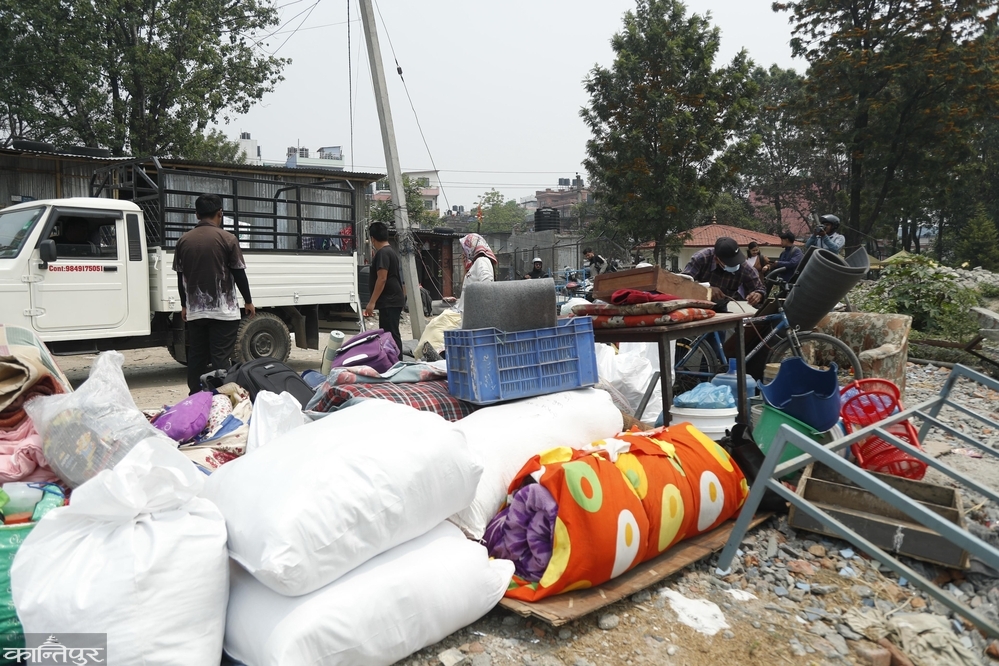
58-year-old Urmila Rai was frantically looking towards the huts in the slums of Thapathali on Friday afternoon, while she was frantically lifting her belongings. ‘Where will we put our belongings, where will we go?’ There is no one here for her.' She doesn't know where she will spend the next night. There is no one to call her to 'stay here', nor to show her a place to stay. Her eyes were watering as she looked back and forth at the empty hut.
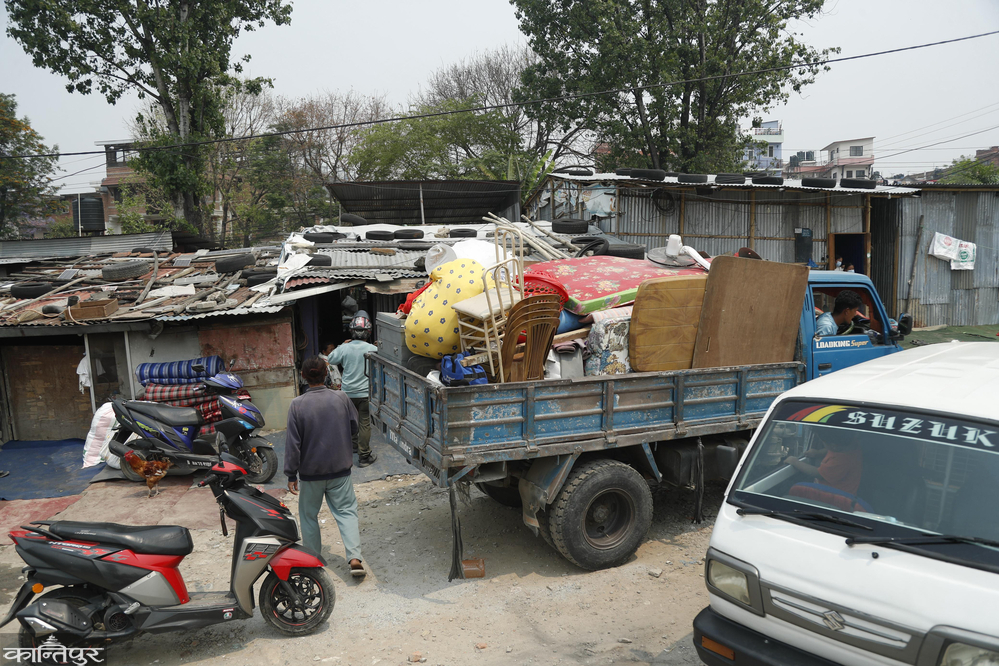
'Now the dozer will come, I don't have the strength to fight the dozer that is coming to demolish it,' Urmila said crying. Like Urmila, other neighbors were also busy moving their belongings. Some were loading them into the car. 'Now we will go to Bhaktapur, rent land, and open a firm,' one of Urmila's neighbors was saying. But Urmila, who was living under the same roof, only sighed. She looked tired. 'My daughter and I used to live here, it has been many years since we came.' We always suffered during the rainy season, we were living as we were,' she lamented, 'but the government has uprooted our homes so that we will never return.'
Land will be distributed to real squatters as soon as possible: Prime Minister Shah Those who have been living there are panicking after the government instructed the squatters to vacate the settlements by Friday evening. Prime Minister Balendra Shah, after discussing with the heads of the security agencies, has directed the removal of squatter settlements on the river banks of the valley. The Ministry of Land Reforms and Management is taking the lead in removing the squatter settlements. The government has repeatedly urged the evacuation of the settlements by miking.
In December 2079, Balendra was the mayor of Kathmandu Metropolitan City. At that time too, he had taken the initiative to remove the squatter settlements in Thapathali. There was retaliation in the process. The situation had become tense. The metropolis retreated after the police were injured. With Balendra becoming the Prime Minister, the work of removing the squatter settlements has moved forward again. On Friday, some were leaving the settlement. ‘We fought a lot, now we don’t even have the courage to fight,’ one of them was saying as he was leaving the settlement, ‘We are tired.’
The same thing is troubling the minds of the 49-year-old Jang Bahadur Magar couple from the squatter settlement, ‘Where will we go now?’ The rumors of the government using dozers and the miking to leave the settlement have not allowed them to sleep. ‘The miking was done to keep the children and the elderly in a safe place, the old woman is here, where will they go,’ he told Kantipur. They wandered around looking for a room. But since they cannot find a place for less than 10,000 a month, he is suffering even more. ‘The grief has also caused a lot of suffering, how will they survive,’ he says.
After being burned by poverty, Jung Bahadur's family moved to Kathmandu 30 years ago. 'I came to Kathmandu at the age of 14 and worked as a carpet weaver, later I became a car driver,' he says, 'Now I am working as a wage laborer.'
Last year's flood submerged the hut. The leg that was stuck in the floodwaters got infected. 'Bir Hospital said that the leg should be amputated, but later with the help of Shanti Sewa and Ganeshman Hospital, I was saved,' he says, showing the wound that has not yet healed. Last year, when the flood came, it was heartbreaking to have to stay outside. Moreover, since the government has imposed a permanent sit-in, they have not been able to sleep. It is more painful that they were not given an alternative than that the metropolis is trying to remove them. ‘We are fine, it is okay if you pick us up, but we have to be kept in a safe place,’ he says, ‘The government may have its own vision, but that vision cannot be used to pick up the poor.’
Jung Bahadur was annoyed when the police came knocking on the door at night or when he heard the miking of the dozers during the day. ‘If a film was made on the story of the squatters, it would be a good film,’ he said, laughing heartily.
49-year-old Ganesh Singh Ghalan often looks at the house he built with his own pains and says, ‘From tomorrow, the dozer will climb on the roof, and it will collapse easily. Our pain will also be mixed with the soil.’
The rooms inside the huts are emptying. He feels that the government will not listen even if he stands in front of the bulldozer and pleads. Even after Baburam Bhattarai became the Prime Minister in 2068, he still has the scars of the house being demolished. ‘Even then, it was demolished without prior notice, and there was nothing left of the things that had been put together one by one. We stayed hungry for two days. Later, we begged and put up a tarpaulin and spent the night there for several days,’ he remembers. He rebuilt the tin hut with the money he had saved by working as a wage laborer. It cost about 50,000. ‘Now it will collapse again,’ he says in a grandmotherly voice.
Ganesh, who lost his mother at a young age, spent his childhood with his sister. He moved to Kathmandu at the age of 16. After that, he started working as a laborer. He also got married in Kathmandu. His three children also grew up here. Now, his family is distraught at having to leave this place in this condition without any other choice. ‘The government is a guardian. It should not be destroyed as much as possible. Even if it has to be destroyed, it has to be given an alternative,’ she says, ‘We even voted that this government would do something. But when it does something that makes us more disappointed, it hurts.’
When we met in the afternoon, 40-year-old Renu Rai looked exhausted. She was in a hurry to find a room. ‘But where can I find her? My belongings are scattered at home, I am confused about what to do,’ she said, wiping her wet eyes. Renu is the mother of three sons and a daughter. She has been living in Thapathali with her children for 19 years. She laments, remembering the hut she built, ‘It was built with so much money, if the dozer runs, the hut will be a mess, but where will we keep these things?’
She was trying to keep the belongings in the house safe by wrapping them in a cloth. ‘We have to wear clothes, if we lose this too, what will we have left,’ she said.
After the discussion of removing the settlement, Anuj Magar did not even go to work on Friday. ‘Suddenly, since yesterday, they asked us to vacate the house through miking. We had no prior information. We work all day long,’ she shared the same pain as other neighbors, ‘We don’t earn much by working for wages. If we have to live on rent, how will we pay?’
Anuj is shocked to see the government becoming ruthless towards them. She has a question for the government that does not want to understand her situation, ‘If we could afford to pay the rent, why would we come to live on the banks of the river?’
Now a bulldozer is coming to the settlement. She does not know how to look at her own house that is being demolished. She does not even have the strength to go to work with a relaxed mind. Anuj works as a house painter. Anuj, who paints other people’s houses, cannot sleep at night because of the devastation of his own house. Her basic demand to the government that does not see an alternative to demolition is, ‘At least make arrangements for living before demolishing.’
Krishnamaya Rai had high hopes after the new government came to power. ‘This government will do something good, I thought I would be able to breathe a sigh of relief,’ she says, ‘But instead, it is working to uproot our roots.’ Krishnamaya, who lost her son just three years ago, was short of money. She keeps saying, 'If there was money, my son would have survived.' The pain of that continues to haunt her. Now, it seems that the government is not only going to bulldoze homes, but also poverty. She said angrily, 'Is there a government that does injustice to the poor?'