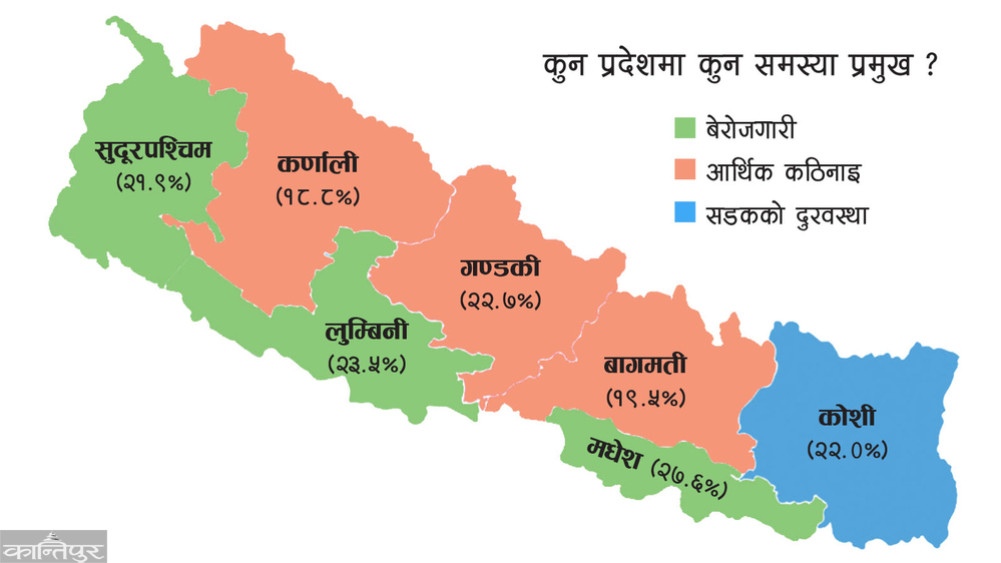
Residents of Sudurpaschim, Lumbini, and Madhesh cited unemployment as a major problem, while residents of Karnali, Gandaki, and Bagmati considered economic hardship as the main problem, while respondents from Koshi identified the condition of the roads as a major problem.
We use Google Cloud Translation Services. Google requires we provide the following disclaimer relating to use of this service:
This service may contain translations powered by Google. Google disclaims all warranties related to the translations, expressed or implied, including any warranties of accuracy, reliability, and any implied warranties of merchantability, fitness for a particular purpose, and noninfringement.
Most of the participants in the nationwide survey cited unemployment and financial hardship as their biggest personal problems. The majority of the 2,955 respondents in the month-long national survey conducted in collaboration with Kantipur Media Group and Sharecast Initiative Nepal cited unemployment and the resulting financial hardship as their biggest problems.
They were asked, “What is the biggest personal problem you are facing in your community today?” In response, 4 out of every 10 people said that the biggest problem they are facing personally is livelihood. The next problems are the poor condition of the roads, lack of access to healthcare, and the problem of drinking water. The results of the
survey show that the widespread unemployment in the country has had a major impact on the lives of the general public. According to the National Statistics Office, the unemployment rate in the country is about 12 percent. Every year, 500,000 new labor forces enter the labor market. Most of them are forced to seek foreign employment. According to the Department of Foreign Employment, an average of 300,000 young people go abroad for employment every year with new work permits. 500,000-600,000 people go abroad to continue their old jobs. These figures, which show the consequences of the lack of employment opportunities in Nepal, and the impact they are having, have been confirmed by the responses of the survey respondents.

On average, one in five of the survey participants said that they had no problems. This reveals the fact that about 20 percent of the people in the country do not feel any problems. While more than two-thirds (72.5 percent) of the respondents said that they were facing some kind of problem, about 6 percent of the respondents did not want to tell about it. Regionally, people in Sudurpaschim, Lumbini and Madhesh mentioned unemployment as the main problem, while people in Karnali, Gandaki and Bagmati considered economic hardship as the main problem. Contrary to the public opinion of these six provinces, people in Koshi Province considered the condition of the roads as their biggest problem.
On average, one in five of the survey participants said that they had no problems. This reveals the fact that about 20 percent of the people in the country do not feel any problems. While more than two-thirds (72.5 percent) of the respondents said that they were facing some kind of problem, about 6 percent of the respondents did not want to tell about it. Looking at the respondents who said they were facing some problem by province, 84.9 percent of the respondents from Karnali Province said they were facing some problem. The highest number in this province was about 23 percent, with economic difficulties and 18 percent citing unemployment as the main problem.
In Madhesh Province, the same proportion of respondents as in Karnali Province said they were facing problems. Of these, the highest number was about 28 percent, with unemployment being the main problem, while about 23 percent cited economic difficulties as the main problem. Then 10 percent cited health/treatment as the main problem they were facing.
About 79 percent of the respondents from Sudurpaschim Province said they were facing problems. Of these, the highest number was about 22 percent, with unemployment being the main problem, while about 13 percent cited economic difficulties and about 12 percent cited drinking water as the main problem they were facing.
Similarly, 74 percent of respondents in Lumbini Province also mentioned that they are facing problems, of which about 24 percent said unemployment was the main problem, about 23 percent mentioned financial difficulties and about 10 percent mentioned health care as the main problem. About 67 percent of respondents from Koshi Province said that they are facing problems. Of which about 22 percent said the condition of the roads, 18 percent said the condition of the drinking water and 15 percent said unemployment were the main problems.

About 66 percent of respondents from Gandaki Province said that they are facing problems, of which about 23 percent said that they are facing many problems due to financial difficulties, about 18 percent said that they are facing many problems due to unemployment and about 13 percent said that they are facing many problems due to the condition of the roads.
Respondents from Bagmati Province are facing the least problems. Of the respondents from Bagmati Province, 59 percent said that they are facing the least problems, of which 20 percent said that they are facing financial difficulties, 17 percent said that they are facing problems due to unemployment and 11 percent said that they are facing problems due to the condition of the roads. Among the respondents from rural municipalities, the highest number, about 18 percent, financial difficulties, and about 13 percent, said that their main problems were unemployment, about 17 percent, and poor road conditions. Similarly, among the respondents living in municipalities, about 20 percent said that they were facing problems due to unemployment, about 19 percent, and about 13 percent, respectively.

Among those living in sub-metropolitan cities, about 20 percent said that they were facing problems due to unemployment, about 16 percent, and about 8 percent, respectively. After the respondents told about the main problems in their lives, they were asked, "What should be the main priority of the next government?" One in five said that the government should prioritize solving problems related to roads and transportation. This was followed by employment (16.8 percent), education (15.4 percent), health services (9.1 percent), and drinking water (6.6 percent). The choice of priority issues for the government seems to vary according to generation.
Respondents in the age group of 18 to 20 years considered education to be the highest priority (23.3 percent), while those above 21 years of age said that the highest priority should be given to roads and transportation (22 percent). By province, Madhesh Province has the highest demand for education, while Bagmati Province has employment, and the remaining five provinces (Koshi, Gandaki, Lumbini, Karnali, and Sudurpaschim) have expressed the opinion that roads and transportation should be given priority.

Similarly, respondents in the age group of 50 to 59 years have reported the highest number of problems in their lives. More than 80 percent of this age group have reported some kind of problem in their lives, which is higher than the average proportion of those who say they are in problems (72.5 percent). Respondents in the age group of 18 to 20 years are the least likely to report problems in their lives, but that too is about 60 percent. That is, four out of every 10 people in this age group have reported that they do not have any problems in their lives.
This is how the survey was conducted
In the survey on ‘Citizens’ Perceptions on Contemporary Social, Economic and Political Issues in Nepal’, about 2,905 people from all over the country were interviewed in person. While selecting the respondents for the survey, the number of respondents (sample) has been distributed based on the proportion of the number of households in all seven provinces.
116 wards from 102 municipalities in 45 districts have been selected for the survey. When selecting households, after reaching the selected ward, a chowk was selected 'randomly' and the houses on the right side of that chowk were selected. From the selected neighborhood, a list of 90 households in the rural municipality, 120 households in the municipality, and 150 households in the metropolitan city was prepared. Members who have been living as members of a single household in the same house for the past 6 months and who eat in the same kitchen have been counted as a household. While distributing the number of households and respondents participating in the interview, it has been distributed based on the proportion of the total number of households living in rural municipalities, municipalities and metropolitan cities. The selection of districts and municipalities for the survey has been done based on the PPS (Probability Proportion to Size) method.
116 wards from 102 municipalities in 45 districts were selected for the survey. When selecting households, after reaching the selected ward, a chowk was selected 'randomly' and the houses on the right side of that chowk were selected. From the selected neighborhood, a list of 90 households in the rural municipality, 120 households in the municipality, and 150 households in the metropolitan city was prepared.
To determine which of the households on the list to interview, only 25 households within that number of households were interviewed. A list of potential respondents has been prepared only for Nepali citizens aged 18 to 70 who have lived in the selected households for at least 6 months and who can hear, understand and respond to what the enumerator says.
The ‘kiss grid’ method has been used to determine which members of the household will be interviewed. Only members selected through this method have been interviewed with prior consent for the interview. The members found at home or those met on the way were not interviewed. Only members selected through the scientific method of research have been interviewed.
During the survey, 38 enumerators were mobilized in 19 groups of 2/2 people for on-site interviews from Pus 17 to Magh 17. The margin of error of the survey is +/-5 percent. The questions asked for the interview and the answers were entered into mobile/tablets using the ‘Open Data Kit Software’.
To ensure the quality of the data, each household selected for the interview has been subjected to GPS, on-site observation, on-site training, and feedback. In addition, about 15 percent of the interviews have been re-tested, while the contribution to the counter-enumerator interviews has been limited to only 2.6 percent. While selecting respondents in the provinces and municipalities, the actual proportion of the 2078 census has been used, and since gender selection is also based on the proportion of the census, these variables are 'self-weighted'.
Related News