”A person who practices journalism has become the Minister of Communications. However, he probably doesn't know that journalists have also been shot in the field, and the Minister of Communications doesn't even know journalists. What's the point of the state!”
We use Google Cloud Translation Services. Google requires we provide the following disclaimer relating to use of this service:
This service may contain translations powered by Google. Google disclaims all warranties related to the translations, expressed or implied, including any warranties of accuracy, reliability, and any implied warranties of merchantability, fitness for a particular purpose, and noninfringement.
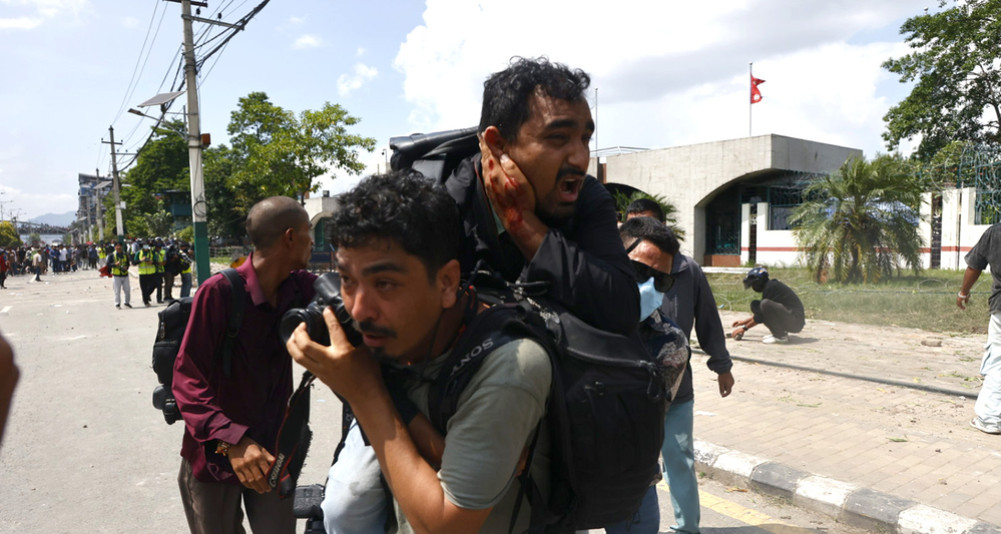
Monday, August 23. 2 pm. Emergency ward of Civil Hospital. Screams of pain, beds full of patients, injured people begging for life on the bloody floor. On the same floor was journalist Dipendra Dhungana, who was bleeding.
Who was stopping the blood from the neck with his hand and was asking, 'When will the X-ray be done, doctor?'. The X-ray that was done shortly after that showed - a bullet right below the ear. Dipendra was desperate. A fire of fear burned inside his heart - 'Now I might die.'
000
It was not certain at what time the protest would take place since Sunday evening. Some said 9 pm, some said 11 am. Still, Dipendra reached Maitighar at 8:30 am. 'People were slowly gathering. I stopped making bikes at the workshop right across from the protest site,' Dipendra recalls, 'The Gen-G movement is creative. I even kept my helmet in the same workshop so that it wouldn't be so scary.'
The national anthem and nationalist songs like Nepathya's 'Gaun Gaunbat Uth, Basti Bastibat Uth' echoed in the movement, which strengthened Dipendra's intention that the movement would be peaceful. The youth who had gathered in large numbers headed towards Baneshwor before 11 o'clock. Dipendra recorded their activities and moved forward. 'It was moving forward in a very peaceful manner. More people gathered than expected,' Dipendra recalled, recalling the behavior of some people after reaching the restricted area. 'After that, I started to feel like I should have brought helmets.'
But when he reached Baneshwor, the scene changed. 'Party workers were also seen in the movement,' he recalled. 'The anarchic youth who came as Gen-ji were deliberately inciting the crowd.' Dipendra also found the police's activities suspicious. 'The police would normally lathicharge during a normal stampede, but they didn't do it that day. They immediately fired water cannons. That too late. There was only one line of barricades. Why was there such poor preparation when they knew there would be a big movement?' The question keeps echoing in his mind, 'Did the police leave intentionally or did they give moral support?'
Even as the number increased, Dipendra had hoped that the state would exercise restraint on school students. But that didn't happen. The restricted area was breached around 11:30 am. The police started firing tear gas and rubber bullets. The situation became tense. Hundreds were injured. A young child was shot in the chest in front of Dipendra's eyes. Dipendra said, 'There was a bigger crowd than this during the MCC. The protesters were equally aggressive, but this time they opened fire on school students in such a way that I never thought it would happen.'
Shot while capturing the brutality
Dipendra, along with four or five photojournalists from his group, was hiding behind a pole and capturing the brutality of the state on camera. 'Umesh Bhai had asked, 'Dai, why didn't you wear a helmet?' We were chatting, and something seemed to hit him. It burned him. When my friends said, 'Oh, Dipendra got shot,' I was even more shocked. Blood started flowing,' he said, 'I tried to cover it up, and the wound was so bad that it was completely covered in acid. My friends put it on my shoulder and took me to the Civil Hospital.'
Before Dipendra reached the hospital, the hospital beds were filled with the injured who had been shot. Dipendra also laid his body on a corner of the bloody floor. The blood was flowing. The nurse came and bandaged it, but the bleeding did not stop. Over time, Dipendra's wound began to hurt. 'The pain in the injured area started to increase. They said I should have an X-ray, but after not having an X-ray for a long time, I called a doctor nearby and got an X-ray. When the doctor said I needed an operation immediately, I started to panic inside,' Dipendra said, recalling the fearful atmosphere, crying and screaming in the hospital. 'I had already given up on the hospital atmosphere. I felt like I had to leave this hospital. After some time, I went to Patan.'
Dipendra had been hit by two rubber bullets in the neck. He reached Patan Hospital in Lalitpur and underwent an operation. He did not regain consciousness for two days. 'There were two bullets just below his ear. If he had been slightly up or down, anything could have happened,' he said, thanking the doctor, 'They gave me a second life. Now they have told me to celebrate two birthdays.'
'Does the state not see journalists?'
Dipendra stayed in the hospital for almost a month. His treatment expenses were covered by the organization he worked for. On the sixth day of his hospital stay, some officials of the Federation of Nepali Journalists visited him. But the state still does not know that he was shot.
'A person who does journalism has become the Minister of Communications. But, he probably does not know that journalists have also been shot in the field,' he said angrily, 'The Minister of Communications does not know journalists. What does the state care about!'
On the sixth day of his admission, the Nepali Journalists Federation reached out to Dipendra and gave him 15,000 in the name of assistance. But the state has not even been able to give him an injured card. 'Free treatment for the injured. Who was distributing what cards? Isn't that for journalists?' he asks.
There is no responsible body
For Dipendra, who has been working in the field since the 2015 earthquake and taking pictures, journalism has now become not just a profession, but a struggle. 'Every time we go out into the field, there is no guarantee that we will return safely,' he said. 'We are in the middle of a fight. It doesn't matter who does what. Neither does he have a protective jacket, nor a helmet.'
Dipendra has seen the indifference of media houses towards his safety. 'International agencies provide training, change equipment.' However, Nepal's media houses could not provide PPE and sanitizers even during Covid. Journalists were beaten and burned to death during the Chaitra 15 movement. Is it the same in the Gen-G movement?' he asked. Dipendra believes that media houses should invest in counseling, training and safety equipment.
Dipendra feels that the federation should be responsible for the safety of journalists along with media houses. 'Shouldn't we learn from the Chaitra 15 incident? True support can only be achieved through a long-term security policy. The 15,000 rupees support was symbolic,' he says.
Dipendra's experience with mental health is even more painful. 'I was 'traumatized' when I took photos of burnt bodies during Covid. I couldn't sleep, I could only see the hospital and the burning bodies,' he said bitterly, 'This movement has also made many journalists depressed, they just can't say it .'
000
Another journalist who was shot on the same day is Shyam Shrestha . Shrestha, who works for Kantipur, left for the Parliament building around 12 noon on Monday with an assistant to report. The vehicle was stopped from moving forward from Tinkune Bridge . But they took the road inside and left for the Transport Department via the Cooperative Building. Students wearing school uniforms were shouting slogans in the Baneshwor area . He thought, 'Why did these school children come to the movement ?'
After seeing the students shouting slogans in the restricted area, Shrestha asked the police, 'Why did you leave people in the restricted area ?' The security personnel replied, 'Sir!, there is no order from above to stop .' After a while, when he reached the south gate of the parliament building, he saw a different scene. Some were breaking CCTV cameras, some were breaking the mesh and wire fences on the wall. Shrestha, who has more than 22 and a half years of reporting experience, had never seen such a young mass (crowd).
Shrestha says, 'The protesters were breaking the wall and moving towards the main entrance where the President and Prime Minister would enter. Then, despite lathi-charge and tear gas, the police were retreating. The protesters started entering by climbing over the mesh. There were barely 15-20 policemen inside, but the number of protesters had already reached more than a hundred.'
Journalist Shrestha was capturing all this on camera. He was confused about which footage to shoot. At that moment, a policeman came out of the parliament with a rifle. The policeman first fired in the air. Then a young man in the crowd was shot. The young man collapsed, writhing. Shyam hurriedly ran to get footage of the young man who had been shot. 'What kind of footage did that guy have? I took the risk to show the camera how badly he was wounded,' he says.
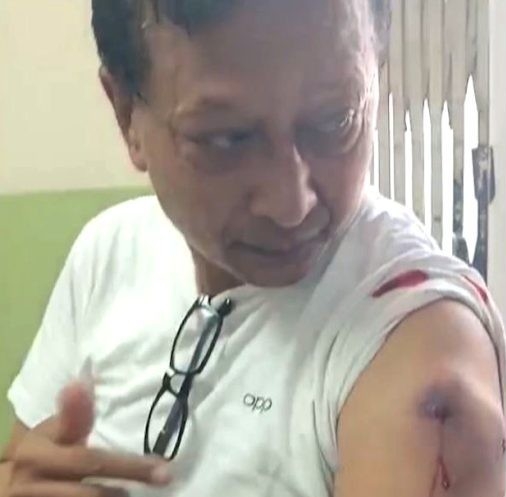
The young man who had been shot was bleeding. Some protesters were removing their shirts and covering their wounds. Journalist Shrestha captured all this on camera. Immediately, the firing started. He was trying to return to his old safe place. He remembers, 'At that moment, I felt something swat past me. A hand gave me a slight jolt on my left arm, and it almost killed me.'
After walking a little distance, he started to feel pain. Looking at this, blood was flowing. The youths around him shouted, 'Uncle has been shot.' Then Shrestha realized that he had been shot. The youths around him quickly lifted him up and took him to the Civil Hospital.
When he reached the Civil Hospital, the scene inside was like a battlefield. Noise, lack of doctors and nurses, and a crowd of two or three hundred injured people. Blood everywhere. The nurses were barely treating the young man who was cursing and expressing anger. His arm was dressed, an injection was given, and he was sent home with a tetanus shot.
The burning sensation of the workplace was greater than the pain of the wound.
The doctor and the office had told him to rest completely. He went home that day and rested. But during the protest on Bhadra 24, he could not sit still. He remembers, 'Suddenly there was a 'dang dang' explosion. Someone said a cylinder had exploded. But when he saw a big plume of smoke to the north, his mind stopped working. 'Kantipur has burned! Oh my God!' The smoke burned me more than my bullet wound.'
He hurriedly reached the Kantipur office in Tinkune wearing a t-shirt and half pants. When he reached there, almost everything was burnt. Everyone had scattered. He and some friends went to put out the fire.
He said, 'I went to put out the fire as best I could. But some youths were waiting outside the gate to light it again. The protesters also repeatedly entered and lit the fire that had already been extinguished. They tried to set fire to the studio and the engine. But brother, don't burn it. This house is burning, my personal vehicle has also burned. They were prevented from burning it because it is our private property.'
The constant lack of reporting
The protest of Bhadra 23 and the demonstration of 24 have not only left wounds on the journalist's body, but also left a deep bitter reality in his professional life. Organizations like the Nepali Journalists Federation and the Press Council met him and provided some support (financial assistance). The organization also paid for his treatment expenses. However, the disregard for the safety of journalists in reporting has troubled him.
Recounting his experience of reporting on the Gaza war, he says, 'Foreign media teams used to have a team of four or five people to hold the boom and carry the equipment. Their bullet-proof jackets and iron caps cost lakhs. But our situation is like this. There is no means of protection against ordinary rubber bullets.'
He says that it has been difficult to work in the field due to the recent anger towards the media. 'We are not even able to wear press jackets now. They chase us away as '12 brothers'. In such a situation, we are afraid to even reveal our identity.'