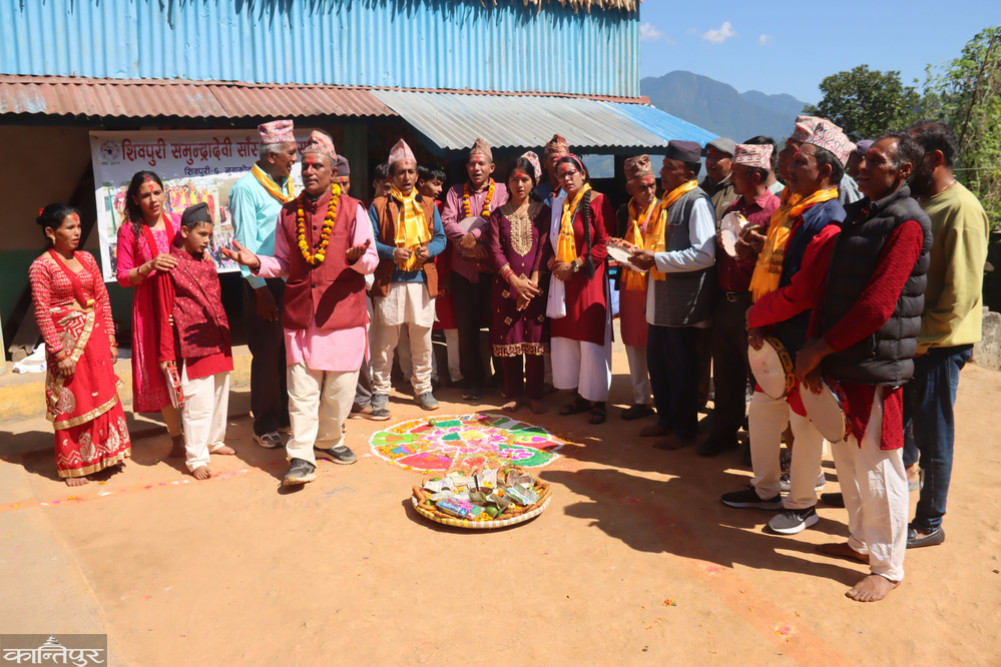
Although it is not an original festival, due to the recent diversity in settlement, the influence of media and social media, and inter-community mixing, the custom of wearing Bhaitika and playing Deusi-Bhailo on Tihar has begun to take hold in most communities.
We use Google Cloud Translation Services. Google requires we provide the following disclaimer relating to use of this service:
This service may contain translations powered by Google. Google disclaims all warranties related to the translations, expressed or implied, including any warranties of accuracy, reliability, and any implied warranties of merchantability, fitness for a particular purpose, and noninfringement.
Tihar, considered the festival of light, is celebrated in different ways according to the community. The main and last day of this festival, which is celebrated for five days as Yama Panchak, is Bhai Tika.
This festival, which begins with the worship of crows, dogs, cows, and oxen from Kartik Krishna Trayodashi and ends with Bhaitika on the day of Shulka Ditiya, is made even more joyful by the Laxmi Puja on the day of Aunsi.
Communities living from eastern Mechi to western Mahakali in Nepal celebrate Tihar in their own way. In most communities, it is customary for children and adults to enjoy the Deusi-Bhailo game that begins with Laxmi Puja. Some communities observe only the day of Laxmi Puja, while others play original games like Deusi-Bhailo in a different way. In most places, the traditional style of playing Deusi-Bhailo has changed.
Although it is not its original festival, due to the recent diversity in settlement, the influence of communication media and social media, and inter-community mixing, the custom of wearing Bhaitika and playing Deusi-Bhailo on Tihar has started to be adopted in most communities.
The Munda community living in Jhapa in the east has a custom of playing Dhausi on Tihar. Just as they start playing Bhaili from Lakshmi Puja, this community also worships ‘Lakhkhi’. On this day, every family worships their fields, cows, grains, and homes. The next day, after worshiping the cows on ‘Goriya Puja’ i.e. Hali Tihar, they gather to play Dhausi.
The Limbu community of Koshi Province celebrates Balihang Tangnam like Deusi-Bhailo on Tihar. They play like Deusi-Bhailo with one person playing, and the members of the group play like Deusi by saying Namlingek and Laringek.
On the other hand, in the Far West, especially during Tihar, it was customary for sisters to sing Bhaili in the Deuda dialect, remembering their brothers and sisters. In recent times, with the introduction of modern songs, the charm of Tihar, which shows the love between brothers and sisters who have migrated, has disappeared. The songs of Deusi-Bhailo, which were played by everyone in the village to reflect the importance of the relationship between brothers and sisters, are no longer heard.
Even the Tharu community, which did not give much importance to Tihar until a few years ago, now holds a Tihar festival. Although Tihar is not a big festival in the Tharu community, Laxmi Puja is celebrated as a special moment of the year. The Ranatharus, who live only in the western Terai, play Deusi-Bhailo and celebrate Bhai Tika with great importance.
In the mountainous villages of Karnali, including Mugu, Jumla, Kalikot, and Humla, Tihar is not in full swing. In those areas, there is a tradition of celebrating Puse Bhaili. The locals play Bhaili from the full moon of the month of Pus to Aunsi after completing the work of harvesting rice and planting barley. At that time, there is a tradition of going from house to house to collect rice, money, oil, salt, and pulses and having a feast.
According to Soru Rural Municipality Chairman Dharma Bahadur Shahi, there is no tradition of playing Bhaili during Tihar in the village. Deusi is played only in Puse Bhaili, and no instruments are played in it. Women wear cotton fariya and uchala, while men wear daurasuruwal and takhu kathana.
According to cultural experts, the importance of Tihar in Jumla and surrounding districts was low until the last decade. The only tradition of wearing dahi-rice tika during Bhai Tika was in recent years. The culture of Saptarangi tika and Deusibhailo has spread to the district headquarters.
Currently, Karnali people living in Kathmandu, Nepalgunj, and Surkhet have also spread the tradition of celebrating Puse Bhaili. They say that the original culture of Karnali is not Tihar, but Puse Bhaili.
Related news: