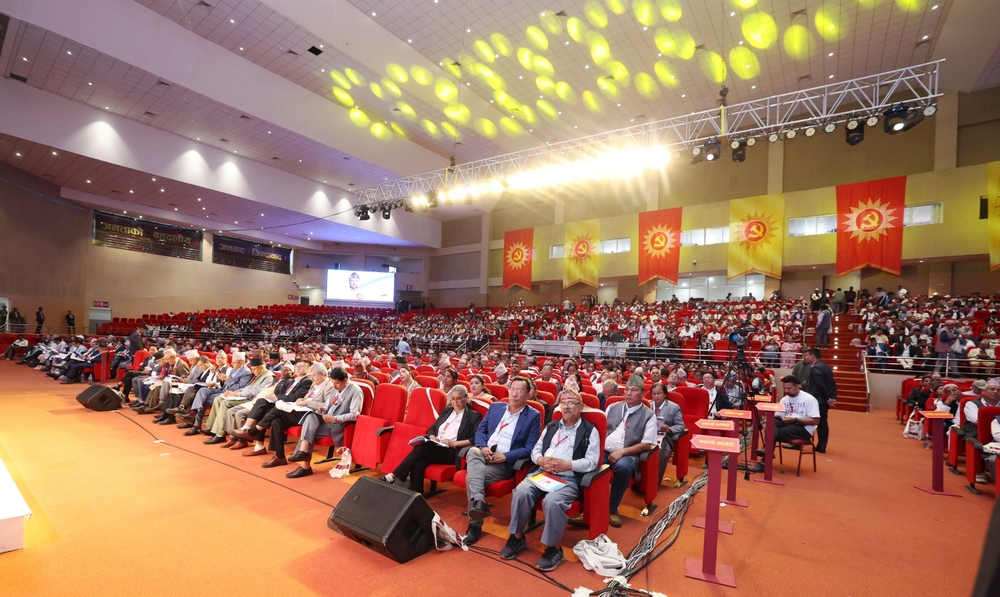
Oli was defeated in the 8th Congress held in 2065. But after his proposal was passed as a separate vote, UML was transformed into a multi-member collective leadership, this was considered a milestone in UML's internal democracy. But after a decade and a half, Oli himself stood against the same policy when he was the leader of the party.
We use Google Cloud Translation Services. Google requires we provide the following disclaimer relating to use of this service:
This service may contain translations powered by Google. Google disclaims all warranties related to the translations, expressed or implied, including any warranties of accuracy, reliability, and any implied warranties of merchantability, fitness for a particular purpose, and noninfringement.
In the seventh national convention of UML in January 2059 in Janakpur, then standing committee member KP Sharma Oli put forward a proposal regarding democratization of party life, but it could not be passed. When the then General Secretary Madhav Kumar Nepal rejected it, Oli had to postpone it. But he continued to do so.
After Oli's resolution on the democratization of party life was passed in the eighth congress held in Butwal in February 2065, the UML transformed into a multi-member collective leadership . This was considered a milestone in UML's internal democracy. Even when it came to the plan of establishment, Oli had a different opinion .
Standing committee member Karn Thapa registered a 30-page dissenting vote at the central office, the agenda mentioned that he would be allowed to speak for 10 minutes, but on Saturday he was suddenly removed from the agenda, demanding to be allowed to speak, he stood for about 30 minutes, but was not given time. It was decided to speak. In the agenda of the convention, it was mentioned that he would be allowed to speak for 10 minutes . But his speaking time was removed from the schedule on Saturday . He stood in his seat for about 30 minutes demanding to be allowed to speak, but time was not given. But when it came to the second legislative convention in Godavari of Lalitpur, Oli himself, who is the president of UML, has destroyed the system of democratization of the party that he had put forward. Although the central secretariat meeting on August 19 decided to allow the leaders who registered their dissenting votes to speak in the convention, it was banned on Saturday.
After he asked for time to speak, President Oli said it was postponed due to lack of time. He pledged to discuss different opinions in 10 groups formed to discuss political and organizational reports.
'I was not allowed to present a written dissenting opinion in the hall, it is being discussed in the group,' he says, 'Earlier, I was told to speak about my opinion in the convention hall.' He said that it was wrong not to allow Thapa to speak about the difference of opinion formally registered in the Legislative Assembly.
'If you look at the debate for the democratization of the party, it is a glorious history, it is a belief established by the UML that being a communist does not mean being a dictator,' he says, 'In the past, the party has a history of institutionalizing and discussing different opinions up to the lower committee.' "Different votes have been distributed among the groups, but the representatives did not show much interest in it," he says, "In all the groups, the president's political proposals, organizational proposals, and the legislative draft have been seriously discussed." Almost all the groups have taken the proposals in stride.'
The fifth Congress held in March 2049 of the then Male* introduced Madan Bhandari's policy of multi-party competition . CP Mainali, who put forward the new democracy proposal, was fired. At that time, the different documents of Bhandari and Mainali were printed by the party and debated in the floor committee.
In the sixth national convention held in Nepalgunj on 12-18 January 2054, the different opinion of the people's multi-party democracy strategy put by Oli was passed by majority . His vote was passed because there was an open debate about different opinions at that time .
In the eighth convention held in February 2065 in Butwal, although the resolution on internal democratization of the party was passed, he was defeated by Jhalnath Khanal . According to Oli's proposal, the party went to a multi-position system (Chairman, Vice-Chairman, General Secretary, Secretary). Leader Ghanshyam Bhusal submitted a different opinion that Nepali society has entered capitalism from feudalism, but it could not be passed. But the ninth convention held in June 2071 concluded that Bhusal's proposal was correct.
UML is under the leadership of Oli, who has gained power with different votes for about 15 years within the party. But the proposal of internal democratization established by him within the party has collapsed by the time of the second legislative convention.
In the secretariat meeting, Oli said, 'Officers should not hold different votes in the convention, the party is in trouble at the moment, contradictions will increase, different votes can be held in the secretariat, standing and central committee meetings.' Then senior vice-president Ishwar Pokharel, vice-presidents Yuvraj Gyawali and Surendra Pandey decided not to hold a different vote on the issue of suspending the membership of former president Bhandari. After Pokharel put a written dissenting vote, Oli asked the office bearers not to put a dissenting vote in the convention. He said, "Let's not hold different opinions in the congress. At the moment, the party is in trouble, the contradictions are increasing . Your dissenting opinion can be put in the secretariat, standing and central committee meeting.'
As Oli asked to focus on political, organizational, and legislation in the legislative convention, Senior Vice President Pokharel, Vice President Gyawali and Pandey came to the conclusion of not keeping their dissenting opinion on the suspension of former president Bhandari's membership in the convention. Since leader Thapa had already registered at the central office, the secretariat decided to allow him to speak. But on Saturday, he was stopped saying 'lack of time'.
He believes that the tendency to restrict questions about the leadership will damage the party in the long term. "If we don't allow a different opinion in the party, the discontent will burn like a fire," says Subadi . Political analyst Jhalak Subedi says that even though Oli raised the issue of age limit and polynomial for party democratization before the ninth convention, he is prohibiting it after the power is concentrated in himself . KP Oli raised the issue of internal democracy to gain power. It took 15 years for him to gain power by holding different opinions," says Subedi, "he is challenging the establishment by staying in different factions. When power comes into their hands, all the established values that they have built up are trampled. If you raise a challenge on yourself, it seems that it is about to end.''
ooo
The question of internal democracy was raised in the group discussion. They have suggested that the legislation should be made activist-oriented, saying that it is leader-oriented. The leaders also suggest that the constitution prepared by the
convention should not be changed by the convention that selects the leadership. They say that the political direction should hold the spirit of multi-party democracy and work in favor of the people while in the government. Even though the party is in the government, the issue of failing to do the work of the people has also been raised in the group. The representatives demanded that the responsibility of the party leader be limited to the appointment and focused only on getting benefits.
Even if there is a moral question about former president Bhandari coming/not coming into active politics, the representatives suggest that the law should not be misinterpreted in the name of stopping him. The representatives say that by removing the age limit for the transfer of party leadership and the provision that the same person cannot serve two terms, the possibility of transferring the leadership and getting responsibility according to the ability has ended . Central member Niraj Acharya says that there is an atmosphere in the group to openly share their views on the
report. "Representatives of all groups have an environment of open opinion on the report and legislation," he says, "There are many suggestions on the report." "There is an opinion that different opinions can be held within the party, internal democracy should be strengthened by respecting different opinions," he says, "Questions have also been raised about the membership dispute of the former president." "There have been suggestions that women's participation should be increased from 33 percent to 50 percent at the party levels," she says. Central member Vishnu Rizal says that there is a suggestion that a clear method should be made for the responsibilities, appointment and ticket distribution of the leaders in the
party. "It is suggested that a clear method is needed to get responsibility on the basis of merit, ability, and contribution," he said.
The leader Ushakiran Timsena informed that the practice of taking action should end when raising questions about the leadership. "Organized membership should not be revoked if there is a difference of opinion in the party, but there is an opinion that the membership should be removed after criminal charges," she said.
*Corrected.