Considering the condition of the food species and the habitat, conservationists say that around 500 tigers can still be managed in Nepal
We use Google Cloud Translation Services. Google requires we provide the following disclaimer relating to use of this service:
This service may contain translations powered by Google. Google disclaims all warranties related to the translations, expressed or implied, including any warranties of accuracy, reliability, and any implied warranties of merchantability, fitness for a particular purpose, and noninfringement.
In the national census of 2022, the number of tigers in Nepal is 355. In 2010, the heads of the countries where tigers were found in St. Petersburg, Russia, committed to double the number of tigers by 2022. At that time, the number of tigers in Nepal was 121.
Nepal has increased the number of tigers better than it promised. Conflicts are also increasing due to the fact that tigers sometimes attack the park and surrounding areas, killing people and taking away domestic animals. Regarding this issue, Prime Minister KP Sharma Oli's statement last year that 'tiger cannot be tamed by feeding people' was very popular. Prime Minister Oli made this statement in a program organized by the Ministry of Forests and Environment on January 11 for the review of COP-19. He said that the time has come to be careful not only in the forest but also in the village if there is a tiger. He said that there will be only 150 tigers in Nepal instead of 3500.
Even if Prime Minister Oli says that, looking at the condition of the food species and the habitat, conservationists say that around 500 tigers can still be managed in Nepal.
According to the 2022 count, there are 128 tigers in Chitwan National Park. Then there are 125 tigers in Bardia, 41 in Parsa, 25 in Banke and 36 in Shuklaphanta. In terms of availability of food species, experts say that about one and a half hundred tigers can still be managed. According to the study conducted by the National Parks and Wildlife Conservation Department, in terms of availability of food species, 394 tigers can be managed in Chitwan, 39 in Parsa, 133 in Bardia, 28 in Banke and 58 in Shuklaphanta.
'This is only in the park, apart from that, more tigers can be managed in the intermediate area, corridor and surrounding forest area,' Haribhadra Acharya, ecologist of the National Parks and Wildlife Conservation Department said, 'In terms of food and habitat, it seems that around one hundred tigers can be managed . Studies have not shown anywhere that conflict with humans will increase if tigers increase.
According to a study conducted in Chitwan-Parsa complex in 2019, the density of food species is 71 per square kilometer in Chitwan and 30 in Parsa. Similarly, the density of food species in Bardia and Banke is 69 and 25 respectively. Based on the national tiger census of 2022, it is found that the density of tiger species in Shuklaphanta is the highest in the country at 146 tigers per square kilometer.
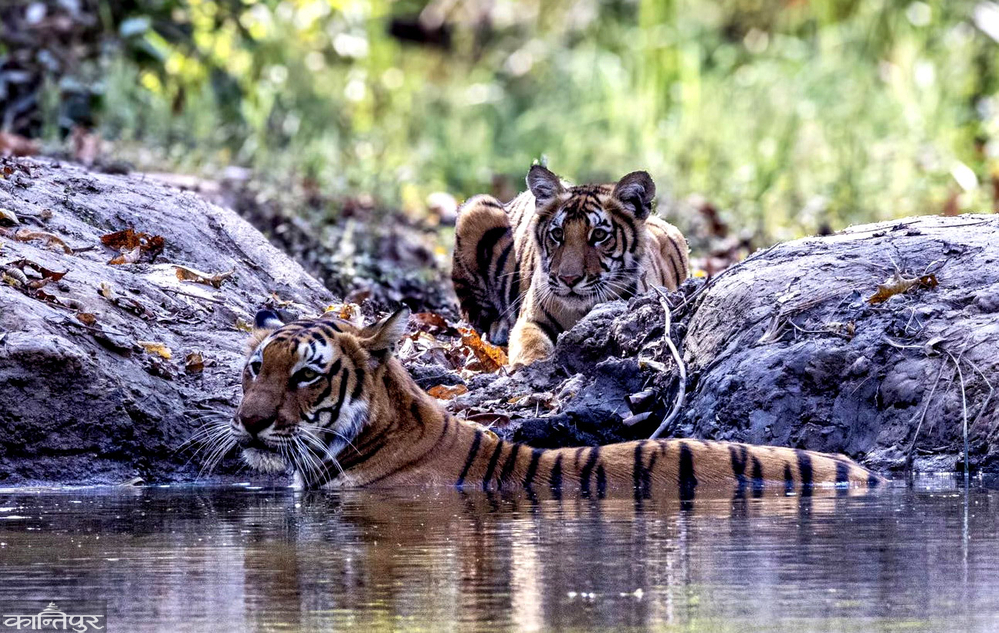
In recent times, tigers have been attacking people and entering some settlements. It is also said that the number of tigers has increased and there is a problem. But according to the study conducted in Chitwan, ecologist Acharya says that 75 percent of the cases of tiger attacks on humans are inside the forest. "Only three/four percent of tigers are problematic, they also have the risk of entering the slums, for this the management plan should be made accordingly." Similarly, a full-grown tiger can also reach the settlement while expanding its territory. He said that even a tiger that is injured for some reason can enter the settlement in search of easy prey.
tiger expert Dr. Baburam Lamichhane says that tigers are not facing any problem due to diet. He said that there is a problem when new born and old tigers go out of the park. In order for tigers to stay inside the park, their habitat should be managed. Some open and some grassy ground and some grassy ground that can be hidden should be made . There, tigers should also be able to hide and hunt," Lamichhane said.
000
In the last three years, the number of deaths due to tiger attacks is also decreasing. According to the data of the National Nature Conservation Fund, only 75 people have died due to tiger attacks in the last 7 years. In 081/82, 7 people died from tiger attacks .
10 people died in 080/81 and 12 in 2079/80 due to tiger attacks. Similarly, 21 people died in 2078/79 and 13 in 2077/78 due to tiger attacks. There are 8 deaths in 076/77 and 5 deaths due to tiger attacks in 075/76. Habitat protection and management, growth of edible species of wild animals, poaching control, expansion of national parks and the construction of wildlife corridors with India have helped in increasing the number of tigers. Naresh Subedi said .
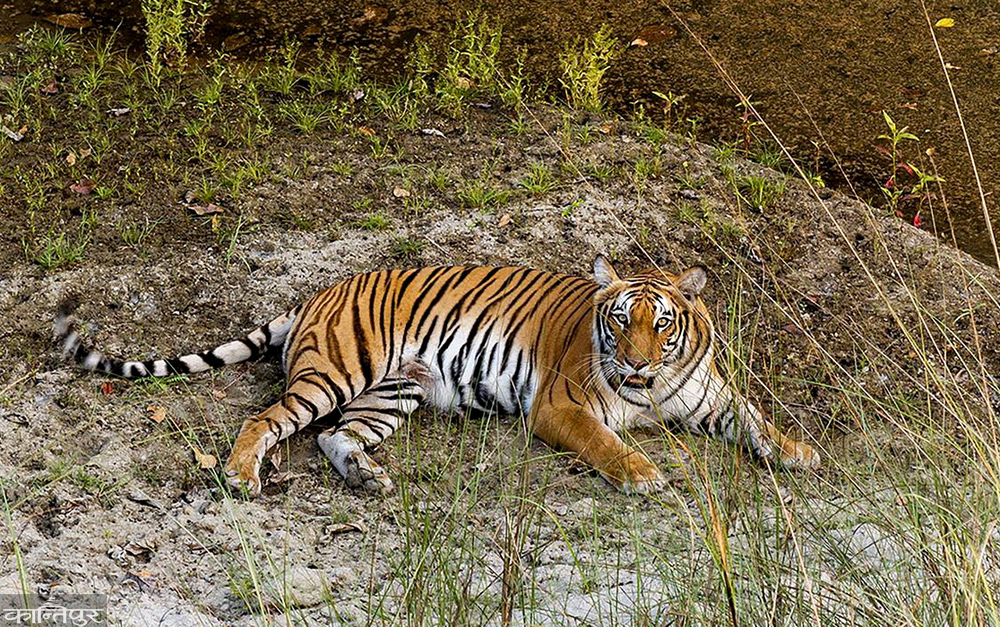
Although tigers have increased as expected, challenges have also been added along with opportunities. Now foreign tourists should be able to benefit by showing more tigers. There are also expensive tourists who spend a lot for tigers,' he said, 'by making a plan targeting them, from the local to the country, they should take advantage.'
000
In general, it is believed that a male tiger occupies 50 square kilometers and a female tiger 30 square kilometers as its habitat, but now it is completely different, said Ashok Ram, Warden of Bardia National Park. In Bardia Park, one tiger has a habitat of 7 to 8 square kilometers. Bardia National Park is spread over 968 square kilometers. There are 125 tigers here.
"The fact that three tigresses can live with one tiger is not compatible in principle," he said, "If other tigers and tigresses try to come and live in their habitat, there will be a fight." The old one does not want to leave its territory, but the one that is defeated in the battle has to find a new place for shelter and food.' Although one tiger can save two tigers, there are 10 tigers living in 10 square kilometers, including six tigers, three female tigers and one tiger. He says that it is necessary to study why so many tigers are living in a small area. "Earlier it was said that tigers live alone". Now that is not the case . It is seen that they are living in the family. It is necessary to investigate whether it is due to a change in the tiger's behavior or for some other reason,' says Warden Ram.
A tiger cub is equal to its mother in two years . After only two years, Damru leaves his mother and starts living in his own territory. If the female tiger is building her territory, the first fight is with the mother, if it is a male, with the father . If possible, they kill it, otherwise they drive it away and make their own territory. Again the driven out from there goes to another area . A tiger also lives there. Again, either he kills in the battle or he is replaced. In this way, when leaving the place, the tigers who lose the fight reach the edge of the park and eat the pet quadrupeds . By the time the tiger reaches there, it may become sick, old and infirm, Warden Ram says.
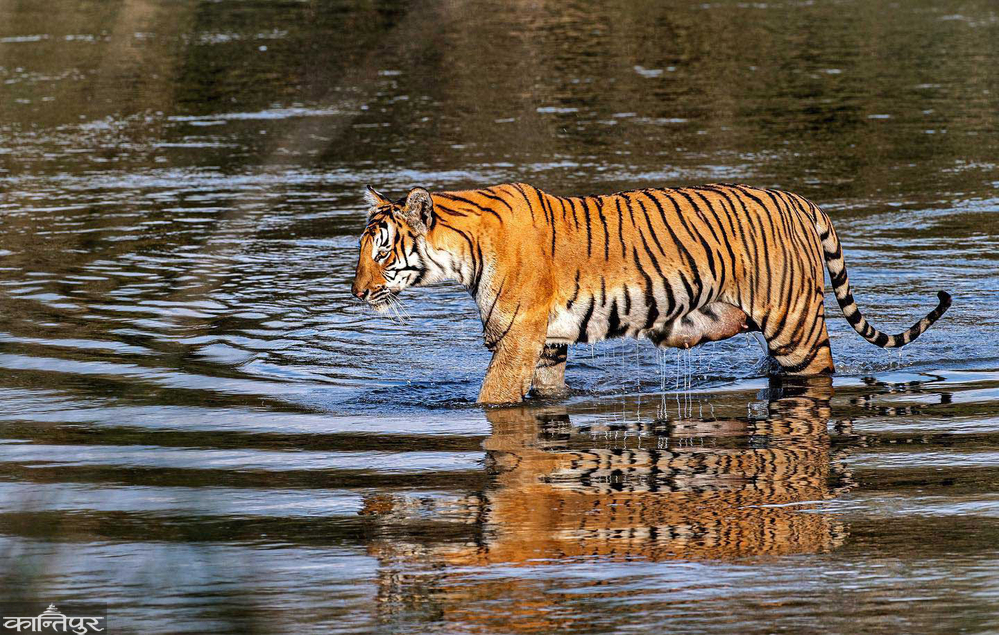
The tiger marks the boundary symbolically by scratching and urinating on the tree . Beyond that boundary, they do not even enter the boundaries of other tigers as much as possible. Baghini takes a lot of care and cleverness in raising damru .
With the increase in the number of tigers, their management, human-wildlife conflict reduction and habitat improvement have become a challenge. People in the central region have been attacked by tigers while going to cut grass, pick vegetables and graze cattle. In order to prevent human-wildlife conflict, the conservationists suggest that the communities around the forest should be given livelihood options without entering the forest, and a program should be started to change the habits of the locals to protect and love wildlife.
With the increase in the number of tigers, there are also incidents of human-wildlife conflict. Two years ago in Kanchanpur, a tiger from India's Dudhuwa National Park attacked a woman in Belauri and a woman in Dodhara Chandni was killed by a tiger from Pilibhit region of Uttar Pradesh. "With the increase in population, we should also focus on habitat and food management," said Purushottam Wagle, Conservation Officer of Shuklaphanta National Park, "Because the park is connected to India, there is also a conflict in the settlement due to the tigers coming from the protected areas there." He said that he used to raise children in sugarcane fields and attack people by entering settlements in search of prey.
(All photos: Chungba Sherpa)

