We use Google Cloud Translation Services. Google requires we provide the following disclaimer relating to use of this service:
This service may contain translations powered by Google. Google disclaims all warranties related to the translations, expressed or implied, including any warranties of accuracy, reliability, and any implied warranties of merchantability, fitness for a particular purpose, and noninfringement.
The investigative report on the plane crash of Solar Airlines last year inside Kathmandu Airport, which has facilities in the country, has revealed serious weaknesses in Nepali air safety. Although the report pointed to pilot error as the main cause of the accident, not bad weather, ship's engine or other technical problems, it showed various levels of negligence, inattention, and inaction.
After 18 people died in a plane crash of Solar Airlines from Tribhuvan International Airport on July 9, 2081 while flying to Pokhara, the government formed a five-member commission under the chairmanship of the former director general of the Civil Aviation Authority, Ratish Chandra Lal Suman. The final report submitted by the Commission to the Ministry of Culture, Tourism and Civil Aviation after almost a year has been released on Friday.
Samun Sasana, Chairman of the Commission of Inquiry, says that the Sourya Airlines plane crashed because the weaknesses were ignored. "It wasn't an accident due to an engine failure or hitting a hill in bad weather," he says, "It was an accident that shouldn't have happened." His conclusion is that the responsibility to be done in an emergency situation at the airport is limited to paper procedures only. "An accident happened in such a place that no one even guessed that such a thing would happen and was not practiced on such a slope." Of the 19 people on board, Captain Manishratna Shakya was the only one who was rescued alive. Shakya had 6,185 hours of flying experience.
The plane crash investigation report of Soorya Airlines has pointed out several issues that should be questioned about the flight safety of the airline operating domestic flights in Nepal. Moreover, there seems to be a lack of skilled manpower in the regulatory bodies. The recommendations suggested by the International Civil Aviation Organization (ICAO) also do not seem to be well followed. The government has not taken this matter seriously.
This incident has shown that the financial situation of the Solar Airlines Company is also a serious matter. The report of the commission has pointed out that due to lack of investment, human resources and technology have not been expanded. The report revealed that Sourya is hiring co-pilots on an hourly basis, not on a monthly salary.
Major cause of Sourya's ship accident: excessive 'pitch rate'
This accident has given a message to the government of Nepal, regulatory bodies and stakeholders, that is - large airport infrastructure, jet aircraft and heroic pilots alone do not ensure flight safety. To develop flight safety, flight safety should be developed as a culture from the lowest level to the top level of any organization. Whether it is a cargo flight or a return flight, every flight has to be strictly followed. Why is responsible for
?
1. Pilot's error
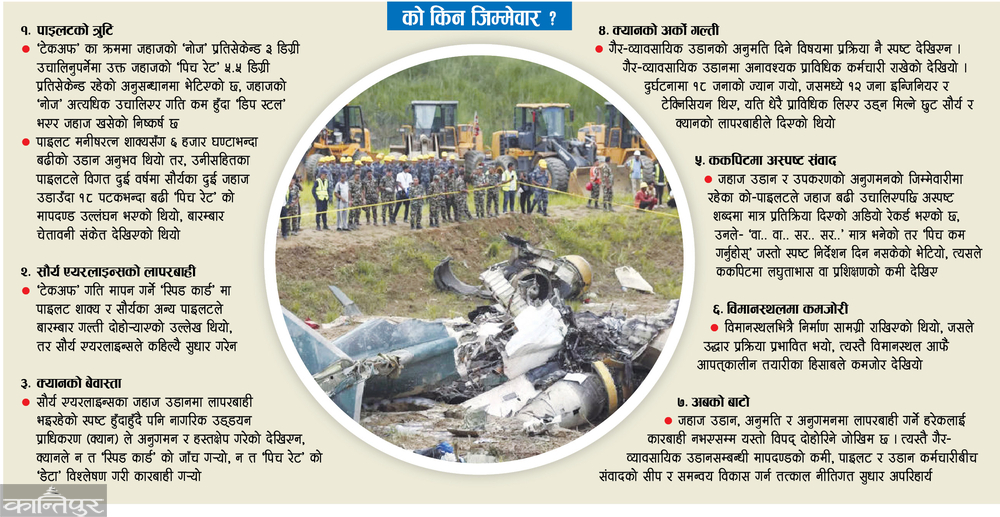
- As the ship's 'nose' had to be raised by 3 degrees per second during take-off, the research found that the ship's 'pitch rate' was 5.5 degrees per second, it was concluded that the ship fell due to a 'deep stall' when the speed of the ship's 'nose' was raised too much
- Pilot Manishratna Shakya had more than 6,000 hours of flight experience. In the last two years, the pilot with him had violated the 'pitch rate' standard more than 18 times when flying two solar ships, warning signals were repeatedly seen
2. Sourya Airlines negligence
- In the 'speed card' measuring 'takeoff' speed, it was mentioned that pilot Shakya and other pilots of Sourya repeatedly repeated the mistake, but Sourya Airlines never corrected
3. Can's negligence
- Although it is clear that the Solar Airlines flight is being negligent, the Civil Aviation Authority (CAN) did not monitor and intervene, CAN neither checked the 'speed card', nor analyzed the 'data' of the 'pitch rate' and took action
4. Another mistake of CAN's
- the process of allowing non-commercial flights was not clear. Unnecessary technical staffing was observed on non-commercial flights. 18 people died in the accident, 12 of them were engineers and technicians.
5. Unclear dialogue in the cockpit
- There was an audio recording of the co-pilot who was in charge of the flight and monitoring of the equipment only responding in vague words when the aircraft was raised too much, he only said - 'Wa.. Wa.. Sir.. Sir..' but it was found that he could not give clear instructions like 'Reduce the pitch', it showed lack of awareness or training in the cockpit
6. Weaknesses at the airport
- Construction materials were placed inside the airport, which affected the rescue process, and the airport itself appeared to be weak in terms of emergency preparedness.
7. The way forward
- Everyone who is negligent in ship operations, permits and monitoring is at risk of repeating such a disaster unless action is taken. Similarly, the lack of standards related to non-commercial flights, immediate policy reform is essential to develop communication skills and coordination between pilots and flight staff.
We found a record high 'pitch rate' of 18 times in two years during ship 'takeoff', that too in two CRJ aircraft of Solar. We came to know that by 'decoding' the data that was recorded in the flight data recorder (FDR) of that ship but was just downloaded without analysis. ICAO, the aviation regulatory body, has not mandated the FDR's 'data analysis' for ships weighing less than 27,000 kg. That is why the regulatory body of Nepal did not make it mandatory. ie not made binding. But there is no stopping today's airlines from going a step further than the regulatory body ICAO's standards. Like – Shree Airlines also flies CRJ aircraft. He not only 'downloads records' into his ships' FDRs, but also analyzes them. Analyzes the technical aspects that need to be improved.
 Sourya bought the equipment and brought it. But because he does not have its 'program', 'software' and 'manual', it has not been put into operation. We have recommended mandatory implementation of data analysis. The regulatory body of Nepal has said that when renewing the certificate of ships weighing less than 27,000 kg but more than 5,700 kg Twin Otter, only record of 'data download' should be required. Such data should be analyzed only if any investigation is required. But ships below 19 seats do not have FDR. Cockpit 'voice recorder' is mandatory in them. Why did only the paper process get priority in Surya Airlines, not safety? Why was the error in 'speed card' never corrected for years?
Every airline company has skilled manpower to look after its 'Safety Management System' (SMS). Quality Manager, Safety Manager, Operations Director, Chief Pilot etc. They should be accountable to all authorities. They have a number of 'manuals' on aviation operations approved by the Authority. They must work honestly, otherwise the authority can remove them from the post. Unfortunately, almost all the 'postholders' of Sourya were killed in this accident. Only the captain was rescued alive. It was seen that the regulatory body also failed to 'audit' how the airline was operating.
Where did the Civil Aviation Authority go wrong in this? Weakness or institutional negligence? Neither 'speed card' check, nor 'pitch rate' analysis, what did the regulatory body do?
Both the airline company and the regulatory body were at fault in this accident. There are posts of 'inspectors' in the authority to check the ships, pilots, technicians and engineers of every airline company but not enough. The European Union has also said this. As in the 'checklist', FDR should have been 'downloaded'. The examiner appointed by the authority only monitored what was on the 'checklist'. The regulatory body should reach beyond that. You can't always sit in the cockpit of all the planes at the airport and see how they are flown. However, sometimes checking, 'monitoring' is the job of 'inspector'. After Sourya's accident, the authority has dedicated an inspector at Kathmandu Airport. But the position is not kept. The authority does not have enough technical manpower. Even if there is, it seems that the capacity should be increased.
Why was the co-pilot silent in this accident? Is it due to fear or lack of training? Why could he not suggest serious and clear reforms?
In past incidents in Nepal, it has been seen that there is not a good combination when there are many senior and many junior pilots in the cockpit. Some accident studies have not considered this to be good, i.e. it is a 'gap'. There should be 'assertive communication' in the cockpit, i.e. if any error is happening or about to happen, the junior should speak positively. But there was no time to correct this incident. There was no room for 'correction' in just four seconds. Nor could he interfere with 'control'. However, the incident had gone out of control. Because a few decades ago, there was an accident in the plane of Nepal Airline Corporation due to a dispute related to the 'control' of two people.
Why are so many passengers kept on non-commercial flights? Was it a risk or negligence? There is no system to set limits on such flights?
ICAO, EU and other bodies have given different definitions for such a flight. It has become clear in this incident that there are more passengers than necessary.
When the ship takes off, the ship is stopped because people are coming again at the end. Because of own company's flight and staff, minor issues are ignored. The regulatory body of Nepal has not yet made a rule about how many passengers should be kept in the flight, 'test flight', 'positioning' flight. Even in the process of granting permission, it seems that sometimes the authority is delegated to the 'Air Ordnance' Division, sometimes to the Director General. Sourya's flight has been given permission by the department that issues regular flight permits for re-flights. He also did not follow the 'Operation Manual'. Nor has followed other flight related rules. A description is provided when asking for permission. A different description has been kept while flying. Consistency is not visible.
On the day of the accident, there was confusion in the rescue. A pile of construction materials obstructed the fire brigade at the accident site. Is this management negligence or not?
Kathmandu Airport has not yet been built according to ICAO standards. Its runway is said to be level up to 280 meters from the center line, but it doesn't look like this on the field. When inspecting the spot, the width of the 'runway strip' was only 150 meters. This is not enough. Emergency rescue drills are held at the airport every time, but due to lack of drills in difficult situations, it was difficult for the fire brigade to reach the place in the accident of Surya's plane. Construction materials were placed on the road. This is a serious matter. The 'fencing' inside and outside the airport should be a road where fire engines and ambulances can move easily.
Why is air safety reform being delayed? Laws, training, monitoring are all weak? Why is there no clear policy on non-commercial flights and technical document testing?
This time we have taken the help of American aviation experts. It is not that there is no improvement in the authority. But there is a shortage of manpower and efficiency. In the safety department of the regulatory body, even now, there is no skilled test pilot to monitor the pilot. Because there are better facilities outside. No one is attracted to being on the authority's salary. But improvements are being made.
Is the 18 times repeated mistake negligence or a complete failure of management?
We found 18 errors in two years. If we look at the 'data' before that, it can increase even more. This time, the Commission of Inquiry gave priority to the investigation of the humanitarian aspect. This topic is new in Nepal. At present, there is more weakness in the human aspect than in the technical aspect. To improve it, we have made various recommendations to Nepal government, authorities, operators and others. The report has been thorough.


