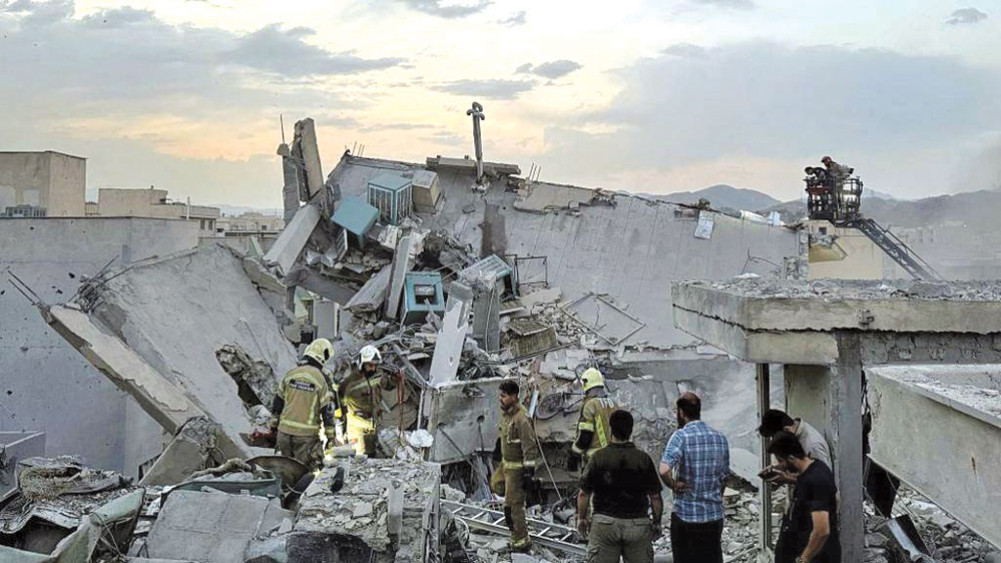
While the Russia-Ukraine, Israel-Hamas war is going on, Iran and Israel are also directly involved in a mutual war.
We use Google Cloud Translation Services. Google requires we provide the following disclaimer relating to use of this service:
This service may contain translations powered by Google. Google disclaims all warranties related to the translations, expressed or implied, including any warranties of accuracy, reliability, and any implied warranties of merchantability, fitness for a particular purpose, and noninfringement.
Tensions between the two countries have escalated after Israel carried out a massive air attack on Iran early on Friday. While the Russia-Ukraine, Israel-Hamas war is going on, if Iran and Israel are directly involved in a mutual war, the economic and political crisis for the world has increased.
According to the media, the head of the Iranian army, Mohammad Bagheri, the head of the Iranian Revolutionary Guards Corps, Hossein Salami, and senior commander Gholam Ali Rashid were killed in the attack by Israel on Friday. Six nuclear scientists were also killed in the attack on Iran's Natanz nuclear processing center. According to the Iranian news agency Tasnim, nuclear scientists Abdulhamid Minuchehr, Ahmadreza Zolfaghari, Seyed Amirhossein Fakhi, Mutalbizadeh, Mohammad Mehdi Tehranchi and Fareedun Abbasi were killed.
According to the Iranian side, more than 70 of its citizens have been killed by Israel's attack until Friday evening. The Israeli military claims that Iran's main nuclear processing plant has been destroyed. According to Al Jazeera, the Israeli military completed a series of attacks on Iran's surface-to-surface missile (SSM) system throughout the day on Friday.
The Israeli army claims that dozens of missiles, SSM storage sites and various military locations were destroyed. In return, Iran claims to have sent about 100 drones to Israel. According to Brigadier General Effie Defrin of the Israeli Defense Force (IDF), all the 'unmanned aerial vehicles' (UAVs) i.e. drones launched by Iran have been neutralized.
Iran's Supreme Leader Ayatollah Ali Khamenei responded that Israel should "expect severe punishment". According to the BBC, Khamenei says that Israel has committed a crime in Iran. "The Zionist (Judaist) rulers have prepared for themselves a bitter and painful misfortune through this crime, which they will surely suffer," the BBC wrote, quoting Khamenei.
Tehran University researcher Mohammad Islami told Al Jazeera that Iranian leaders are preparing for an immediate invasion of Israel. He said that Israel's military and nuclear infrastructure will be targeted in Pratyakranam. He has compared the Israel-Iran conflict with the Iran-Iraq war of 1980.
Various countries have expressed concern about Israel's air strikes on Iran. Some countries have criticized and there are countries that support it. US Secretary of State Marco Rubio responded that Friday's attack was a unilateral move by Israel. "Israel told us that today's attack is necessary for self-defense," he said, "We have now made the security of the American forces in the area a top priority."
Rubio also warned Iran not to attack its forces or other US locations. Some civilian staff at the US Embassy in Iran have been relocated. At the same time, American President Donald Trump has posted on his social media platform "Truth Social" and has given Iran 60 days to reach an agreement with him, but Iran has not accepted and threatened that there is still a second chance. He warned that if the agreement is not reached this time, there may be "more brutal" attacks.
Russia has condemned the Israeli move. Konstantin Kosachev, the deputy speaker of the upper house of Russia, said that if such attacks continue, the whole of West Asia will go to war. "Israel's actions seem unjustified from legal, political, military and moral points of view," he said. According to the Russian news agency "Tass", Kosachev says that Iran's patience is running out.
Lin Jian, the spokesperson of the Ministry of Foreign Affairs of China, urged all parties to exercise restraint and emphasized that the situation should not be allowed to escalate further. "China opposes the attack on Iran's sovereignty, integrity and national security," Jian said.
Saudi Arabia has strongly condemned the Israeli attack. "The Israeli attack against the Islamic Republic of Iran undermines its sovereignty and security, in clear violation of international laws and regulations," the Saudi Foreign Ministry said in a statement. Lebanon, Qatar and Turkey have criticized the Israeli move, saying it goes against international efforts to stabilize West Asia. Britain, France, Germany, Japan, Australia, Czech Republic spoke in favor of Israel. Germany says Israel has the right to defend itself.
United Nations Secretary General Antonio Guterres and others have condemned the Israeli attack and urged both sides to exercise restraint. UN Secretary General Guterres insists that if there is a war between the two countries, it will not only have a regional but also a global effect, so that any military attack should not be promoted. On the initiative of US President Trump, talks on the nuclear deal between the US and Iran were scheduled to take place in Oman on Sunday. The international media reported that Israel attacked on Friday with the suspicion of a nuclear agreement between the US and Iran. Israel was unhappy with the US-Iran talks that have been going on since last April regarding the nuclear program. Among this dissatisfaction is the analysis of BBC journalist Rafai Berg that Israel carried out a massive attack on Iran as 'Operation Rising Line' from 3 am on Friday morning. After the Israeli attack, there is no possibility of US-Iran talks.
Israel's Prime Minister Benjamin Netanyahu has been arguing that Iran has enough material to make 9 nuclear bombs and that it will endanger Israel's existence. Iran maintains that its nuclear program is for peaceful and civilian purposes. But the International Atomic Energy Agency (IAEA) and Western countries do not believe in it.
Israel says that Iran's nuclear program cannot be accepted under any circumstances. Israel accuses Iran's leaders of publicly thinking of removing Israel from the world map and expanding its nuclear program rapidly for that purpose. For this reason, Israel is considered to be the main target of attack on Natanz, Iran's main site where uranium is processed with great results. Israel damaged Iran's air defense system in a cyber attack last October. Before it could be rebuilt, Israel attacked again. Some have analyzed that the incident exposed Iran's weak military and defense system.
Israel-Iran strained relations
The ongoing direct-indirect conflict between Iran and Israel is based on decades of theoretical, geopolitical and strategic tensions. But when Israel was founded in 1948, Iran was among the countries that initially recognized it. Israel and Iran had good relations until the Islamic Revolution in 1979. Israel, which has fought with most Arab countries, had friendly relations with Iran, and Iran was considered the second home of the Jewish community outside of Israel.
Many Jews left Iran after the 1979 Islamic Revolution. After that revolution, the monarchy was removed and Iran became the Islamic Republic. Ayatollah Ruhollah Khamenei, who came to power as the country's supreme leader in the late 1970s, scrapped old agreements with Israel. He likened Israel to a "Zionist" state while supporting Palestinian rebels.
He embraced a strongly anti-Israel policy. Since then, both Iran and Israel have blamed each other for regional instability and conflict. Iran has been supporting anti-Israeli groups such as Hamas in Palestine, Hezbollah in Lebanon, Houthis in Yemen, and anti-Israeli rulers such as Syria's former dictator Bashar al-Assad.
In recent years, relations between the two countries have soured after Iran openly pursued its desire to give up nuclear weapons. Seeing a nuclear-armed Iran as a threat to its existence, Israel has engaged in espionage, underground operations and cyber attacks.
Officials involved in Iran's nuclear program have been attacked and even killed in some cases. In response, Iran has increased pressure on Israel by using its religious and regional influence to support indirect war and rebel attacks in countries that are connected to Israel and under its influence.
Tensions fueled by Israel-Hamas conflict
After Iran-backed Palestinian group Hamas attacked Israel on October 7, 2023, the two countries descended into direct conflict. Israel and other Western countries accused Iran of helping Hamas to obtain financial, weapons, training and necessary information for that attack. Iran has denied its involvement. Israel has extended its retaliation to Iran-backed militias in countries such as Syria, Lebanon, and Iraq, along with Palestine. By mid-2024, Israel had launched missiles and drones on Iran-backed and Iranian soil.
Iran escalated its attacks through anti-Israel organizations. Houthi rebels, mainly from Yemen, have repeatedly targeted Israeli and US ships transiting the Red Sea. In the 20 months since October 2023, there have been more than 8,000 attacks and counter-attacks between Israel and Iran or Iran-backed groups, according to the media. In terms of
war, Israel appears to be strong in terms of technology and resources. Iran is strong in terms of Muslim religious sentiment along with human resources and regional influence. Israel currently has 170,000 active and 465,000 reserve military forces, while Iran is estimated to have around 1 million active and reserve troops. Israel is believed to have 240 fighter jets, 600 fighter jets and state-of-the-art fighter jets such as the F-35. Israel is full of weapons and technology including the powerful Iron Dome, other missile defenses, artificial intelligence. He has more than 1,300 tanks and about 40,000 military vehicles.
Iran has 551 aircraft, 1,713 tanks and nearly 62,000 military vehicles, Al Jazeera has mentioned. Iran has 25 submarines and 7 frigates with more than 107 naval vessels. Israel has 62 naval vessels including 5 submarines and 7 corvettes. But the war will not be limited to two countries because the US, UK and European countries have been openly supporting Israel.
In the last few years, some countries in West Asia, including Turkey, can help Iran, which is close to Russia. Analysts estimate that Israel has 80-90 nuclear warheads, although it has not openly declared that it has nuclear weapons.
What will happen next?
Former US Secretary of State Hillary Clinton has said, "If there is a war between Israel and Iran, the map of the entire Middle East region will change along with borders, organizations and economies between countries." American political analyst and author Ian Bremer has stated that if such a war occurs, it will not only be regional but will affect the entire world.
Only on Friday, the stock markets of the world, including the US, were affected. Crude oil prices rose by around 7% to $73 a barrel, writes BBC business reporter Jonathan Joseph. An organization called RAND Corporation estimates that a one-year war between the two countries will cost about 12 trillion US dollars along with thousands of lives. (with agency help)