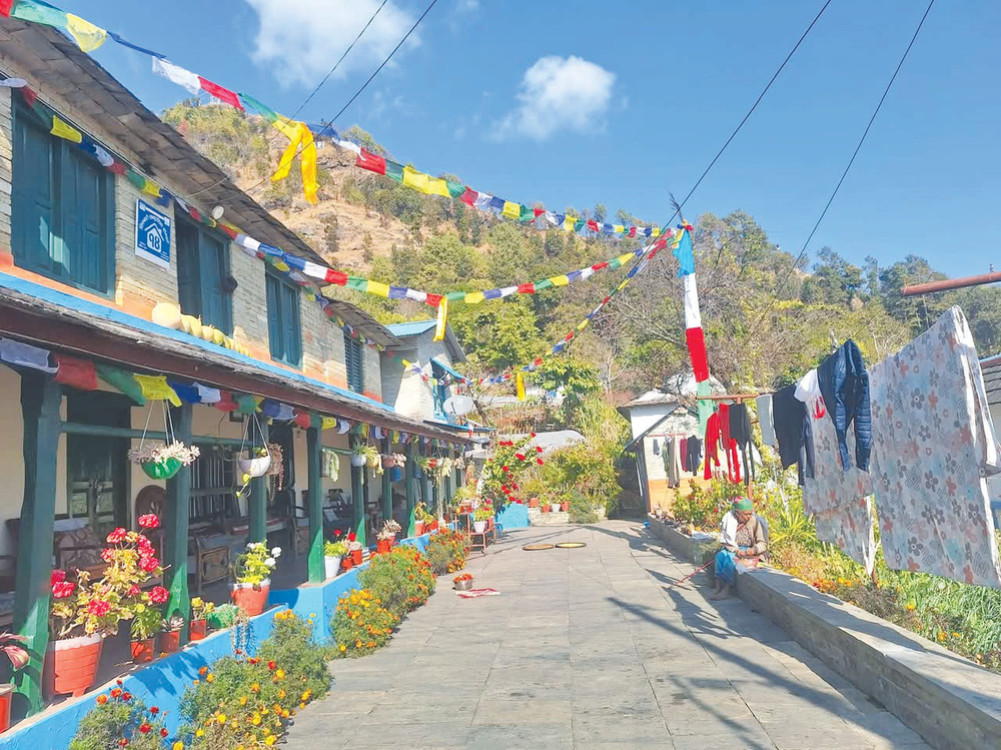
27 years ago, Rudraman Gurung laid the foundation of rural tourism by starting South Asia's first community homestay in Sirubari.
We use Google Cloud Translation Services. Google requires we provide the following disclaimer relating to use of this service:
This service may contain translations powered by Google. Google disclaims all warranties related to the translations, expressed or implied, including any warranties of accuracy, reliability, and any implied warranties of merchantability, fitness for a particular purpose, and noninfringement.
Sirubari village is at a distance of 23 km from Syangja headquarters. At an altitude of 1,610 meters above sea level, Sirubari is no different from the village of former British and Indian soldiers. Neat and tidy houses, toilets and drinking water facilities like in a developed city, clean and spacious stone paved streets.
Green hills and Gurung culture that entices the heart. On top of that, Sirubari of Andhikhola-1 is a beautiful place where you can see the attractive view of community forest, monastery, museum, Dhaulagiri, Annapurna, Machhapuchhre Himal.
The community homestay (Gharbas) was started 27 years ago in Sirubari of Gandaki province. Late Rudraman Gurung laid the foundation of rural tourism by starting South Asia's first community homestay in Sirubari.
Rudraman dreamed of establishing rural tourism from Sirubari as an employee of the Indian Army. But it took more than two decades for his dream to come true. Retired as a captain in the Indian Army, he was elected MP from Syangja-2 in 2048 and started to realize his homestay dream.
Under the leadership of Gurung, 35 out of 43 houses in the village were prepared for homestays and with the registration of the Tourism Development Management Committee Sirubari in the local administration, they started hosting guests from October 23, 2054. After the construction of the tourism house, the then prime minister Girija Prasad Koirala inaugurated the home stay during the village tourism festival in 2056.
homestay has an orderly room for guests, a comfortable bed or bed, white linen, clean vinegar-dishna, mirror, towel, and clean toilet and bathroom. The guest is initially welcomed with garlands along with Panchebaja . Soon after, an introductory program is conducted at the tourist home and taken to the homestay.
After a meal made from local ingredients, a traditional dance and song program including Ghatu, Sorthi, Salaijo, Jhyaure and Bhajan Chudka will be presented. Maize, mohi, millet bread, local wine, gundruk, local curry vegetables, local chicken meat and dhido are part of the tourist welcome.
Lately, free WiFi, solar electricity, CCTV cameras have been added to the homestays in Sirubari along with bathrooms with hot and cold water. But the number of houses associated with homestays has decreased to 20 . Especially the locals of Sirubari who are working in the British and Indian army have migrated to cities like Pokhara, Kathmandu.
One night package of 400 rupees 27 years ago has now reached 1400 rupees. But the welcome to the guests, the taste of the food and other facilities have not changed .
Even though Sirubari Gurung is a majority village, nearby Dalits and other communities also belong to it. Although the role of the Gurung community is basically in the management of the homestay, the presence and role of the Dalit community is strong in cultural programs, art and entertainment. Others have learned from Sirubari to end caste discrimination and inequality.
The homestay culture that started in Sirubari has now spread across the country. Lately Sirubari has also developed as a research and training center for homestays. The number of visitors from different parts of the country to get information about various aspects of homestay operation and management is also significant.
According to government data, there are currently 1,200 community homestays operating across the country. Suraj Bastola, the treasurer of the Homestay Federation, says that around 300 more private homestays are operating.
Along with Sirubari, Lamjung's Ghalegaon Kaski's Lwang and Kalabang Gharedi, Parbat's Chitre, Tanahun's Kaulepani, Bandipur and Tanahunsur and East Nawalparasi's Amaltari and Piparhar are Chalti's homestays in Gandaki province. Out of these, only Sirubari, Kaulepani and Piparhar are operating according to the community concept, said Dhaniram Guru, president of the Homestay Federation of Gandaki. "Other homestays do not understand the meaning of community homestays, due to which they are keeping arbitrary guests and not following the standards," he said.
332 community homestays are operating in 11 districts of Gandaki province. Bastola says that more than 600 homestays are operating informally. "The order of opening more homestays in different places is increasing," Guru said.
Only 13 years after the start of Sirubari Homestay, the government introduced the 'Homestay Operation Procedure' in 2067. In the procedure, the necessary standards and minimum infrastructure for homestays have been specified . According to which, it is mentioned that community homestay can be brought into operation with the involvement of at least 5 original house owners . Gandaki Province has set a minimum of 10 houses for community homestays.
Guru says that due to the lack of necessary monitoring and action and the local level issuing and renewing operating permits, some places do not comply with the standards according to the procedure . District Tourism and Industry Office has started monitoring in Gandaki Province after the local government neglected to monitor and take action. But he said that the monitoring is also not practical and effective.
The state government has also invested directly in some community homestays. But the government does not have the data of how many locals have benefited from those homestays.