The student leader who led the movement last August has been demanding a political ban on Hasina's party, but Yunus has said that his interim government ”does not want to take any decision on political parties”.
We use Google Cloud Translation Services. Google requires we provide the following disclaimer relating to use of this service:
This service may contain translations powered by Google. Google disclaims all warranties related to the translations, expressed or implied, including any warranties of accuracy, reliability, and any implied warranties of merchantability, fitness for a particular purpose, and noninfringement.
It has been four months since Bangladesh's former Prime Minister Sheikh Hasina fled the country. Hasina, who ruled Bangladesh for 15 consecutive years, fled the country on August 5 after the anti-reservation movement broke out. In July and August, when the anti-reservation protests intensified, Hasina's government severely suppressed the protestors.
At least 400 people were killed during the protest. A nationwide curfew was issued after the student-led protests escalated. But after the students disobeyed it and intensified the movement, Hasina resigned as the Prime Minister after a discussion with the heads of the security agencies.
After angry mobs of protesting students surrounded the auditorium, security chiefs ruled out the use of force because of the risk of bloodshed. Apart from that, Hasina was forced to leave the country after other family members suggested not to use force.
Hasina was escorted by the army from the Prime Minister's residence Ganabhavan to the airport. Soon after, Hasina, who reached India by military ship, landed at the Indian Air Force Airport in Hindon, Ghaziabad. After being kept there for two days, he was taken to a 'safe house' in New Delhi. It was said that Hasina would stay in India for a few days and then leave for Britain. Indian media reported that he planned to seek asylum in Britain or the Middle East. But even for four months after leaving the country, she is living in exile in India.
Hasina, who was in the limelight for a few days after leaving the country, is now anonymous. According to the latest news published in the Indian media, Hasina is currently in India. But the Indian government has not officially mentioned anything about the location of Hasina. Indian Foreign Minister S. Jaishankar, while speaking in Parliament last August, said that Hasina had requested permission to come to India for the time being and was granted permission.
Earlier, "The Print" requested information about his situation, but the Ministry of Foreign Affairs said that it was not given. He is currently said to be in the high-security 'The Lutyens' bungalow area'. There is a tight security system in the area, where Indian parliamentarians and high-ranking officials reside.
It is said that Hasina is being protected round the clock by security personnel in plain clothes. Hasina is said to be there with her daughter Saima Wazed. Saima is the Regional Director of the World Health Organization's South-East Asia Region. Indian media have also mentioned that Hasina sometimes walks with her friends in Lodhi Gardens in New Delhi. But when he came out of the safe house, he was closely monitored by security personnel.
Hasina had earlier taken refuge in India in 1975. When Hasina's father Sheikh Mujibur Rahman, who was the President of Bangladesh at the time, along with her family members were killed, Hasina and her sister Sheikh Rehana managed to survive because they were in Europe.
They were then in West Germany and took refuge in the residence of the Bangladeshi ambassador. Later, Hasina and Rehana took political asylum in India by contacting former Indian Prime Minister Indira Gandhi, who helped for the independence of Bangladesh.
After 6 years in 1981, President Ziaur Rahman allowed them to return to the country. Hasina, who joined the Awami League party founded by her father, was the Prime Minister from 2009 until last August.
Various cases have been filed against Hasina and her cabinet members at the Internal Criminal Tribunal of Bangladesh (ICT-BD).
ICT-BD has also issued arrest warrants against Hasina and 45 other people including senior leaders of her party Awami League. According to local media, more than 60 complaints of genocide and crimes against humanity have been filed against Hasina and other Awami League leaders.
Bangladesh's interim government has made an informal call for Hasina's extradition. Similarly, the Interim Government of Bangladesh has also written to Interpol to issue a 'Red Corner Notice' against him. Dhaka has also revoked Hasina's diplomatic passport.
Bangladesh's interim government wants to prosecute Hasina at the International Criminal Court (ICC). According to the media of Bangladesh, the chief advisor of the government, Muhammad Yunus, has stated that he is ready to be prosecuted for 'crimes against humanity'.
"Interim government's chief advisor Yunus has discussed with ICC prosecutor Karim A. Khan about prosecuting Hasina," an official from Yunus's press secretariat said a few days ago.
According to the official, in the meeting with Karim, Yunus discussed the issues of Hasina's allies during the 15-year rule and the repression of the protests in July and August.
Similarly, the committee formed by Chief Advisor Yunus has concluded that huge amount of money was embezzled in Bangladesh during the reign of former Prime Minister Hasina. The conclusion of the committee led by economist Devpriya Bhattacharya is that during the 15-year rule of Hasina, an average of 16 billion dollars was illegally taken out of the country annually.
Hasina has accused Yunus, the chief adviser of the interim government, of mass murder. Hasina has accused Yunus of oppressing the minorities of Bangladesh. Addressing the program of her party Awami League held in New York, Hasina said that Yunus was responsible for attacks on religious places including temples, churches and ISKCON.
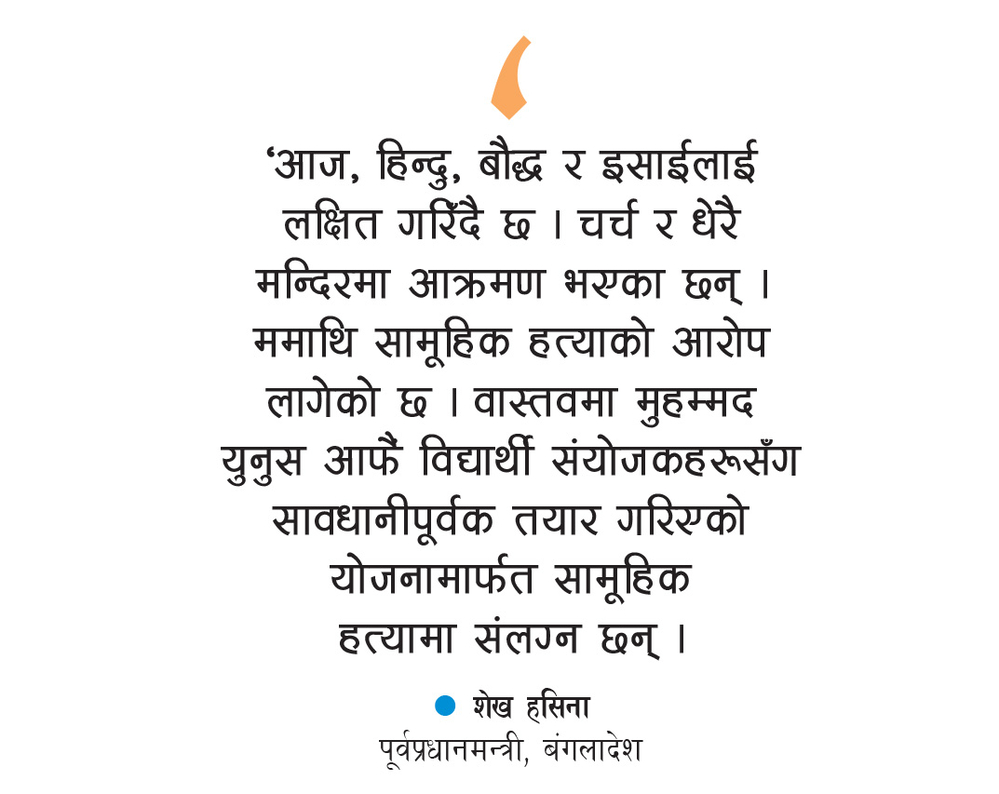
'Today, teachers and police have all been attacked and killed. Hindus, Buddhists and Christians are being targeted. Churches and many temples have been attacked. Why are minorities being targeted in Bangladesh now?' Hasina said in her speech, 'Today I have been accused of mass murder. In fact, Muhammad Yunus himself is involved in the mass murder through a carefully prepared plan with the student coordinators. They are the masterminds.'
Bangladesh Nationalist Party leader and former Prime Minister Khaleda Zia's son, Tariq Rehman, who is in the UK, also said that the government would not survive if the series of killings and violence continued in the country, Hasina said. Last week, the police arrested three monks in Dhaka, the capital of Bangladesh.
Hasina has claimed that there was a plan to kill her like her father and Bangabandhu Sheikh Mujibur Rahman. He says that he left the country because he did not want 'genocide' in Bangladesh.
'There was a plan to kill the father of our nation who was killed on August 15, 1975. It was about 25-30 minutes. But I told my security personnel not to fire," Hasina said while addressing the party members, "If I wanted to stay in power, there would have been a massacre. But I don't want genocide. If my security personnel had opened fire, many people would have died in the Ganabhavan. I didn't want that and left.'
In an interview with the Bangladeshi newspaper "Prothom Alo" last October, Yunus, the chief adviser of the interim government, admitted that there is a disturbance in basic things like law and order in Bangladesh.
Bangladesh's minorities, who were never completely safe, have become more vulnerable and vulnerable since the fall of Hasina's government. There have been reports of violence against Buddhist and tribal groups.
Hindus in particular are said to have been further persecuted because they were seen as supporters of Hasina's secular Awami League party. Although it is unclear whether the Yunus-led interim government is autocratic or not, there has been an increase in violence against political and religious opponents and street violence in Bangladesh since the fall of Hasina.
Along with this, a big question has arisen in the politics of Bangladesh recently about elections. The question has started to arise whether the interim government of Yunus is comfortable in the role of holding elections.
Last September, 'Prothom Alo' published news that the main opposition Bangladesh Nationalist Party (BNP) was unwilling to wait long for elections before Hasina's downfall. BNP had suggested a period of about 18 months stating that 'the interim government can make the necessary reforms in a short time and hold elections'.
But lately, the interim government is under pressure to ban Awami League from contesting the upcoming elections. The student leaders who led the agitation last July/August have been calling for a political ban on the Awami League. But last November, Yunus said that his interim government did not want to make a decision on 'political parties'.
But in response, the student leaders who supported Yunus have warned of a "second phase of agitation" if their demands are not met. Because of this, currently Yunus and other political parties are seen wanting to tread cautiously on the question of the future of Awami League in Bangladesh.
But the majority of Bangladeshis in the country and in the diaspora are said to be in favor of the Yunus-led government's need to save the country from Hasina and her dictatorial regime and to establish political and economic stability in the country.
(with the help of agencies)

