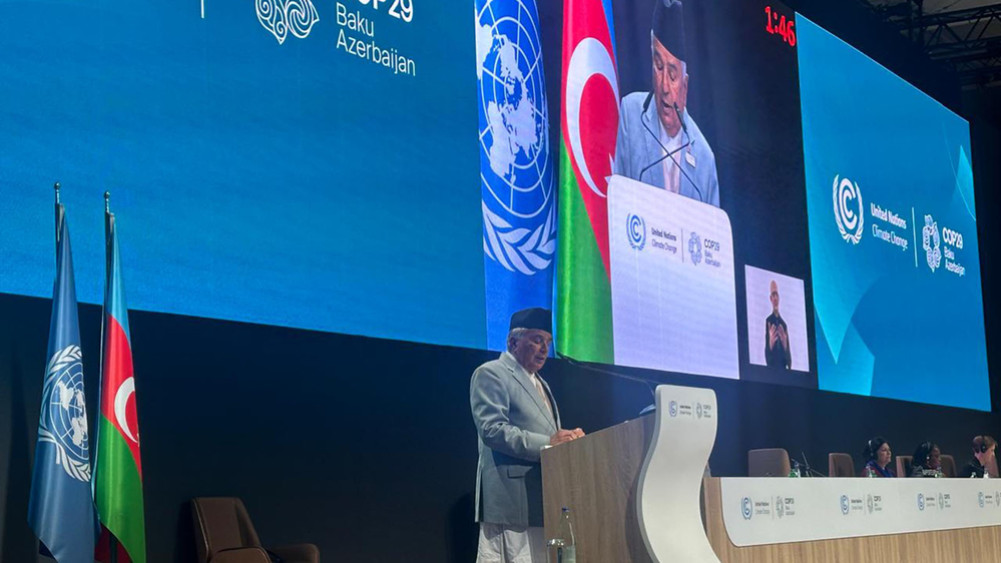
”The huge resources spent on ammunition should be used to save human civilization while minimizing the negative effects of climate change.”
We use Google Cloud Translation Services. Google requires we provide the following disclaimer relating to use of this service:
This service may contain translations powered by Google. Google disclaims all warranties related to the translations, expressed or implied, including any warranties of accuracy, reliability, and any implied warranties of merchantability, fitness for a particular purpose, and noninfringement.
President Ramchandra Paudel has called upon the world community to take care that the security of the mountains is the security of the earth.
At the 29th Conference of Parties to the United Nations Framework Convention on Climate Change (COP-29) in Baku, the capital of Azerbaijan, President Paudel drew the attention of the world community by presenting Nepal's agenda at the high-level session of the world leaders.
Let us all take care that the protection of the mountains is the protection of the earth, the world should not forget that the process of turning the white mountains into black mountains will not only lead to the crisis in those countries but also the low-lying coastal countries He also proposed in COP-29 to make the concept of collective adaptation a subject of formal dialogue. He also informed the world community that Nepal is going to conduct the Everest dialogue program based on this concept.
The President made it clear that he came to participate in this conference with the voice of climate justice and compensation. "The huge resources spent on ammunition should be used to save human civilization while minimizing the negative effects of climate change." He clarified that especially poor, underdeveloped, developing and small island countries are more affected by its pain. "Nepal is going through a paradoxical situation of having negligible carbon emissions but having to suffer extensive negative effects," he said.
He said that Nepal is still suffering from climate-related disasters. President Paudel mentioned that hundreds of people have died and material damage of billions has been caused due to the recent floods, landslides and avalanche eruptions and the recovery and restoration has not been done yet.
'For the benefit of the world community and the protection of the earth, Nepal is implementing an ambitious NDC plan to reduce carbon emissions while maintaining discipline in the use of natural resources, increasing the forest area, emphasizing clean energy production and supply and many other efforts have been made,' he said. said Compared to the
effort, the impact of climate change is extensive, so there are many challenges and Nepal's ability to cope with it is clear. "For climate adaptation and emission reduction, we have had to cut the budget allocated for poverty alleviation. This has made us more unjust. For this, the principle that polluters should pay compensation for pollution should be implemented in practice as well as emission reduction," said President Paudel.
He complained that the amount announced in the climate finance fund was insufficient and the same amount was not collected. "It is a sad matter that the amount collected is not easily accessible to the target community due to the complicated process," he said.
He also called for the speedy operation of the Harm Damage Fund, which was established to give to the developing countries that are at risk of climate. "I want to emphasize on the evaluation and payment of the contribution of countries like Nepal that contribute to the protection of mountains, clean water and biological diversity," he said.
President Paudele emphasized that it would be appropriate to run the program through the state fund as a subsidy. "According to the binding provisions of the Paris Agreement and the commitments of developed countries, sufficient grant funds should be provided for technology transfer and capacity development," he said.
He said that new common quantitative goals of climate finance should be determined based on climate justice, equity and capacity. He expressed his belief that the conference will make a firm commitment to limit the increase in the average temperature of the earth to 1.5 degrees Celsius and to ensure climate justice and sustainable development for mountainous and underdeveloped countries. In that session, President of Azerbaijan Ilham Aliyev welcomed all the participants in Baku. United Nations Secretary General Antonio Guterres and other Heads of State and Government of different countries of the world addressed and urged everyone to invest in the field of climate change.