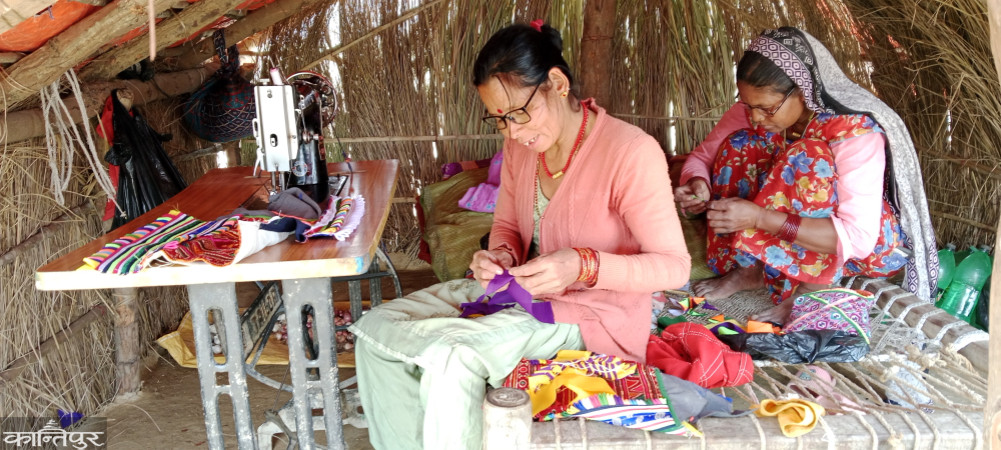
In the past, the traditional clothes worn by Ranatharu women were sewn by hand. But now there are very few women who sew by hand.
We use Google Cloud Translation Services. Google requires we provide the following disclaimer relating to use of this service:
This service may contain translations powered by Google. Google disclaims all warranties related to the translations, expressed or implied, including any warranties of accuracy, reliability, and any implied warranties of merchantability, fitness for a particular purpose, and noninfringement.
Doda riverbed at Khalla Jain in Laljhadi rural municipality-4. Cultivation of gourds, cucumbers, parsley and melons around. In the middle of the bugger is a trap. Mantura Rana, who went to the hill under the same camp, is busy with the sewing machine.
Ghari Lahe goes out to take care of Vegeta. Ghari goes inside and sews clothes on the machine. 46-year-old Manthura is engaged in sewing traditional clothes of the Ranatharu community. She looks busy sewing traditional clothes along with taking care of the vegetables planted in the bagger.
She prepares clothes such as angia (choli), ghagaria, uniya (chunni) to be worn by the Ranatharu community. In this, you should work on those clothes with flower-like frills, attractive designs, etc. "It takes a month and a half to prepare a set," Rana said, "We take 6/7 thousand of that." According to her, it costs more than 15 thousand including clothes. This has made it very easy for him to manage his household expenses.
In the past, the traditional clothes worn by Ranatharu women were sewn by hand. After the farm work, the women used to sleep at home. But now there are very few women who sew it by hand. It also takes a lot of time. That's why she started sewing by machine, says Mantura. Even today, Ranatharu women rarely wear traditional clothes. In rural areas, only old women are seen in this dress. However, in various types of fairs including festivals and weddings, from the new generation to the elderly, they are seen in traditional dresses. Rana says that they sewed this dress for this purpose.
Mantura herself rarely wears traditional clothes. She wears Kurtasuruwal while working at home or working in the fields. From fairs to weddings and festivals, she also wears traditional clothes like others. Until a few years ago, Mantura also sewed her traditional clothes by hand. She has learned from her mother and grandmother since childhood. She also learned while helping her mother and grandmother. This skill learned as a child has now made him self-employed.
Rana, who has gone to the mountains, is also skilled in making original dresses of her community like Mantura. She also learned to sew by hand from her mother and grandmother. But now it takes a lot of time to sew by hand. That's why she started sewing with a machine, she said. She sews 8/10 sets of dresses a year, that too with the help of family members.
The material required to sew this dress, from the fabric to the fabric, is not available in the local market. Mahendranagar, Dhangadhi and Basahi in India should be reached. It is also found in Belauri market in small quantities. According to the traveler, sometimes the work stops without getting the goods. She said that stars, woolen thread, different colored cloths are needed to prepare the costume. She said that because of the investment and effort, sewing is more expensive. The residence of the Ranatharu community is only in Kailali and Kanchanpur in the far west.