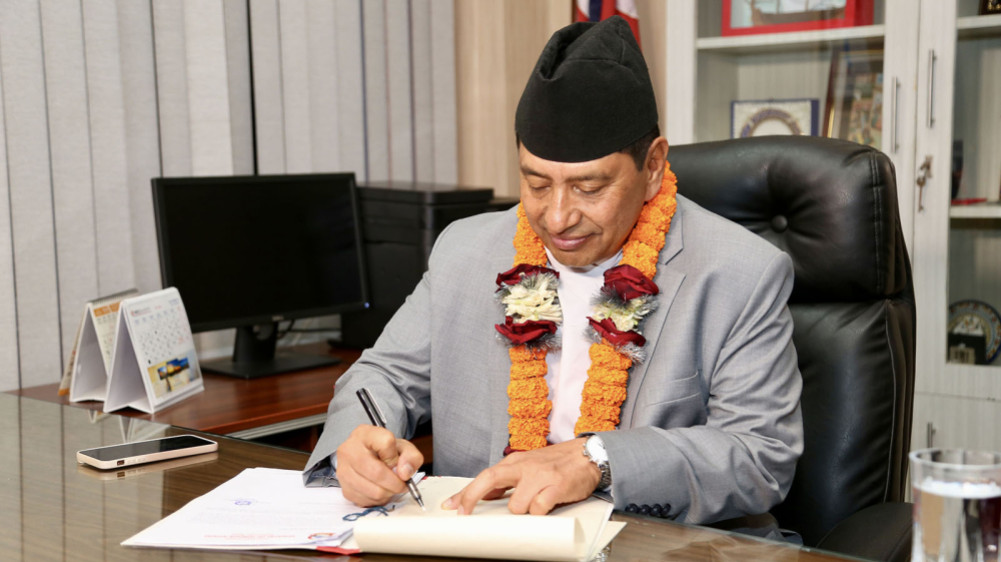
Deputy Prime Minister Shrepth became the Foreign Minister for the first time in 2068. After 12 years, when he comes to take responsibility in the same ministry, the same challenges as in the past remain.
We use Google Cloud Translation Services. Google requires we provide the following disclaimer relating to use of this service:
This service may contain translations powered by Google. Google disclaims all warranties related to the translations, expressed or implied, including any warranties of accuracy, reliability, and any implied warranties of merchantability, fitness for a particular purpose, and noninfringement.
After the formation of the new alliance, Narayankaji Shrestha has transferred from his home to the Ministry of Foreign Affairs. Deputy Prime Minister Shrepth became the Foreign Minister for the first time in 2068. After 12 years, when he comes to take responsibility in the same ministry, the same challenges as in the past remain.
In the case of Nepal, his first priority will be to cooperate with the two neighbors North and South and the American-led Western world with trust. Lately, there is a discussion of 'Delhi and Beijing' in Nepal's power change.
In such a situation, Deputy Prime Minister Shrestha, who is well-versed in foreign affairs, may be interested in how Prime Minister Pushpa Kamal Dahal will advance foreign policy according to "Nepal adopts a balanced foreign policy".
UML, the main partner of the new power alliance, the head of the foreign affairs department, Rajan Bhattarai, commented that the old alliance has raised suspicions when conducting Nepal's foreign policy. "Whether that suspicion has increased because of some decisions and positions we have taken, or because of some activities here, or because of the indifference we have shown on the program agreements made externally," he said, "this foreign relationship should be conducted by resolving all these suspicions. . The neighborhood is our priority. Foreign policy should be advanced by gaining an atmosphere of trust with neighboring and friendly countries.'
As Bhattarai said, Deputy Prime Minister and Foreign Minister Shrestha should remove the atmosphere of suspicion in relations with both neighbors and other friendly countries including America. The challenge is . The responsibility of strengthening neighborhood relations has also come on his shoulders.
Nepal's two neighbors, India and China, are rising powers. China is now the second economy while India is doing homework to come from fifth to third. Also, it is suspected that political decisions and changes in Beijing and New Delhi will affect the power of Kathmandu. Therefore, maintaining a special and important relationship with both neighbors will be Shrestha's challenge. After that, Shrestha will have to work on smoothing the relations with the friendly countries . There is also a need to move forward by taking into account Nepal's development partners and relations with labor destination countries and other countries.
Shrestha's next present The challenge is to bring back the Nepalis who were illegally recruited into the Russian army. In addition, at least 13 Nepalis have died after joining the Russian army, the Deputy Prime Minister Shrestha should pay attention to bringing their dead bodies and other compensation.
Because the former Foreign Minister NP Saud has repeatedly initiated, Russia has agreed to hold talks with Nepal on Thursday . The Deputy Minister of Russia has agreed to hold a telephone conversation with the Foreign Minister of Nepal on Thursday. Shrestha's first responsibility is to make the dialogue meaningful and bring the Nepalese back from Moscow.
In addition, 5 Nepalis who joined the Russian army and are captured by the Ukrainian army have to be rescued . On the other hand, the challenge is to continue the initiative taken by Shrestha to bring back Bipin Joshi, who is under the control of the rebel group Hamas in West Asia.
On October 7 last year, 10 young people from Nepal were killed when Hamas rebels attacked. Joshi, who was captured by Hamas, has not been brought back yet. Shrestha, who has held the responsibility of Foreign Affairs Minister before, knows about the operation and work of the Ministry . In such a situation, he needs to focus on making Nepal's foreign missions more effective. Because the Nepalis living abroad are complaining that the embassies of Nepal are ineffective.
Another challenge before Shrestha is to implement the diplomatic code of conduct in Nepal. Any foreign ambassador or representative in Nepal is meeting anyone without the representative of the Ministry of Foreign Affairs. The code of conduct is important for achieving unity in foreign policy . In addition, he should effectively implement the work of "prioritizing the good and not us" in appointing ambassadors.
Shrestha has to appoint the head and deputy head at the Institute of Foreign Affairs Studies . Because even though the responsibility of the head ended two years ago, he has not been appointed, while the deputy head has also become vacant now . Shrestha should work to facilitate the implementation of bilateral agreements and agreements in other ministries. It happens .
Shrestha will have to focus on strengthening Nepal's presence in multilateral forums including the United Nations. Finally, as the South Asian Cooperation Organization (SAARC) chairperson in 2014, Nepal should take immediate action to hold the 19th SAARC Summit. Nepal has now become the longest chairman of SAARC. Which is not a good topic for Nepal. Therefore, Shrestha's role will be important to advance the regional organization by discussing with the members of SAARC.
Arun Subedi, a geopolitical expert and former Prime Minister Sher Bahadur Deuba's foreign affairs adviser, suggests that Nepal should proceed with a change in the basic principles of its foreign policy. He mentioned that the foreign relations of a nation focused on self-interest cannot be developed unless the principle is changed.
'Samduri's foreign policy does not work as before. Even the principle of non-alignment during the Cold War cannot be carried now. Our foreign policy should be focused on the interests of our nation . That means we cannot go beyond the democratic governance of Nepal," he said. "Our relationship with the international community is a democratic relationship. We cannot go outside of that foreign relations . Another factor is our environment, imports and other issues. In that basic relationship should be developed . The third is labor relations. The fourth is the countries that support and cooperate with Nepal. And, the fifth is diasporic matter.' He suggested that it would be better if the Foreign Minister conducts foreign policy by paying attention to the above five important relations in foreign policy.
These are the challenges
1. Strengthening neighborhood relations by improving
2. Making relations with friendly countries smooth
3.
of returning Nepalis who were illegally recruited into the Russian army 4.
of rescuing 5 Nepalis who joined the Russian army and were captured by the Ukrainian army 5. Bringing back Bipin Joshi, who is under the control of the rebel group Hamas,
6. Making Nepal's overseas missions more effective
7.
to implement the diplomatic code of conduct 8.
of giving priority to the good and not us in appointing the ambassador 9.
appointing the head and deputy head at the Institute of Foreign Affairs Studies 10. Facilitating implementation of bilateral agreements and agreements in other ministries
11.
to strengthen Nepal's presence in multilateral forums including the United Nations 12. As the SAARC Chairman, to take quick action in holding the 19th SAARC Summit