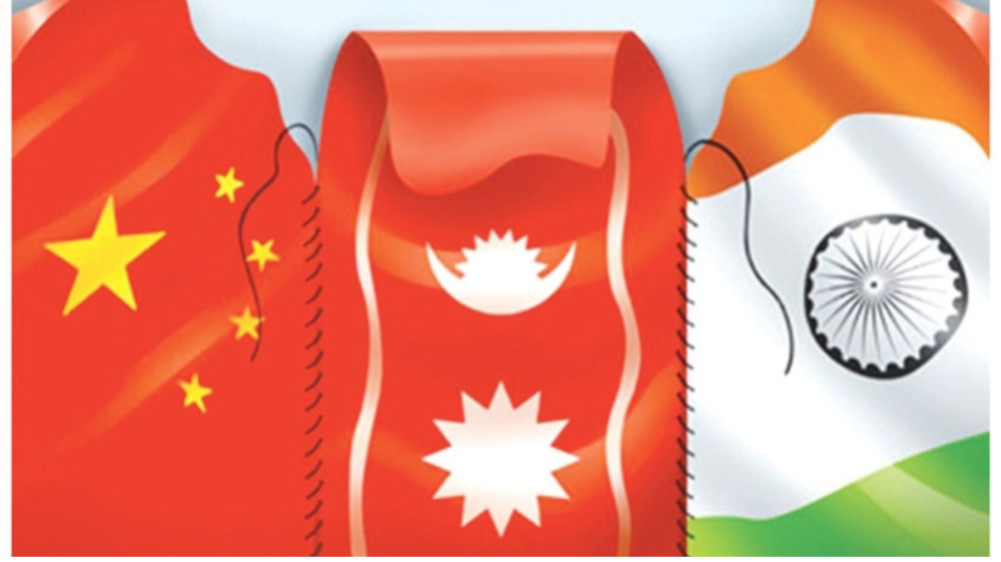
Why is it explained by linking India with Congress and China when there is a communist alliance? Is there such an effect this time?
We use Google Cloud Translation Services. Google requires we provide the following disclaimer relating to use of this service:
This service may contain translations powered by Google. Google disclaims all warranties related to the translations, expressed or implied, including any warranties of accuracy, reliability, and any implied warranties of merchantability, fitness for a particular purpose, and noninfringement.
A year ago, when the alliance of UML and Maoists broke and the Congress joined the government led by Pushpa Kamal Dahal, many people commented and discussed it as 'India's eternal' alliance. Right now, after a year, the UML and Maoists broke up with the Congress and became an alliance again, and there is a discussion about it as an alliance that has achieved the "satisfaction of China".
Especially the Indian media have been reporting this news since morning. And experts in geopolitical affairs also explain these changes of power as the interest and activism of neighboring countries by connecting them to the series of various events.
When India is with the Congress and the communist alliance, why is it explained by linking it with China? Is there such an effect this time?
Geopolitical expert Chandradev Bhatt says that government building and its change in Nepal is seen only as an ideology. For example, we say it is because of the communist ideology that is closer to Beijing than the left alliance. Because India is also a democratic country, it is seen in connection with the Democratic Party of Nepal. There may be other activities as well.'
Mrigendra Bahadur Karki, the executive director of the Center for Nepal and Asian Studies (SINAS), believes that the reason behind the left-wing alliance is to Beijing and to Delhi when there is a democratic alliance. He mentioned that in the first leaflet issued by the Nepal Communist Party in 1949, the world was divided into two parts, one led by America and the other led by Russia. "At that time, the communists of Nepal interpreted India as a country that carries the value of America's ideas and called China a neo-democracy," he said. This is a historical narrative .' Due to that history and practical reasons, Delhi and Beijing are being discussed in Nepal .
Geopolitical expert Bhatt Mentioning that foreigners see Nepal as their own national interest, the Kathmandu government should look at it and explain it in their own way. told . He said that he cannot talk about others based on what he saw.
If we look at the activities from the historical events till now in the same context, then various activities have been confirming this . In some cases, the fact that they have directly interfered in the affairs of Nepal is also surprising. Nepal's The leaders who lead the government also keep changing the distance between India and China, taking into account the geopolitical interests. That is why the role of India and China is discussed in every change of government.
While the internal game of the power equation is going on, the Indian and Chinese ambassadors in Nepal have a close meeting with the Nepali leaders . Such meetings also show the interest of India and China.
This time too, with the collapse of the Congress-Maoist alliance, India's ambassador Srivastava met Prime Minister Dahal in Baluwatar in the evening. Congress President Sher Bahadur Deuba reached Budanilkanth and met him .
But since two weeks ago, Prime Minister Dahal, UML President Oli and other communist leaders The Chinese ambassador chose were meeting . Hou, who was previously the Chinese ambassador, replaced Yanchi, and played an important role in forming the left coalition. So this time It is being discussed that Chan also played that role .
If we look at the environment since the promulgation of the constitution in Nepal in 2072, the 'communist alliance' is associated with the northern neighborhood of China and A Congress-led coalition with or without Communists is seen as connecting the southern neighborhood with India and the West.
After the last general election, on December 10, 2079, a coalition government was formed under the leadership of the Maoist chairman. The third party was allied with the UML led by President Dahal, Raswapa and RPP . The coalition government lasted only until February 15. Then Maoist Chairman Dahal came to form an alliance with Congress, the first party in Parliament.
Prime Minister Dahal did not participate in the 'Boao Forum for Asia' held in China after the alliance with the Congress. Chinese Ambassador Chen Song met Dahal on February 10 and invited him for the program to be held in Henan Province from March 14 to 17, 2078. Even if Dahal said to go in the beginning, he did not go later.
Dahal, who had been holding talks with China and India until February 15, made his meeting with the Indian Ambassador to Nepal Naveen Srivastava thick in Baluwatar after the alliance with the Congress. In addition, the former ambassador to Nepal and now the Indian foreign secretary Vinay Mohan Kwatra also held a separate meeting at Baluwatar at night when he came to Nepal to hold a meeting of the foreign secretary-level mechanism. During the visit of India's Foreign Minister S. Jaishankar, Dahal decided that the Indian Embassy would be able to spend 20 million rupees directly for a project according to India's wishes.
The Belt and Road Initiative (BRI) program signed by Nepal in 2017 has not progressed in Nepal, but Indian affairs were being done. During Prime Minister Dahal's visit to China, China put forward a proposal for BRI project implementation agreement.
In addition, China sought Nepal's support in the Global Security Initiative (GCI), a security-related project. But Dahal rejected both those proposals pointing to the Congress which is in power coalition . As a result, Beijing did not feel comfortable with the current power coalition.
But recently Chinese Ambassador Chan Song who is in Nepal and Chinese officials visiting Nepal have met Prime Minister Dahal and his party leaders many times . According to a Maoist leader, China always says the same thing in every meeting, ``It is better if parties of the same ideology move forward together.'' China is asking the Communists of Nepal to move forward together.
Before the new change in the ruling coalition on Monday, the last time Chinese Ambassador Chan met Prime Minister Dahal and UML President KP Sharma Oli in the second week of February. Besides, Chan also had a meeting with former Prime Minister Jhalnath Khanal. In that meeting, Ambassador Chan talked about communist unity and mentioned that parties with the same ideology should move forward together.
The dispute between the UML and the Maoists in the CPN on 'Chinese Facilitation' and the Supreme Court brought it back to the old situation was the question of whether there will be a left coalition or not. Although the Left Alliance moved together on December 10, 2079, it broke up within a month and a half. Once again, UML and Maoist have started to move forward together . Which can be seen from the meetings and recent activities with Beijing's representatives and leaders.
2072 years ago, pictures of Indian ambassadors visiting the homes of Nepal's top leaders were seen in Kathmandu. But after the end of the monarchy in Nepal and then the ambassadors of Beijing under the leadership of President Xi Jinping in China also started visiting the homes of the top leaders in Nepal after 2072 . The last link of which was the election synergy between Nepal's two largest parties, CPN UML and Maoist Center in 2074, and then the role played by China in the left unity.
The left unity was broken with the controversy of CPN . While there was a dispute in the CPN, it was broken with the visit of Samant Goyal, the head of India's spy agency RA. After that, Indian activism increased in Nepal. But after the general election of 2078 in Nepal, the left alliance that was about to meet again broke down in a short time . Again, the same left coalition has formed . Which the Congressmen are interpreting as a 'government leaning towards Beijing', while the communists were explaining the previous alliance as a 'government leaning towards Delhi'.