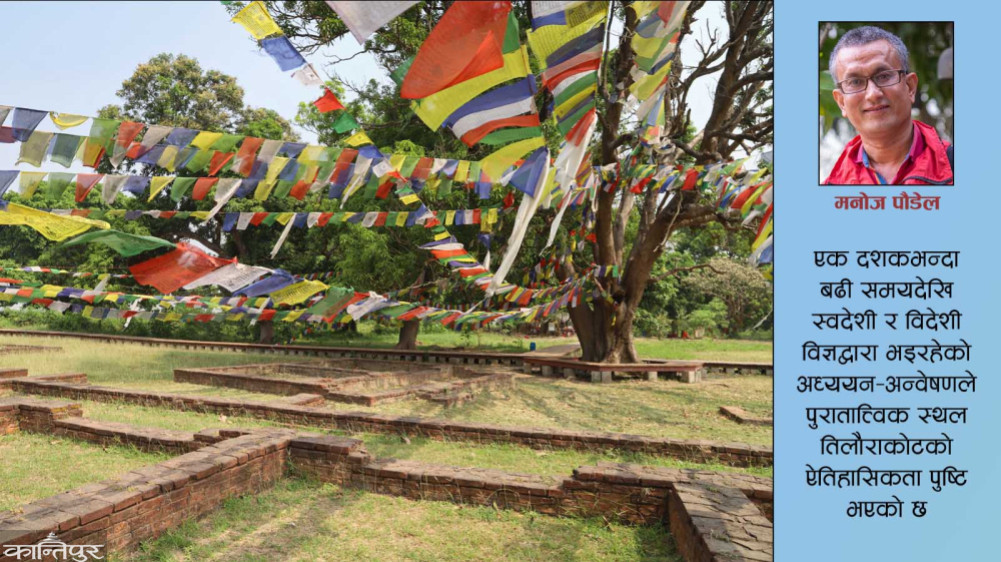
The historicity of the archeological site of Tilaurakot has been confirmed by the study and research carried out by local and foreign experts for more than a decade.
We use Google Cloud Translation Services. Google requires we provide the following disclaimer relating to use of this service:
This service may contain translations powered by Google. Google disclaims all warranties related to the translations, expressed or implied, including any warranties of accuracy, reliability, and any implied warranties of merchantability, fitness for a particular purpose, and noninfringement.
Kapilvastu is an open museum of historical, archeological, cultural and natural sites. There are 136 historical, archaeological and cultural sites in the district. Many Buddhist places are in the womb. Some of those discovered are encroached upon. V.No. Kapilvastu Museum was established in 2019. That does not cover the district.
Prince Siddhartha spent 29 years of his life in Kapilvastu. Tilaurakot is the Rajprasad of Maharaj Suddhodan. It is said that Kapilvastu provided the dynamic energy to Prince Siddhartha to attain enlightenment. It is not enough to know about the Buddha only by coming to his birthplace Lumbini . He has to reach the place where he grew up and played. Kapilvastu is where Buddha grew up and met his parents for the first time after attaining enlightenment.
Sakya dynasty capital Tilaurakot is here . Here is the Rajprasad of King Suddhodan. There are greenery and beautiful gardens. Four ruins are clearly visible from the excavations carried out at different times here . The ruins of the Western, Eastern Dwar and Rajprasad are located here . Likewise, the ruins of the administrative building of 100 meters by 100 meters are also in existence from four years ago. A city of historical form is being found in Tilaurakot. The historicity of the archaeological site Tilaurakot has also been confirmed by the study and research carried out by local and foreign experts for more than a decade.
Roads, drains, security fort walls and human settlements have been found in Tilaurakot. Large building structures, wells and ponds have also been found in places. According to senior archaeologist Kosh Prasad Acharya, co-director of the Tilaurakot Study Excavation Project, many things mentioned in the travelogue by the Chinese traveler have been confirmed by the excavation.
East of Tilaurakot is the Kanthak Stupa . It is believed that Prince Siddhartha's horse died in his memory when he returned the horse Kanthaka and the charioteer Channa from the Anuma river, which he had taken from the royal palace to seek enlightenment. Similarly there is Dhamnihawa Stupa near Tilaurakot . There are two Stupas . It is believed to have been built in memory of the great king Suddhodhana and the small goddess Mayadevi . Niglihawa and Gotihawa, the birthplaces of Kanakamuni and Krakuchhanda Buddha are also located here . When the Indian emperor Ashoka came to make a pilgrimage to that place, he built a pillar. Which can be seen even now . Araurakot, the city of Kanak Muni Buddha is also located here . The city looks huge surrounded by square mounds. Nigrodharam located in Kudan under Taulihwa Maryadpur road section is also a place related to Buddha . Here Prince Siddhartha met his parents for the first time when he came to the capital Kapilvastu after gaining knowledge. Son Rahul became a monk .
Sagarhava is the slaughterhouse of the Sakyas . The headquarters is 9 km north of Taulihwa and 7 km south of Bangai on the East-West Highway. Kaushal Naresh Bidhurak made a fierce attack on Sagarhawa. After knowing that his father was seduced by the Shakyas and married to a slave girl, he became angry.
Kaushal said that 9,990 people died in the attack of King Bidhurak, which was mentioned by the Chinese traveler Hwang Sang in his travelogue, according to Vasant Bidari, a senior archaeologist. The Chinese traveler Hwang mentioned that thousands of stupas were built in Sagarhawa, north of Tilaurakot. The Stupa is written in the travelogue made in memory of Shakya Yoddha . The German surveyor who first identified Sagarhawa. AA Fahrer did it . In 1895, when Fuhrer came in search of Niglihwa, he noticed that Sagarhwa was also an archaeological site. Sagarhwa was first excavated in 1897 . "Kapilvastu is an open museum," said Senior Archaeologist Bidari, "It has a mine of natural charms ranging from peace, harmony, compassion and mantri". No matter how much you inquire, it will be less.'
Taulihawa-Lumbini road section rope has a coat of archaeological significance . Dohni, which is 3.5 bigha, is also an important archaeological site. "Chinese pilgrim Hwang Tsang has mentioned that he saw 10 ruined cities around Tilaurakot, Dohni is believed to be one of them," recalls senior archaeologist Vasant Bidari.