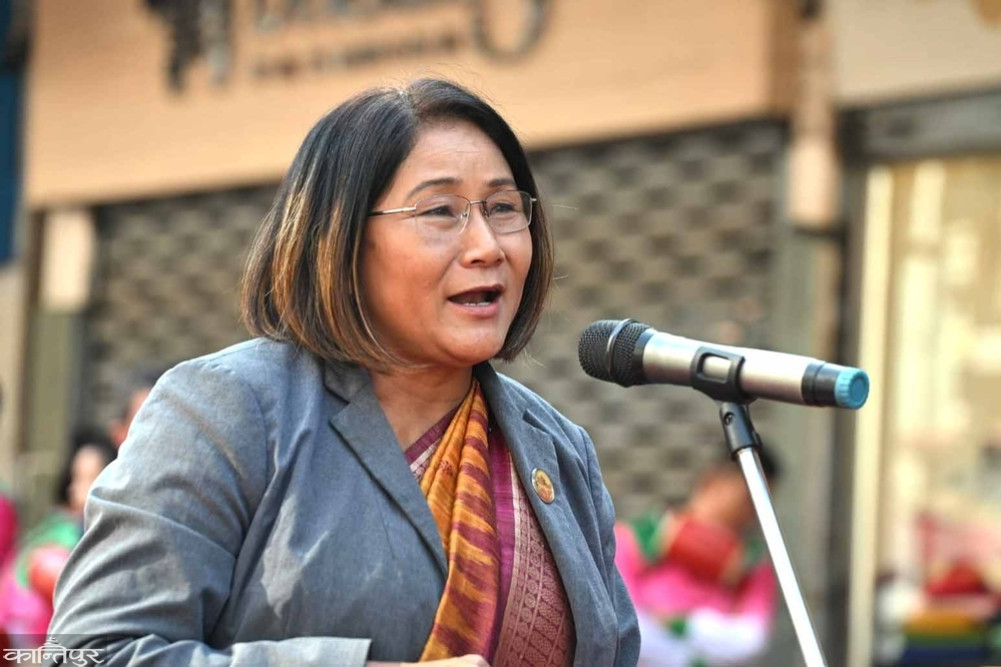
Indira Rana Magar, elected from Jhapa-2, defeated the previous Speaker of the House, Devraj Ghimire, by a margin of 48,742 votes. Indira secured 60,110 votes.
We use Google Cloud Translation Services. Google requires we provide the following disclaimer relating to use of this service:
This service may contain translations powered by Google. Google disclaims all warranties related to the translations, expressed or implied, including any warranties of accuracy, reliability, and any implied warranties of merchantability, fitness for a particular purpose, and noninfringement.
Indira Rana Magar, the Deputy Speaker of the dissolved House of Representatives, entered the parliament as a proportional representation MP in the 2079 elections. This time, she has made her way to the parliament for the second time, defeating celebrities through direct elections.
Elected from Jhapa-2, Rana defeated the previous Speaker of the Parliament, Devraj Ghimire, by a margin of 48,742 votes. Indira got 60,110 votes. Keshav Kumar Bhandari of the Shram Sanskriti Party came in third. He got 7,291 votes. Sarita Prasai of the Nepali Congress came in fourth with 5,616 votes. Bhadra Prasad Nepal (Swagat) of the RPP, who had come in second in the previous election, had to settle for fifth place this time, with 3,966 votes. Last time, he had got 26,455 votes.
Devraj-Indira, who had collaborated as Speaker-Deputy Speaker in the previous House of Representatives, entered the fray as competitors this time. Due to the clash between these two, Jhapa 2 was also in the news.
Born in Jhapa's Arjundhara Municipality Salbari in BS 2027 as the youngest daughter of Pratap Rana Magar and Manmaya Rana Magar, Indira Rana Magar started her formal education in grade 4 at the local Maharaniganj Primary School at the age of 12. After completing her master's degree in sociology, she chose the field of humanitarian service.
She has been telling in various interviews that her meeting with the famous writer Parijat changed the direction of her life. While she was going to Kathmandu to study, Parijat not only protected her, but also inspired her to become a volunteer in a human rights organization. Indira was deeply affected by seeing the condition of the children of prisoners during a prison visit.
So before entering politics, she founded an NGO called 'Bandi Sahayata Nepal' and, as its president, launched a campaign to provide education, rights and a safe childhood to the young children of prisoners serving prison sentences. 22 years ago, she started protecting helpless children in Kathmandu by renting two rooms, and has also established two primary schools by running child protection homes in places such as Jhapa, Palpa, Kathmandu and others.
During the Covid pandemic, Indira garnered further attention by launching a campaign to feed hundreds of hungry people for free.
Her humanitarian efforts also received international recognition. She was honored as one of the world's most inspiring women by being included in the 'Ashoka Fellow' in 2005, the 'Asia Janaseva Award' in 2009, the 'World Children's Honorary Award' in 2014 and the BBC 100 Women list in 2017.
After the formation of the National Independent Party (NISP), she entered politics at the request of Chairman Ravi Lamichhane. Within a short time, the House of Representatives also gave her the responsibility of Deputy Speaker. While working as Deputy Speaker, she was embroiled in controversy. She was accused of writing letters to the US Embassy for visas for unauthorized persons at an international event. Because of her quick decision-making nature, some have been commenting on her as someone who cannot maintain the dignity befitting her position. Active in the social service sector for more than three decades, she has made a significant contribution to the transformation of society by rescuing hundreds of children.