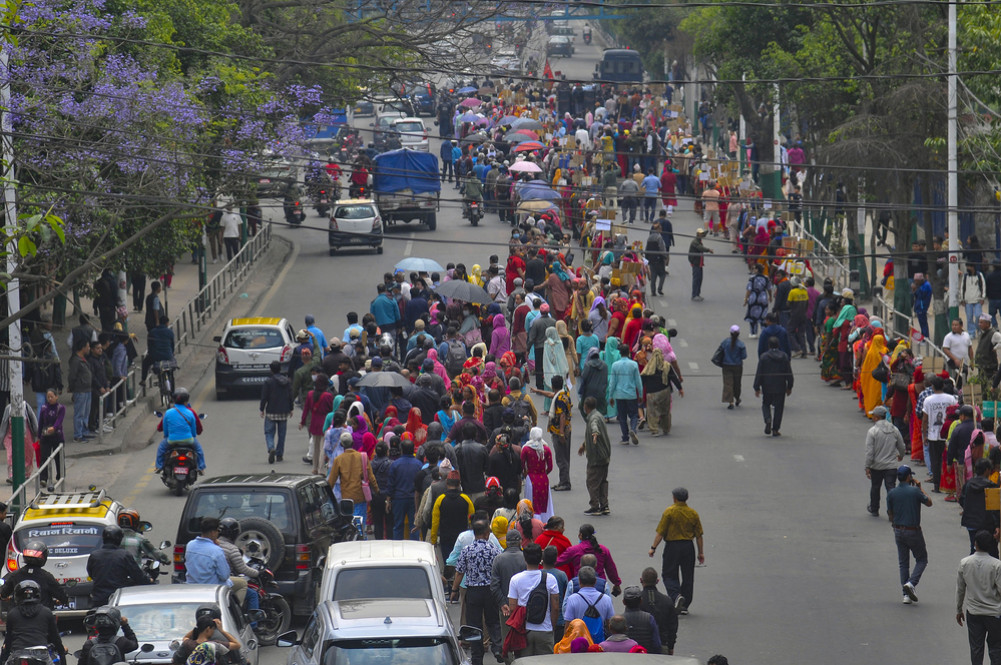
Kathmandu's main transit point, Ratna Park, is filled with stories of joy and sorrow from thousands of people who pass through its banks.
We use Google Cloud Translation Services. Google requires we provide the following disclaimer relating to use of this service:
This service may contain translations powered by Google. Google disclaims all warranties related to the translations, expressed or implied, including any warranties of accuracy, reliability, and any implied warranties of merchantability, fitness for a particular purpose, and noninfringement.
With the passage of time, Ratna Park has also changed its appearance, importance and identity. The current Ratna Park is a green and magnificent park amidst the busy life of Kathmandu, where children who are suffocated in small houses are seen jumping around in search of a spacious lawn. People are exercising here or busy with their mobile phones under the shade of trees. In this spring, the purple Brazilian native flower Jacaranda blooming under the blue sky makes Ratna Park look wonderful.
This park near Ranipokhari and Tundikhel was built as a children's playground. But, gradually it turned into a place for locals and outsiders to relax, roam and 'break'.
In fact, Ratna Park was a center where people gathered from all over the country to listen to and tell their stories and sorrows. They were homeless or disillusioned or disappointed youths, who would sit here all day long – surrounded by plants and trees disfigured by dust.

This park near Ranipokhari and Tundikhel was built as a children's playground. But, it gradually turned into a place for locals and outsiders to relax, roam and 'break'. Time has made it dirty, but Ratna Park did not let itself be destroyed. The main transit point of Kathmandu, Ratna Park, listens to the stories of joy and sorrow of thousands of people who move around its banks.
After the democratic movement, the names of many 'locations' related to the monarchy were changed, but the name of Ratna Park, named after Gyanendra's younger mother, did not change. The construction of Ratna Park began in 2018 and was completed in 2021. Ratna Park is nearby – the country’s oldest educational and health institution – Trichandra College, Durbar High School, Bir Hospital. Two big mosques (Jame and Kashmiri Takiya), Tundikhel, Ghantaghar, Ranipokhari and Khulamanch are located in Ratna Park.
000
Khulamanch is an independent ‘space’ connected to Ratna Park. It is a witness to the democratic movement and many other movements.
It was only recently that the padlock here was opened to the public, but this platform had to overcome many obstacles and struggles to open up. This open grassy field in the middle of a busy road is a living platform for people’s dreams and struggles. People have created history standing under the open sky here.

Many leaders have abandoned underground politics and come out in the open from Khulamanch. From BP Koirala to Madan Bhandari, people have told their stories to the people on Khulamanch. In the People's Movement of 2046 and 2062/063, leaders expressed their views against the government on the open platform. The open platform had been a place for people to express their views since the Panchayat.
Historians consider the open platform to be a part of Tundikhel, which was later divided – after the construction of Ratna Park. Ratna Park was built, but Tundikhel was divided. The southern part was protected by the Nepali Army and the Royal Army Platform was built. The 'space' in the north became a round platform, which was called 'Khula Manch'. Even though it was under the control of the army, the open platform was open to the general public. Over time, it was closed to the general public.

In fact, the beauty of the open platform lies in its openness. This open square is a breathing location in the city. Let us pray that the open platform always remains open.
000
During the people's movement, people would sit on the streets of Ratna Park, shout slogans, and fight with the police. Ratna Park was the roaring place of the people's movement against Gyanendra. That is why it is the wounded land of the people's movement. Let's go back to the story of Ratna Park. This is a square that connects the entire country - from people with different ideas to many businessmen who make a living every day, you can find it here. Just like a decade ago, you would find traders waiting for customers by dipping dozens of watches in a bowl of clear water. Or you would find people selling everything from CDs and DVDs of pirated films to luxury consumer goods.
Before the glittering world of online, you would find evening newspaper hawkers flipping headlines to sell ‘exclusive’ news here. A child walking along the banks of Ratna Park to sell super glue, purses, socks, etc. would be amazed by this vast city. Young people, full of dreams, would sit in the mud of Ratna Park with slices of watermelon and cucumber on their plates and ask, ‘Will you eat?’. There was only one collage of many colors – Ratna Park.
During the people’s movement, people would sit on the streets of Ratna Park, shout slogans, and fight with the police. Ratna Park was the roaring place of the people’s movement against Gyanendra. That is why it is – the wounded land of the people’s movement.
Groups of people would gather here, standing under trees or leaning on fences and chatting. Suppose Ratna Park was a ‘speakers’ corner’. A group of people having political discussions was a permanent sight in Ratna Park. But Ratna Park probably did not invent any new ideas. For many young people, students and unemployed people who came from outside the capital, it was a place to relax.

During the height of the Maoist conflict, ‘Mukunde’ would climb a tree in the afternoon sun and give political speeches without a microphone. A permanent group of young people listening to the speech would probably listen to him. Mukunde would declare himself President, Minister or Prime Minister. In the corner of the park, hidden from the world, the Munamadans would indulge in lovemaking.
A wave of buses-micro-tempos, an ocean of people! This is the true face of Ratna Park. The last stop of many routes is Ratna Park. And, it is also the starting point for reaching other locations in the city. For ages, people have been boarding and alighting buses at Ratna Park, coming from somewhere, and going somewhere from here.

Now Ratna Park has completely changed. You have to buy a ticket to enter the park. That dirty, dirty, dusty park is now neat and green. Ratna Park has now changed its face. Ratna Park is still bustling with children playing in the park during the day and people selling clothes, glasses, watches and many other things on its banks in the evening.
However, Ratna Park is not completely shiny and clean. Due to the bus park near Bir Hospital, Ratna Park is becoming dusty and unorganized. Once named Shankhadhar Udyan, this park tells the story of both history and memory. Having such a large and open ‘space’ in the middle of the city makes the city beautiful and majestic. Now Ratna Park is alive – with the laughter of Nanibabu.