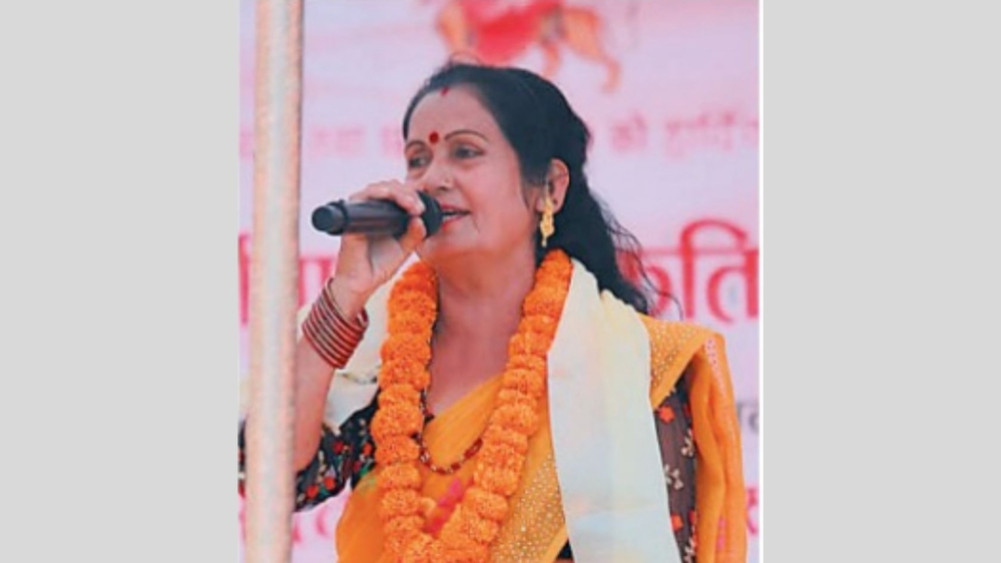
Dikra Badir, a famous singer from the Badi community, is synonymous with the dialect of the Far West. Most of the songs she sings contain a philosophy of life and the pain of the voiceless.
We use Google Cloud Translation Services. Google requires we provide the following disclaimer relating to use of this service:
This service may contain translations powered by Google. Google disclaims all warranties related to the translations, expressed or implied, including any warranties of accuracy, reliability, and any implied warranties of merchantability, fitness for a particular purpose, and noninfringement.
The Gandharvas of the middle and far reaches lived a nomadic life. Their main two occupations were making pottery and playing musical instruments, blending their voices with rhythm. Their instruments included the sarangi, tabla, beenai, khakar, etc. The Badi or Gandharva community is known as a community that goes from village to village singing songs and earning a living by collecting food and water.
After all, life is not a story. Sometimes the story of separation, sometimes of longing, sometimes of pain, sometimes of lack was constantly emerging on the path of their lives. In a way, the Gandharvas are considered to have started using music professionally, but there seems to be no research on this. The Badis of the Far West have been living an independent life since the time of the twenty-two-two kings.
Singer Dikra Badi is a famous character of the Badi community. She used to sing songs in a melodious voice when she was young and enchanted many people in the villages of Bajura. Since 2052, that voice started resounding on the radio. The Thadi Bhaka sung in the Far West and she began to seem synonymous with each other. At that time, there must have been few people in the Far West who did not listen to the Thadi Bhaka she sang.
As time passed, Dikra Devi suddenly disappeared from the singing field. Most of her songs also disappeared. As technology took a new turn, no one was able to convert her albums into CDs. Even after listening to her voice, no one cared much about her because of her caste. She was busy enjoying the moments of her life.
12 albums have been released in her voice. There is no count of how many other songs she sang. She no longer has those cassettes. Recently, Padam Budha, the owner of Sangeet Saugat Pvt. Ltd., has been searching for her songs and uploading them on YouTube. Most of Dikra's songs contain a philosophy of life and the pain of the voiceless. For example,
'Banj Buraska Daura Balla Guruguru'
Saiki Nadi Mera Haat Challi Surusuru'
Born in Bajura, Dikra used to sing Deuda since she was a child. It was customary to carry a tape recorder in her hand. Those who carried a tape recorder were mostly Lahures who had returned from serving as porters in India. The tape recorder was called Terpikad in the countryside.
Many people liked Dikra's voice and used to record it on Terpicard. According to singer and musician Narendra Raj Regmi, Dikra was once known as a skilled dancer by the people of Bajura. After she stepped into the singing field, the dance art faded away.
At the age of 14, Sanima from Kitha Badi of Bajhang lured her to Bajhang. Dikra was married to the same Kitha Badi. She does not know her date of birth. She is two years younger than her husband. Her husband was from 2023. Kitha was an only child who lost her father at the age of 10.
Kitha's father came to Bajhang from Doti. Men and women of the Badi community, who did not have any land of their own, used to make clay sulpa hookahs and pick wheat in the houses of the so-called upper castes by giving sulpa and hookah. Picking wheat means taking the grain reserved for them. When it became very difficult to earn a living by collecting paddy, playing the sarangi, and singing, they reached Dhangadhi in 2049 in search of open land.
They stayed there for a month and a half but were unable to find a place to build a hut. ‘Let’s not talk about the struggle and pain of that time, tears still come to mind when I remember it,’ says Dikra, ‘I even spent 19 days in jail on charges of deforestation.’ After enduring the ordeal, they built a hut on nine acres of land in a place called Bank in Kanchanpur.
In 2052, singers Narendra Raj Regmi and Gorakh Thapa found out that the Dikra couple had come to Dhangadhi and searched for them. Narendra took Dikra and Kitthe to Mircha Studio in Palia, India. There, Kitthe played the sarangi, played the madal, and Dikra sang songs. The first album (Basibiyanlo) was released. Dikra gradually became known in the market.
Then, singer Antaram Bista called them. Bista prepared the songs for the Baiju album and arranged for the Dikra couple to stay, eat, and travel in Kathmandu to sing. He sent them back with a salary of 30,000 rupees. After that, many people, including Narayan Bista, invested and released the album in Dikra's voice.
There is a saying in the Far West - The sharper the needle sharpens, the sharper the thorn is born. Dikra's voice also sharpened like a thorn while being born. Both his father and grandfather were skilled tabla players. They also played the madal and harmonium. There was dancing and singing at home.
Dikra's voice breaks when he remembers the remuneration he received for singing in the past. While other singers who sang with him would get paid according to the prevailing rate, some gave Dikra three hundred, two hundred, and some only a hundred rupees. Most of them only assured him that they would arrange it the next day. Dikra had several moments of rebellion in his mind, but it vanished in an instant like a flash of lightning. Finally, she cursed her own actions and composed the song-
‘Khutta Khayo Chappalle Haat Khayo Balale
Isa Khaye Hiyo Karim Salale’
Dikra has been missing from the music scene since 2066. The pain of suddenly disappearing from the singing field is on one side, but the painful series of events that happened at that time is separate. During that period, her 20-year-old sister, mother and another 15-year-old sister left the earth in turn and her sister was also gone.
Nine years after Dikra disappeared from the music scene, her solo concert was organized by Amrit Bhadgaunle and initiated by Hemant Bivas. In recent days, she has been invited to festivals and festivals for honors and singing. She has also had the opportunity to record songs. She plans to spend the rest of her life in this field. ‘How long can you sing?’ When asked, she says, ‘I can sing all day long. I can sing for four hours straight at a show.'