Do you really want to experience Kathmandu? If yes, it must be understood as Yen Yah ie Indrajatra. Kathmandu will not be understood unless you watch Indrajatra with pleasure. The biggest aspect of Indra Jatra is the Kumari-Ratha. And, the remarkable aspect of Nepali culture is the story of Kumari.
We use Google Cloud Translation Services. Google requires we provide the following disclaimer relating to use of this service:
This service may contain translations powered by Google. Google disclaims all warranties related to the translations, expressed or implied, including any warranties of accuracy, reliability, and any implied warranties of merchantability, fitness for a particular purpose, and noninfringement.
As long as the Jatras continue, the city remains sunny. Kathmandu Valley is a city of folklore, pilgrimage and celebration. Gathamug (Gathe Mangal), the first festival of the year, has just been celebrated in the valley. The excitement of that Jatra is ending and another Jatra is entering and now there is Jatra-Jara in the monsoon-calendar of the valley. In this year's issue of 'Koseli', an attempt has been made to explore the stories, myths and lives of some Jatras in the valley and beyond. In the Jatra series, Indra Jatra will be celebrated in Kathmandu for 8 days with enthusiasm and gaiety. This content is an article in the Jatra series published on Saturday in Koseli.
Namai Yen Ya: . That is, the pilgrimage to Kathmandu. In Nepali language, it happened - Kathmandu . It happened – Jatra . So, Indra Deuta is connected with it in many ways . That is why it is called Indra Jatra. However, there are many who say that the name of this festival is ``yen yah''. It goes without saying that the Jatra named after the city is the biggest Jatra in Kathmandu. On the day of Bhadrashukla Dwadashi, this Jatra starts formally after taking Yasin at Hanumandhoka.
And, this journey lasts for eight days . What's not the only thing in Yen Yah ? A lot happens . After raising this, the statue of Bhairava is put on display in Toltol. And the next day, Akasha Bhairav of Indrachoka is taken out . Lache dance, Pulukisi dance is performed during this festival . And all Bhakku and Mahakali dances also take place . Ten Avatars are also shown in the temple near Kumarighar in Vasantpur .
The big attraction of Yen Yaah is the tradition of pulling the chariot of a virgin. This chariot is drawn once in Thah Neyaah . That is towards the top . Kwahneya is drawn twice, towards the bottom . Nanich Yah occurs on Ashwin Krishna Panchami and it is the last day of Yen Yah . On the last day, with the end of the Rath Yatra, the head of the nation pats the tika from the hands of Kumari, Ganesha and Bhairav and with this the Indra Jatra ends. 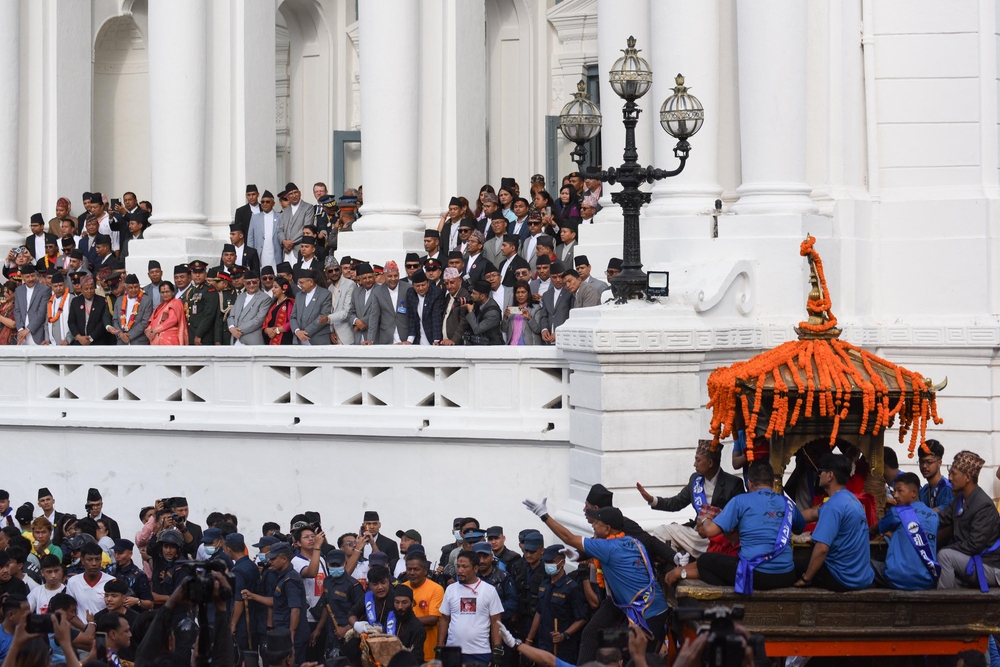
If you really want to experience Kathmandu, the question is - is this city culturally? If you want to understand this, you have to experience Yen Yah . As long as you do not enjoy this festival, you will not understand Kathmandu. The biggest aspect of this festival is the pulling of the chariot of Kumari. In particular, the Kumari tradition is one of the most remarkable aspects of Nepali culture, especially the Kumari of Vasantpur associated with this festival.
But, this festival is much bigger and bigger than this . Moreover, the biggest feature of this festival is that it has been changing according to time . When the foundation of this festival was being prepared, deities used to come down to Kathmandu like common people. She also used to talk to common people in their own language. Now it has become more new and attractive according to modern times. As a
, the tradition of only women pulling a virgin chariot for a day has already started . An opportunity to eat prasad falling from the mouth of Shwet Bhairav in Hanumandhoka is now reserved only for women. This is a change of time in the last decade. A closer look at the eight days of Yen Yah and understanding them from cultural, philosophical and many other perspectives is sure to give an amazing experience .
The eight major features of these eight days can be considered .
The purpose of Pitru Moksha is
On the first day of Yah, ``Upaku Vanegu'' takes place . Its purpose is Pitru Moksha . No matter how many people die within a year, their relatives go around inner Kathmandu lighting lamps. That is, 'Upaku' goes . In this process, lighting a lamp and moving around a certain place is done. This journey starts from Maru Cab in Kastamandap area and ends there. It is said that this was the real Kathmandu once upon a time.
During the Nagar Parikrama, green lamps are lit in Dobato, Chaubato, Chaitya, Peetha and temples. It is believed that Pitru Moksha will be attained by keeping the raw lamp lit in this way . Let's say that it is Sumati's wish that the dead should live in heaven. The family members of the deceased participate in the upaku yatra after a special pooja. And in this process, there is also a tradition of singing various verses and hymns.
plays are also performed during
s, this is another great feature of it. It is called, Deepyakhan . Yen Yah is the main area of celebration, Kilaghah . There is a decrease in the fort here, so it became a fort . It is customary for the Japu community of this region to perform the goddess dance. While pulling the Kumari Rath, the Deepakhan is continuously lit in this area . After the journey of the Kumari Rath is over, the play is performed in front of Akash Bhairav at Indrachok . 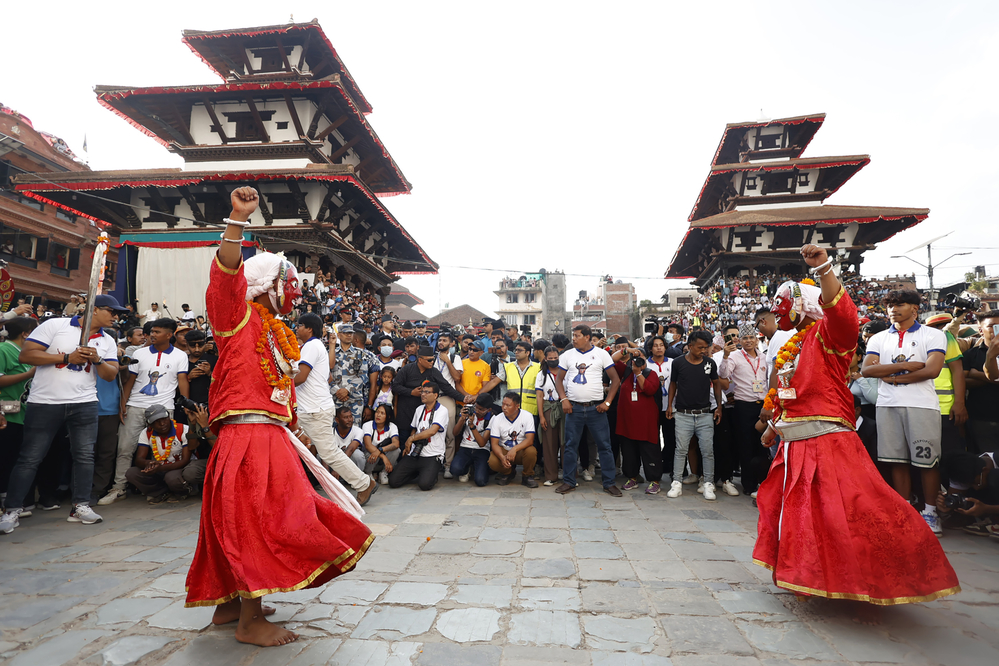
Traditional Khin and Dhaah Baja's Deepakhan is performed to the tune of . It has seven main characters. They are Bhairava, Kumari, Chandi, Daitya, Kavan, Vetta and Khya. A long time ago, during the time of Gunakamdev, there was a big outbreak of cholera in Kathmandu. The king was told in a dream that the Deepakakh should be performed to end the cholera epidemic. After this the tradition really started . There is also a tradition of singing songs during Deepakhan.
Indrahwaj hoisting
Indrahwaj hoisting is considered to be officially started after the work of raising the rainbow flag. This is done in front of the Kalbhairav of Hanumandhoka. This is the rainbow. And this is it, the wooden lingo . Yassin brought from the canal is kept in Bhotahiti for four days . The work is done to deliver it from Bhotahiti to Hanumandho. The Manandhar community has a special responsibility in this.
Along with Guruju's platoon, army also participates in its journey. And as a symbol of the state, one person from the care office of Hanumandho participates in it by carrying a sword. Shah dynasty king Pratapsingh is believed to have started the tradition of doing this before Kalbhairava. Before this, it is mentioned in the language genealogy that this is done in Atkonarayan.
The symbol of Indra's mother was worn
The most heard/told story is this, Yen Yah Bere . According to legend, Indra disguised himself and came to Maruhiti to pick Parijat flowers. The locals caught him as a thief. Later, Indra's mother had to come to rescue her son. At that time, the locals expressed their wish to meet their relatives who passed away that year in heaven.
Accordingly, after the end of the chariot journey, the jewelry is removed from the lower part. Dagin is considered as a symbol of Indra's mother, the mask she wears is white . In this way, it is believed that if you follow Dagin, you will reach heaven . And for this, this journey is made from Maru to Indrachok . There is also a custom of sprinkling Shatbees so that they will not be born again. Similarly, there is a tradition of washing the mouths of those who walk with the dagi and reach Maruhiti.
During the extraction of Baumat for people's rescue
When this journey reaches the upper region, it is customary to remove Baumat . This became another important tradition of Yen Yah . The task of extracting it also belongs to the Manandhar community. The lamp placed on the top of a long bamboo is called Baumat. A long reed is tied and dung is smeared on it . A lamp is lit on top of it. It is said that Baumat is taken out for the salvation of the people.
When Dagin Yatra goes around the upper region and takes it to the lower region, at that time there is a custom of taking Baumat . What is popular opinion is that Dagin and Baumat do not meet each other, it should be circled from the opposite pole . Therefore, after completing the journey to the upper region to bring Baumat, they do circumambulation in the lower region . If there is any faith, there was also a custom of lighting a lamp to see if anything happened to any of the participants in Yen Yah .
Sav Bhakku Dance
Putwar community of Halchok performs Sav Bhakku Dance. They reach Kilagal for this . It is specifically the name of three goddesses and the vibrant culture of the Putuwar community of Halchok. There are mainly three characters in the dance. Among them, Akash Bhairav has a blue mask. Similarly, Kumar and Chandi are seen in red masks. This can be considered as the main attraction of Yen Yah .
All Bhakkus are symbols of Bhairav Deuta. It was customary to take them to Nasal Chowk of Hanumandhoka and give them Ranga. In the beginning it was a tradition to give them Ranga in Narayanhiti . During Pura Yen Yah, they dance around Hanuman Dhoka . In this order there is also a tradition of worshiping . Apart from Yen Yah, they also have a separate Jatra of 12 years.
Lache Naach
is equally attractive in Lache Naach. On this auspicious day, the Mukut is worshiped according to Tantric method in Jaisedeval's Lakhe house. After that, from the first day of Yen Yah, Lakhe Naach starts . All Bhakku and Lakhe do not try to separate each other's dance . Therefore, it is customary for them to stay in different places from each other . It is believed that the practice of lac dance along with the Kumari Rath started during the Rana period . 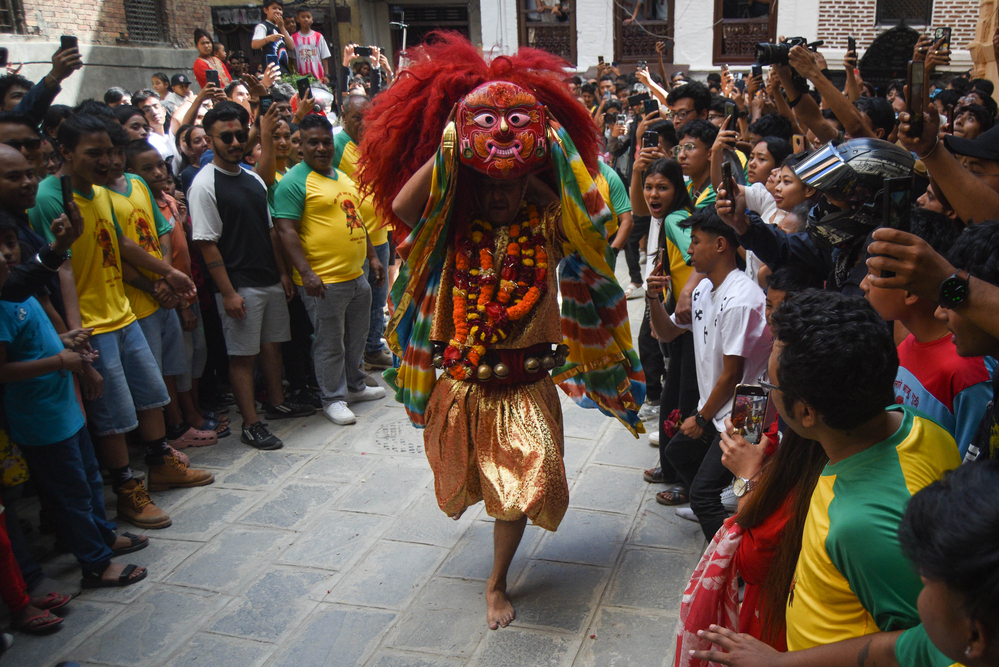
This can also be considered an important cultural aspect of Yen Yah . Entertainers have been doing the work of showing lakhs of dances. If Lakh has red hair, the mask is also attractive . A small child also joins Lakhe . He is - Jhyalincha . This jhyalincha teases Lakhe during the dance . Lakhe also chases those jhyalinchas in that order .
Pulukisi follows Chirag
Pulukisi comes out of Kilagal and in front of him is Chirag . Kisi means elephant, this . The story connected with it is also very interesting. Indra once rode down the Airavata elephant. This was his vehicle. Later stayed here . Why not? Especially Indra Parijat came to steal flowers. Caught and somehow stuck here badly . 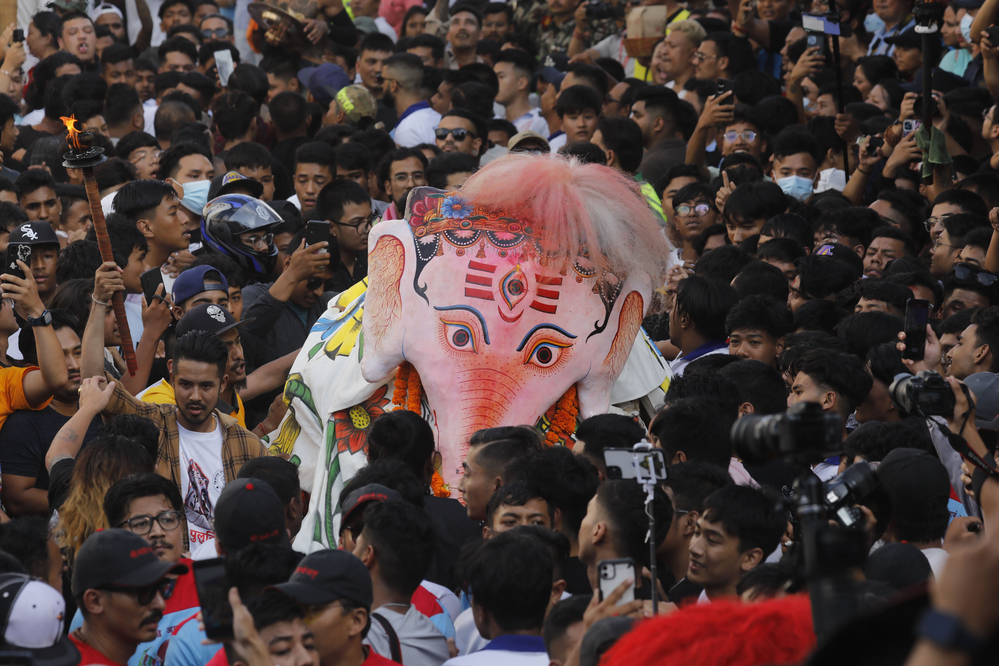
Before that, he had tied his elephant to Kilagall. But, Indra did not return . The elephant's talk has happened. Later he went out to find his master. As a symbol of this, there was a tradition of taking out Pulukisi . It is produced by the Japu community of Kilagall. Pulukisi also has its own dance. Pulukisi is considered by many to be the most attractive tradition in Yen Yah .
Also read other content related to Indra Jatra:

