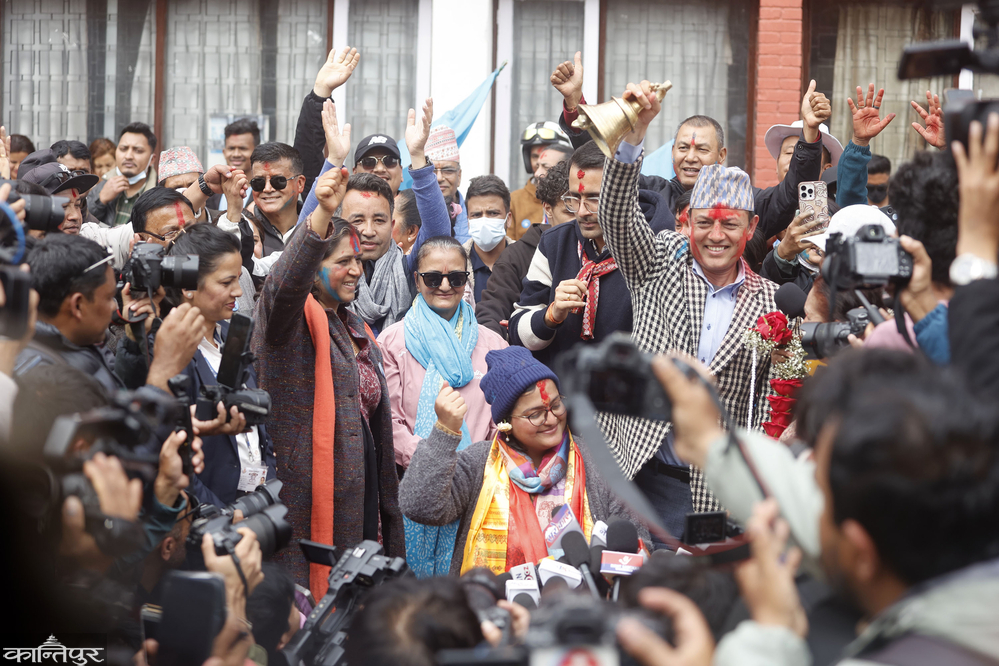
The Congress received fewer votes in proportional representation than in direct representation in 146, the UML in 138, and the NCP in 115 constituencies.
We use Google Cloud Translation Services. Google requires we provide the following disclaimer relating to use of this service:
This service may contain translations powered by Google. Google disclaims all warranties related to the translations, expressed or implied, including any warranties of accuracy, reliability, and any implied warranties of merchantability, fitness for a particular purpose, and noninfringement.
Looking at the results of the general election, it is clear on the surface - the Rashtriya Swayamsevak Sangh (RSS) won 125 out of 165 seats in the direct route, while the seats won by the Congress, UML and NCP were limited to 35. But looking at the results in the proportional route in 165 constituencies, another clear picture emerges - not only have the old political parties lost seats in the direct route, their party foundation has collapsed.
In the election held on 21 Falgun, each voter cast two votes. On one ballot, they chose a representative from their constituency to go to Singha Durbar, and on the other, they chose their favorite party at the national level. In the system of voting for candidates in their constituency, their votes are cast based on factors such as the candidate's personality, his activism at the local level, and community influence, while proportional votes show the picture of the party chosen by the voter.
When the votes received by the parties in each constituency in the direct and proportional systems are put together, it is seen that the votes of the Congress, UML and NCP are less in the party's base, and more in the strength of the candidate. For example, in 146 out of 165 constituencies, the votes received by the Congress candidate directly are more than the votes received by the party in proportional representation.
window.addEventListener("message",function(a){if(void 0!==a.data["datawrapper-height"]){var e=document.querySelectorAll("iframe");for(var t in a.data["datawrapper-height"])for(var r,i=0;r=e[i];i++)if(r.contentWindow===a.source){var d=a.data["datawrapper-height"][t]+"px";r.style.height=d}}});
The NCP brought fewer votes proportionally than its candidate in 115 constituencies . Overall, it lost about 17 percent (one hundred and sixty-five thousand votes) of the votes it received directly . That is, one in every six voters who voted for the NCP candidate did not vote for the party proportionally .
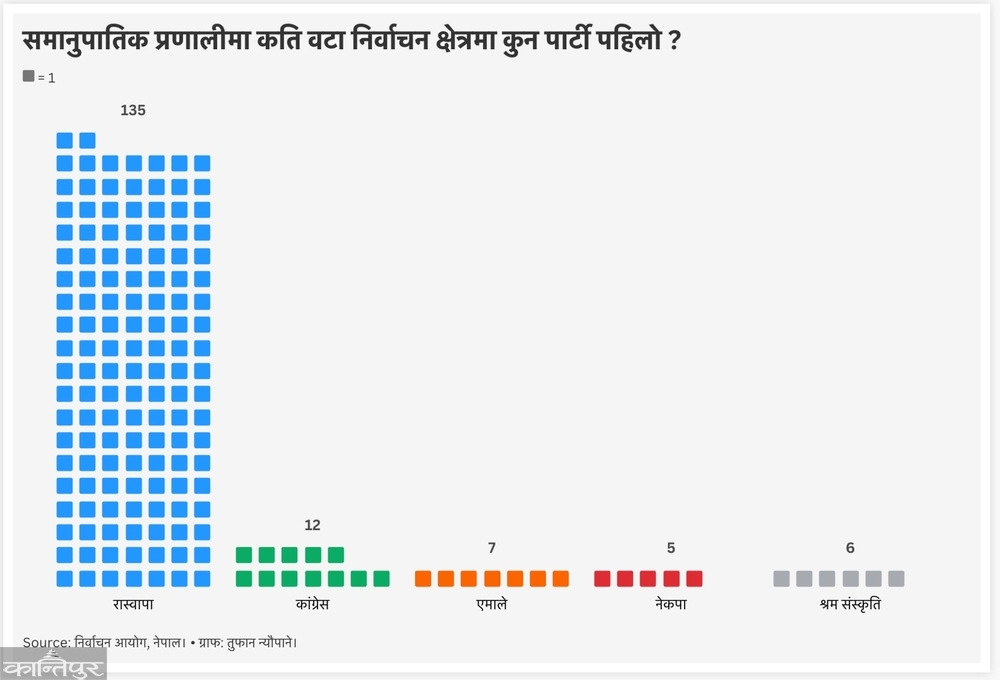
On average, the RSVP got 1 seat out of 37,000, the Congress 110,000, and the UML 180,000. These three parties lost about 600,000 votes proportionally more than their candidates got directly . The data shows that those votes were divided between the RSVP and the Shram Shakti Party . The RSVP brought more votes proportionally than its candidates in 153 out of 165 constituencies . Overall, the RSVP attracted about 5.5 million more votes than its candidates received nationwide. In many constituencies, voters who did not vote for the RSVP candidate directly also voted for him in proportional representation.
The RSVP came first in proportional representation in all 125 constituencies it won directly, and in 10 more constituencies where its candidates could not win directly, the RSVP came first in proportional representation. In Sindhupalchowk-2, the NCP candidate won, but the RSVP came first in proportional representation by about 13,000 votes. In Kapilvastu-3 and Palpa-1, the Congress candidate won, but the RSVP came first in proportional representation by 12,000 and 6,500 votes respectively.
Vote and seat ratio: The most unbalanced election result of the last 3 [See 6 graphs]
Out of the 18 constituencies won by its candidates directly, the Congress could not come first in the proportional representation in seven. In Dailekh-1, Kapilvastu-3, Palpa-1 and Rautahat-2, the Congress candidate won, but the party preference of the voters there was the Rashtriya Swayamsevak Sangh (RSS). In Tehrathum, the Congress candidate won the election directly but the first vote in the proportional representation went to the UML. In Ilam-1 and Panchthar, which were won directly by the Congress, voters chose the Labor Culture Party in proportional representation. In two out of the nine constituencies won by the UML candidate and in four out of the eight constituencies won by the NCP candidate, the party preferences of the voters are different.
Analyst Chandra Kishore, recalling his conversation with voters in Madhesh before the election, says, ‘This is a rebellion by the cadres of the old parties against them, who are fed up with their own party and its leadership. In many districts, those parties have received fewer votes than their active cadres in the proportional representation system.’ He said that cadres dissatisfied with the party leadership have chosen the RSVP in the proportional representation system even though they voted for their own candidates in their respective areas.
Balkrishna Khadka, an associate professor and statistician at Kathmandu University, says that such data shows that voters who could not vote directly also chose the RSVP in the proportional representation system with the idea of making Balendra Shah the Prime Minister. ‘There was a trend of saying that one vote is not enough, that is the effect of that,’ he said.
The bell of change has rung
Sharecast Nepal Chairman Madhu Acharya, referring to the results of a survey conducted in coordination with Kantipur some time ago, said, ‘54 percent of the country’s voters said they had no trust in any party. Of the 46 percent who said they had trust in some party, half chose the Rashtriya Swayamsevak Sangh (RSS).’ He added, ‘The secret behind the proportional votes of the old three parties being lower than the direct votes and the RSSP getting more is hidden in the 54 percent who said they had no trust in any party.’
Political analyst Indra Adhikari said that this result was achieved when voters who had been voting for the Congress, UML and NCP chose the Rashtriya Swayamsevak Sangh (RSS) in the proportional representation system this time. ‘It seems that voters have chosen the path of making their own party responsible for yesterday’s bad situation rather than the party of faith.’
Adhikari said that the ‘craze’ of Balendra Shah’s personality also increased the votes for the RSS in the proportional representation system. ‘Due to the slogan of ‘silently stamping the bell’, even the so-called committed workers of other parties secretly chose the bell in the proportional representation system,’ she said.
Successful elections through the fog of suspicion
Mrigendra Karki, executive director of the South Asian Research Center (SINAS) of Tribhuvan University, had reached Madhesh and Koshi provinces for on-site study and survey before the elections. In his opinion, the voters came to choose the ‘new’ after the statement that ‘the parties that ruled after 2047 are responsible for the current situation’ was made and the dissatisfaction with it was voiced in the Gen-G movement. ‘Yesterday, the choice of those going to Europe and America was the Congress and the choice of those going to the Gulf was the leftist parties,’ he said. ‘Now, both these types of voters have chosen the Rashtriya Swayamsevak Sangh (RSS). If only a chance were given to the new ones.’

![संसद्मा नयाँ पुस्ता, नयाँ दल तर पुरानै जातीय वर्चस्व [हेर्नुस् ६ ग्राफमा]](http://assets-cdn.ekantipur.com/uploads/source/news/kantipur/2026/election/madesh-voting-0532026063351-1000x0.jpg)


![मत र सिटको अनुपात: पछिल्ला ३ मध्ये सबैभन्दा असन्तुलित निर्वाचन परिणाम [हेर्नुस् ६ ग्राफमा]](http://assets-cdn.ekantipur.com/uploads/source/news/kantipur/2026/election/vote-0932026095757-1000x0.jpg)