Thursday is the hottest day of the winter, as per the temperature measured by the Department of Water and Meteorology at this time for the last 6 years
We use Google Cloud Translation Services. Google requires we provide the following disclaimer relating to use of this service:
This service may contain translations powered by Google. Google disclaims all warranties related to the translations, expressed or implied, including any warranties of accuracy, reliability, and any implied warranties of merchantability, fitness for a particular purpose, and noninfringement.
In the last week, the heat has increased in the hilly areas including the Kathmandu Valley. There is a lot of anger in Terai. Crops have also been affected due to non-activation of winter rains in hilly areas. Three months ago, the Department of Water and Meteorology predicted that both the maximum and minimum temperatures in the country would exceed the Sardar average from October to December.
December, January and February are considered winter months. But this year, in the second week of January, i.e., the normal temperature has increased as the end of January, meteorologist Sudarshan Humagain of the Water and Meteorology Department informed.
He said that due to the weakening of the western wind system, the normal temperature is increasing and the heat has been felt for the last one week without the end of winter. The winter of 2025 is not over. January is considered to be a slightly colder month in our country. But this year, the winter is getting less," he said, "because the western wind has not come, so the temperature could not drop that much." According to the
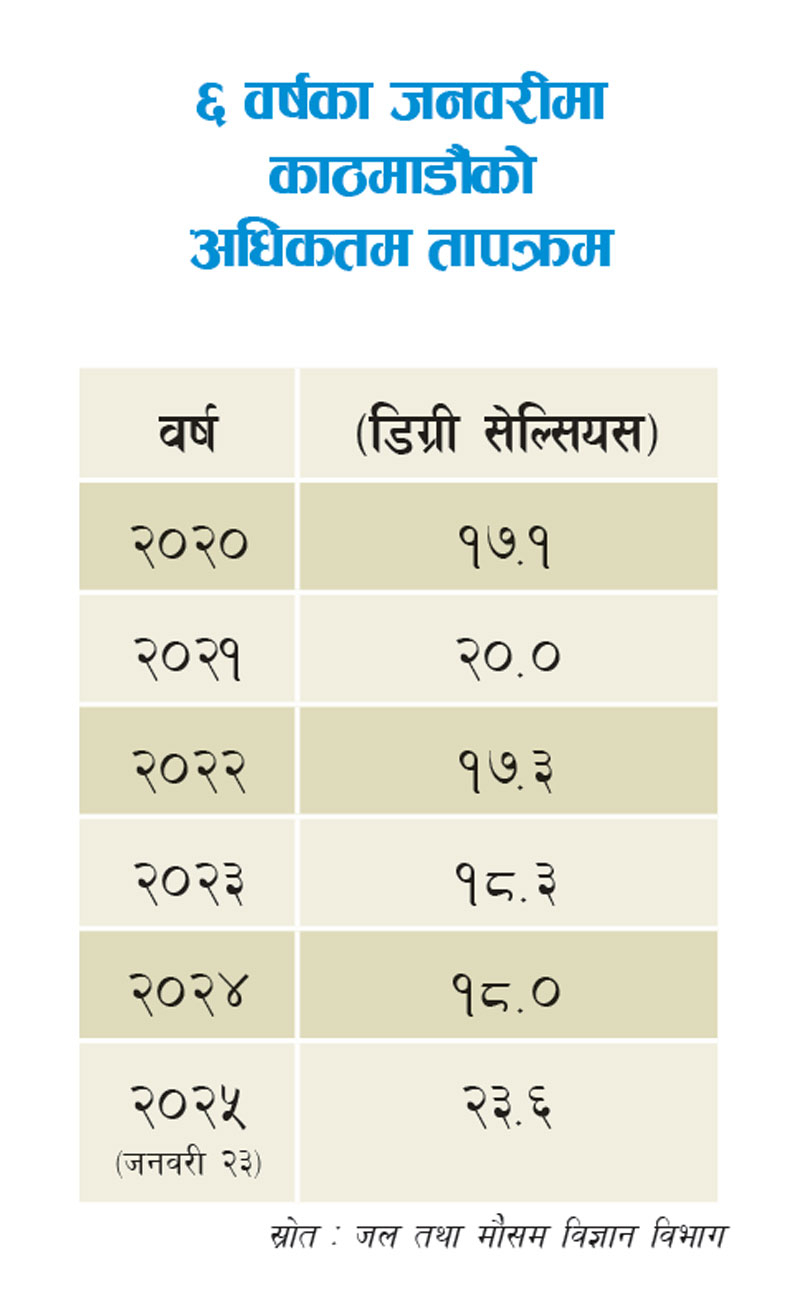
department, the normal temperature in Kathmandu during January is 19.2 degrees Celsius. But now from January 17 to 23 (January 4 to 10) the temperature is increasing by an average of 5.2 degrees Celsius. Till January 17, the temperature in Kathmandu Valley was below normal. The temperature is continuously increasing from the 17th to the 23rd," he said. "The temperature was measured at 24.6 degrees on Wednesday and 23.6 degrees on Thursday." Last year, the temperature was measured at 17.8 degrees on this day. He said that from January 17 to 24, 2024, the temperature was below normal.
Likewise, if we compare the temperature of the same period from 2020 to 2025, this is the second highest temperature measured after 2021. The average temperature in Kathmandu in January 2021 was 20 degrees Celsius. "If we look at the temperature of the last 6 years, January 2025 is hotter than 2021," added Humagai, "the temperature is higher than that of 2021." 17.3 in January 2022, 18.3 in January 2023 and 18.0 degrees Celsius on average in January 2024.
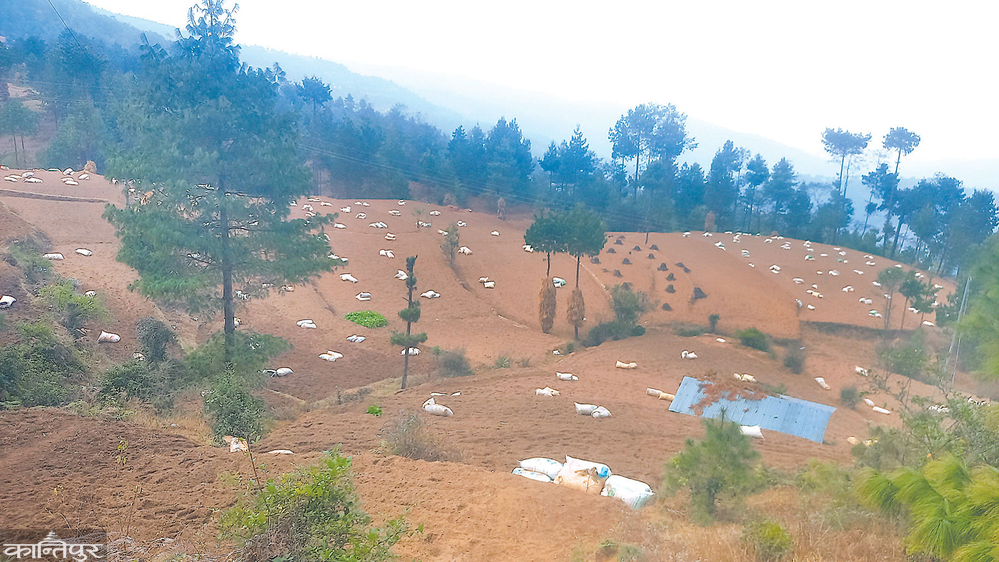
Manure placed in sacks to put on potatoes in Shailung rural municipality-8 of Dolakha. Farmers are waiting to plant potatoes and apply fertilizer in the hope of snow or rain. Photo: Kedar Sivakoti/Kantipur
 It has been observed that the temperature of Kathmandu valley has started increasing since last 7 days. Before that, the temperature was lower than normal, that's why if we compare the average temperature of this time for the last 6 years, this time's temperature is high,' says meteorologist Humagain, 'If we look at the last seven days, the temperature was not so high in the previous year.' The hottest years include 1990, 2006, 2009 and 2017. But he says that the average temperature cannot be known as the end of January this year is still left.
While the heat is increasing in the Kathmandu Valley and the hilly areas, this week, there is fog and fog in some parts of the Terai and some parts of the central and eastern areas. He said that the temperature did not rise due to fog and fog in the area. But although the temperature is lower in Terai, the average temperature is 20 degrees Celsius in the hilly areas. He says, "In the last one week, the temperature can be seen higher in the hilly areas than in the Terai." More than 20 degrees is visible in mountainous terrain.'
Is this the effect of climate change?
While the heat is on in the plains, the winter is over and the heat has increased in the mountains. Winter crops have been affected due to lack of rain in high mountain areas and mountains. Is this an effect of climate change? Climatologist Sudeep Thakuri says, 'It cannot be called climate change yet. If we look at the data, the temperature of the earth is increasing. This time it seems that it is weak. This has happened because the western wind is not active.
Thakuri is also an associate professor at the University and also the dean of the Faculty of Science and Technology of the Midwest University. He said that although the lack of winter rain has affected farming, it cannot be said that it is due to climate change. It can be said that this has happened due to the rising temperature on earth. The condition of glaciers and glaciers is a clear indicator of climate change," he adds, "In Nepal, the area of glaciers has decreased by 15 percent. There seems to be less snow in the mountains. It has a direct effect on the river and the land. According to a study conducted 3 years ago about water resources in various places in Nepal, 25 percent of the main source of water has been found to have dried up.
In the last three decades, he admitted that the decrease in rainfall has affected agriculture. But they say that it is not clear how much its effect is. "In the Himalayan region, the potato and vegetable crops there are said to be affected by the snow," he added.
Manure placed in sacks to put on potatoes in Shailung rural municipality-8 of Dolakha. Farmers are waiting to plant potatoes and apply fertilizer in the hope of snow or rain. Photo: Kedar Sivakoti/Kantipur
 Sudarshan Humagai, a meteorologist of the Meteorological Department, also says that looking at the data of 3/4 years, it cannot be said that the rain has decreased due to climate change. "If we change over a long period of time, such as 30 years, we call it climate change," he says.
The Department of Climate Change Studies prepared a report in 2017 using data from 1971 to 2014. According to that report, the maximum temperature is increasing by 0.05 degrees per decade. The minimum temperature also shows an increase of 0.2 degrees per decade,' he added, 'this average number looks small but it sounds small because it is an average of many years. If we keep increasing this standard every year, it will be too much.'
Environmental researcher Gobind Prasad Pokharel also says that although it is not clear that the decrease in rain and early heat is due to climate change, there are signs of it. "The state of the oceanic, atmospheric, global, glacial and biological systems determines the temperature," he said ?
The winter monsoon has not been active this year. Humagain, a meteorologist of the Meteorological Department, says about the reason for this, "rain falls in Nepal in winter due to the western low pressure system." Afghanistan, Pakistan and India are raining where we will come. When that system is weak, there is less rain in Nepal. According to him, there has been some rain in the western, far western and upper parts of Karnali this season. As the rain slowly moves eastward, the air may lose moisture and rain may decrease.
'Only the dry air comes to the east, that's why the rain falls,' he added, 'Only 3-4 percent of the rain falls in the winter.' He says it is time. This is the dry season. It has not rained because the western wind system is not active,” he added. The data of the department shows that the winter rainfall in Nepal has been less in the previous years as well. In January, Humagai said that since 2016, except for 2020 and 2019, the water has not been good.
'The years 2016, 2017, 2018, 2021, 2022, 2023, 2024 and 2025 are the driest winters on record. During these times it rains less than Sardar. "It rained more than Sardar in 2019 and 2020," he told, "In this, it could have stopped raining until September, which is behind our Nepal's monsoon. Now it rains from the first week of October to the middle. Monsoon is moving later. If you look at the latest trend, the winter rains are decreasing.'
When does the winter monsoon start in Nepal?
The winter monsoon in Nepal starts from mid-June and lasts until the second week of October. "But this year, the monsoon was also late," said Pokharel, an environmental scholar. This year on 10th June the monsoon ended on 12th October. But in Nepal usually from October 2 Monsoon leaves.
Likewise, the monsoon that entered Nepal on June 14, 2024 left on October 15. But this year, the weather department has informed that the monsoon is over after 10 days. According to the Meteorological Department, there was 1570.4 mm of rain last year. Last year, the period from December to February was below average and most parts of the country did not receive rain.

