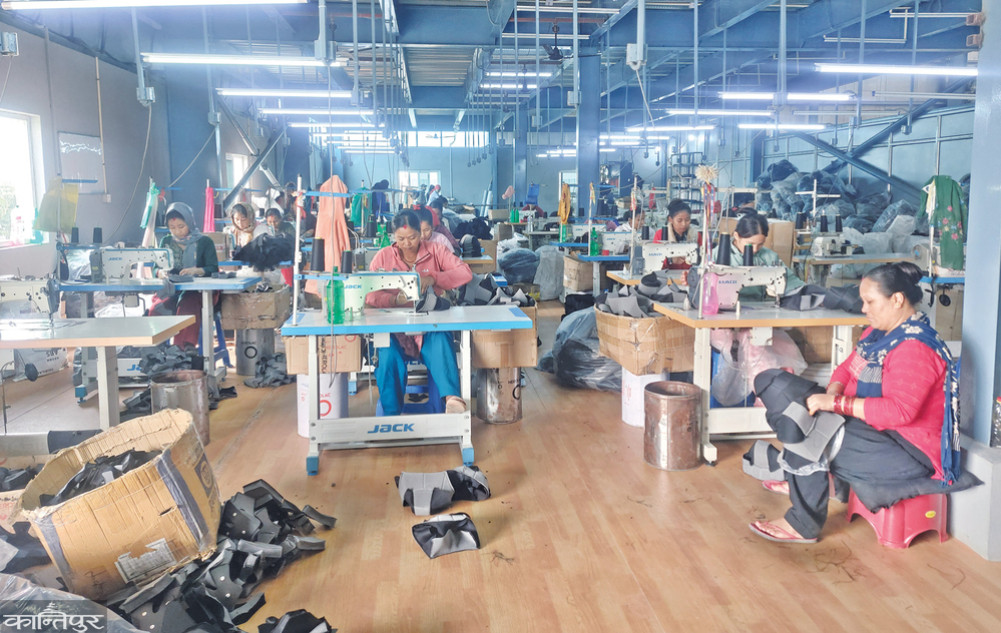
Suman has been running the industry since 2068, he knew that his products occupied the market all over Nepal, Suman understood that there is a demand for helmets in the market, so he decided to make Nepali helmets.
We use Google Cloud Translation Services. Google requires we provide the following disclaimer relating to use of this service:
This service may contain translations powered by Google. Google disclaims all warranties related to the translations, expressed or implied, including any warranties of accuracy, reliability, and any implied warranties of merchantability, fitness for a particular purpose, and noninfringement.
About 40 years ago, Ramprasad Basyal of Butwal-9 Deepnagar in Rupandehi used to train local youth to speak on radio. For this he opened a training center at the highway intersection in Butwal. They used to come to him from Kathmandu to learn.
He taught the art of speaking and thought of pursuing this as a 'career'. But kept it that way. The thought of running a metal industry suddenly came to his mind. And opened, 'Kohinur Metal Industry.' Through this industry, he has established himself in Rupandehi.
Basyal started manufacturing air coolers, washing machines in the year 2044 with the help of bank loans. The industry flourished. At that time there was a wave of buying motorcycles. But the motorcycle legguard used to be imported from India. When Basyal saw the demand for legguards, he started producing them. Business increased. Basyal claims that he is the first to produce legguards in the country. The market of legguards produced in his industry located in the industrial area of Ramnagar in Butwal has expanded throughout the country.
At that time, he had to 'lobby' in the government agencies to be established in the market and it became easy to establish in the market after the problem of rust seen when it was kept in the Indian laggard did not occur in the products here. Basyal has a son and a daughter. After completing his graduation from Kathmandu, son Suman returned to take over the management of the industry established by his father.
In the beginning, Suman's thoughts were foreign. He also made up his mind after his friends followed the path abroad. Suman said that he was thinking of going to Australia or America. The documents had been prepared for that. When he came home, he used to visit the industry. He changed his mind when he started looking at the business. His father became interested in business. After having to handle the management of the industry, the family members started staying in the country. He accepted the suggestions of parents and relatives.
Since 2068, Suman has been ruling the industry. He knew that his products occupied the market all over Nepal. Suman realized that there was a demand for helmets in the market. So decided to make a Nepali helmet.
"I also got a suggestion that helmets coming from India and China could be replaced if they were made here," he said, "Leggard was doing good business." That's why I thought of producing helmets as well. According to Suman, helmet production started in 2070. For that he established Kohinoor Plastic Industries. The main product of the industry became helmets. "The Kohinoor helmet is the first full production in Nepal," Suman said.
Father Ramprasad started his industrial journey from Butwal-8 Sukkhanagar. Then he established an industry in Butwal Industrial Area. Now they have started a new industry in Tilottama-17 Gangolia with an investment of 700 crores. His industry is spread over an area of two bighas. Not only Suman, sister Seema and father are also involved in the
industry. The industry produces all the materials needed to make helmets. Suman said that after fitting the helmets, they are packaged and sent to the market. He said that the raw materials needed to make helmets have to be brought from third countries. To make a
helmet, ABS plastic granules are first melted and 'injected'. The granules are placed through a needle into a machine to be dissolved. The molten grain moves into the key and takes shape. After that screws, other parts come out. The shape of the helmet formed on the key is sent to the paint section. After it is smoothed and painted, the sticker is pasted, and again 'clear outer coat' is applied from the outside. And it is sent to the fitting section. There the thermocol is prepared by placing the shape of the helmet on the outside. There is also a 'testing lab' in the
industry. After ensuring the quality of the helmet in the lab, it is also batched and further refined to produce the final output. Suman says that KPI helmets are sold with the tag 'Made in Nepal, Proudly Nepali'.
The Kohinoor helmet is Nepal's first fully indigenously produced helmet. But due to the policy of the country, the product has not been able to get the Nepal Standard mark. But for the first time in Nepal from Kohinoor Bureau of Indian Standard (BIS) ISI and ISO certified product has become. The industry, which has 15 different plants, produces 11 models of helmets. whose model starts from KH 1 and goes up to KH 11.
Basyal said that Kohinoor is moving forward by producing a new model of helmet every year. Every model of Kohinoor helmet has Om Namah Shivaya written on it and a picture of Shiva is drawn on it. ``There is a mention of Mustang road and Muktinath temple in some,'' Suman said, ``which is called off-road helmet.''
A picture of a religious place with the national objects of Nepal is engraved on a helmet. This has made it easier to sell helmets in the market and increase recognition. "If the product is not updated, there is a fear that it will become outdated," said Suman, "I plan to add something or the other to the new model, it will make it easier." After that, he said that the logo of the Nepali flag was placed on every helmet.
He says that since Nepali products have to compete with helmets made in India and China, the government should be interested in encouraging production within the country. "Send the documents with all the proofs to the quality department and come and see them, they should not even ask them to provide Nepali standards," he said. Suman said that since the
lab is also available, the concerned body did not accept the request that all the tests should be done and separate those who passed and those who did not pass.
'If the helmets produced with the same efforts and safety concerns are allowed to be sold all over Nepal and even outside, it would prove that the country is self-sufficient in helmets,' he added, '3 to 3 thousand 200 helmets are produced in our country every day. consumption, our full-phase production is 5,000 capacity, if we get the market after production, Nepali helmets are ready to go abroad.
daily 3 1000 helmets are currently produced in Kohinoor after producing 1000 and selling them. According to Suman, the market of the young Jamaat Bidesine wave, which is considered to be a helmet user, has decreased. At present, 150 employees are directly employed in the industry, which previously had up to 300 employees. He said that despite the post-Covid and Bidesine trend, there is some reduction in the employment and production of people, they are proceeding with the process of selling in India.
"If the government were to increase the price of helmets instead of raw materials coming from outside, only Nepali helmets would be used all over Nepal, it would increase revenue, no one understood this," he lamented. He says that there is a problem when raw materials are expensive. Japanese technology equipment is embedded in the industry. Similarly, the same dye costs 1 crore.
Suman Rupandehi, who is very simple in nature and gets along with anyone, is also the secretary of Udyog Sangh. He believes in work. He is proud of the work he is doing while staying in Nepal. He says, "If I had gone abroad, my parents would have been worried, the Kohinoor helmet would not have come, I am a product, I have an identity and this offspring also needs it."
Suman said that since he was taught by his father, it will be an easy way for his children to step into this industry. Helmets costing between 1,200 to 4,000 rupees are available in all colors, while the employees working in the industry get a salary of 17,300 to 75,000 rupees.
He has kept some of the workers by providing accommodation facilities. Suman says that in the early days, he paid up to 1 lakh from India to bring skilled manpower to train, called other experts and taught the employees about the finishing of helmets. "If there were other industries in Nepal, the staff would have been changed, it would have been learned that way. Being the only one, it is still impossible to work without bringing in external manpower," he said.