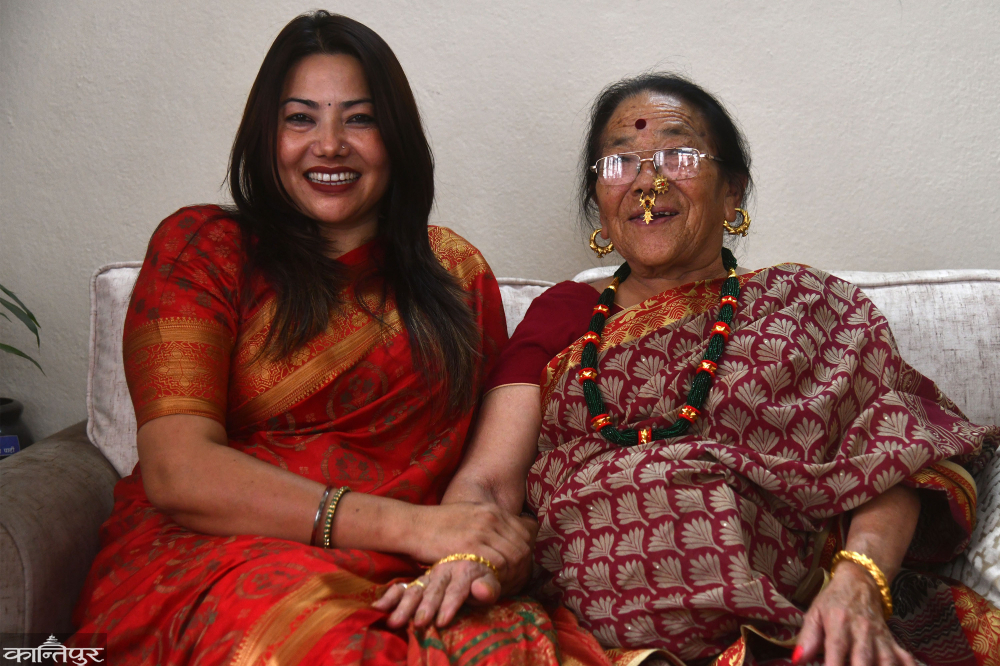
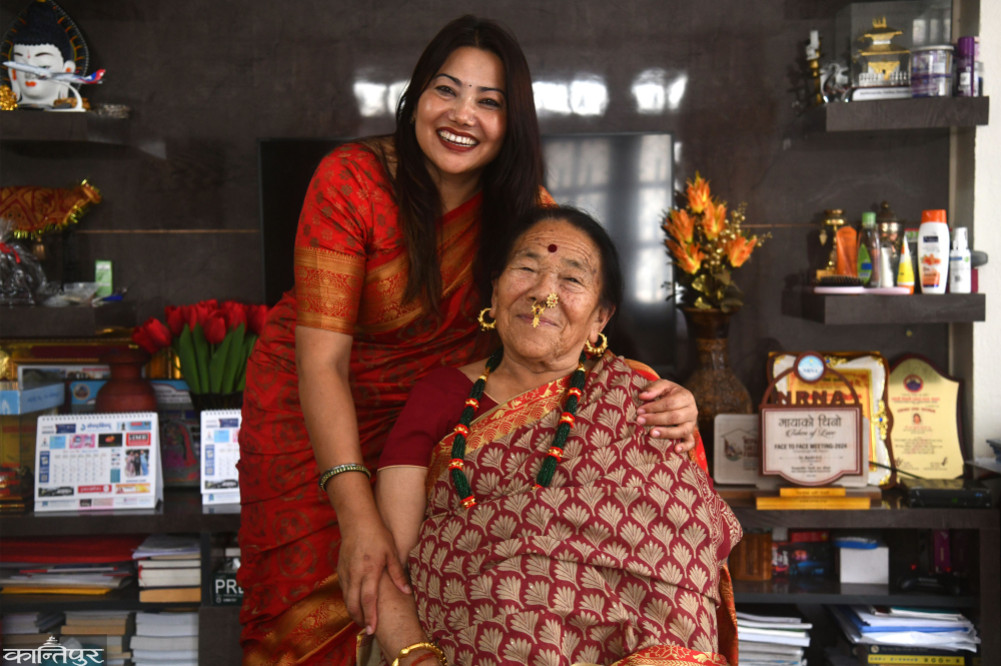
I came here because of my mother's idea that my daughter should be educated and see. ”My mother's thinking was far-reaching,” says Ramkumari, ”My mother also studied adult education for the 20th time but never knew the alphabet.”
We use Google Cloud Translation Services. Google requires we provide the following disclaimer relating to use of this service:
This service may contain translations powered by Google. Google disclaims all warranties related to the translations, expressed or implied, including any warranties of accuracy, reliability, and any implied warranties of merchantability, fitness for a particular purpose, and noninfringement.
When she remembers her mother sitting in Goretto, the forest of the village where she grew up, she feels like this - mother is a huge banyan tree, under whose canopy her children enjoyed themselves. Rankumari Jhankrimgar (83) is a witness of the changing times. He feels as if he has entered another world from a different world. Surrounded by 19 grandchildren, a dozen great-grandchildren, 7 children, Rankumari is amazed by the present, even more amazed by the change of times.
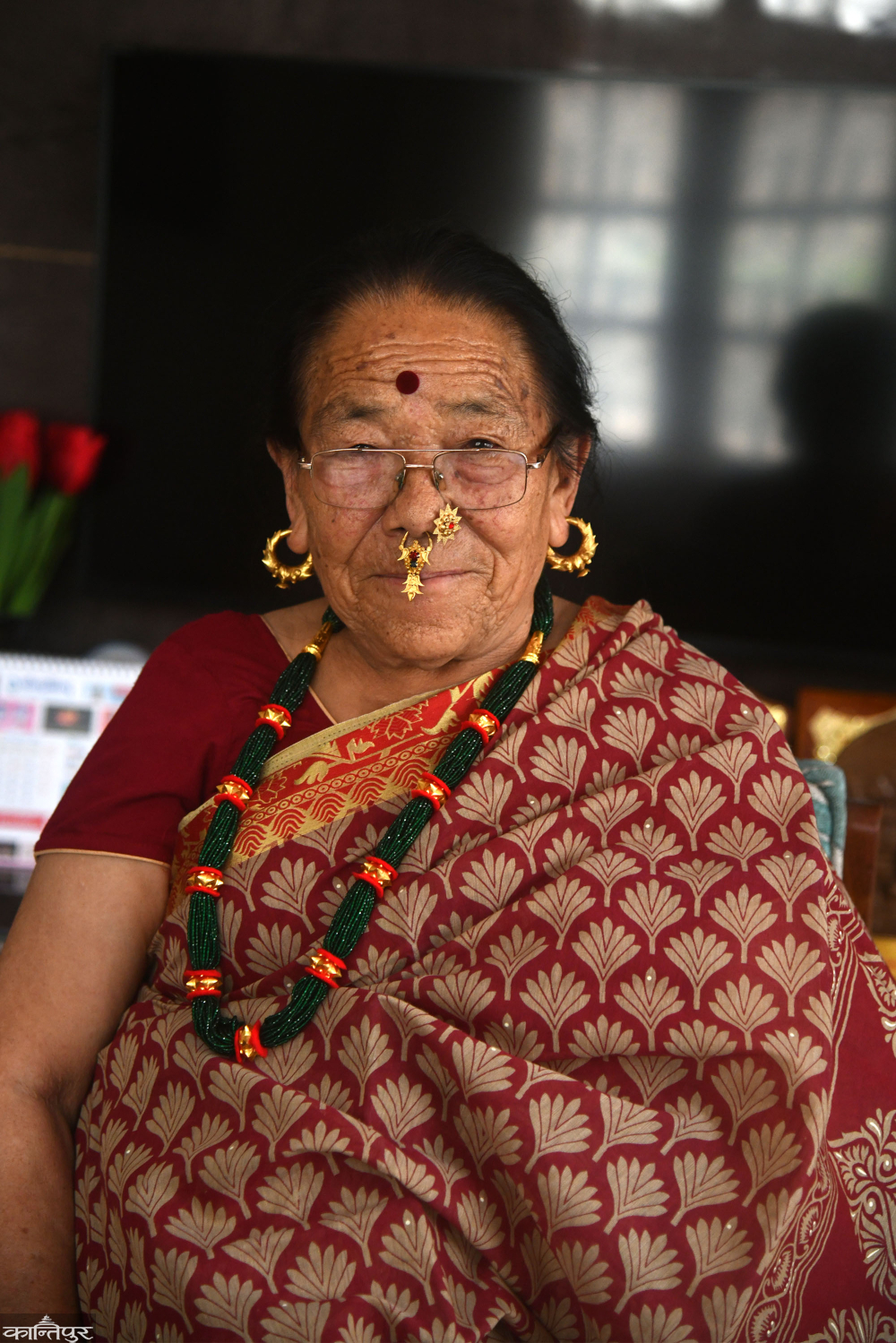
"At that time, I had to go to the forest in the desert at night to defecate, now there is a toilet inside the house. Back then, you had to wash the dishes with ashes, now you have soap,'' says Rankumari, who wears a bulaki in her nose, rings in her ears, a red cloth around her neck and a scarf on her head. How happy people are today. The age has come!'
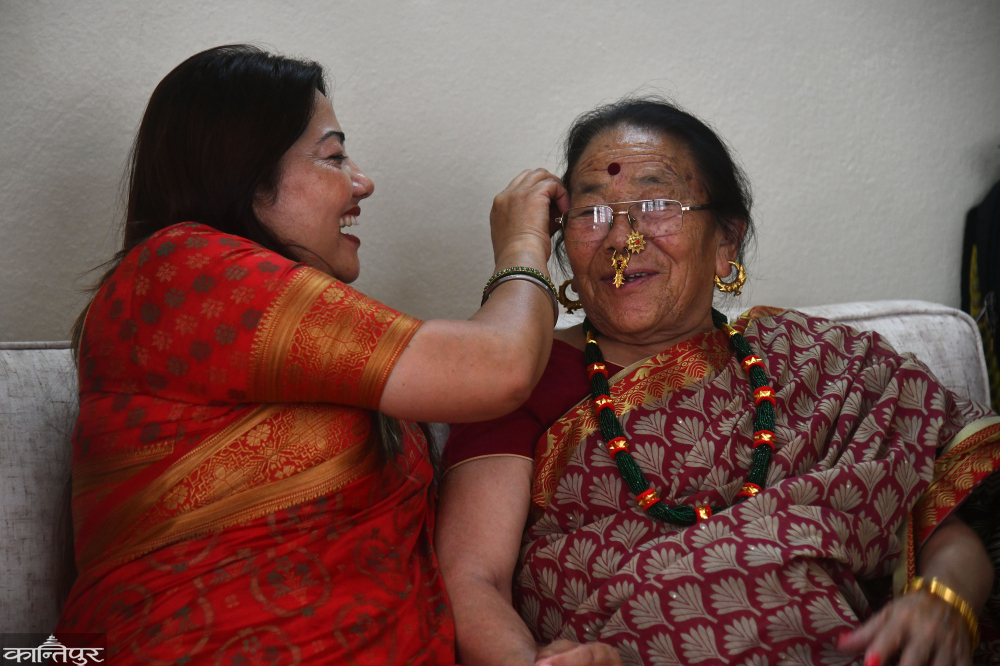
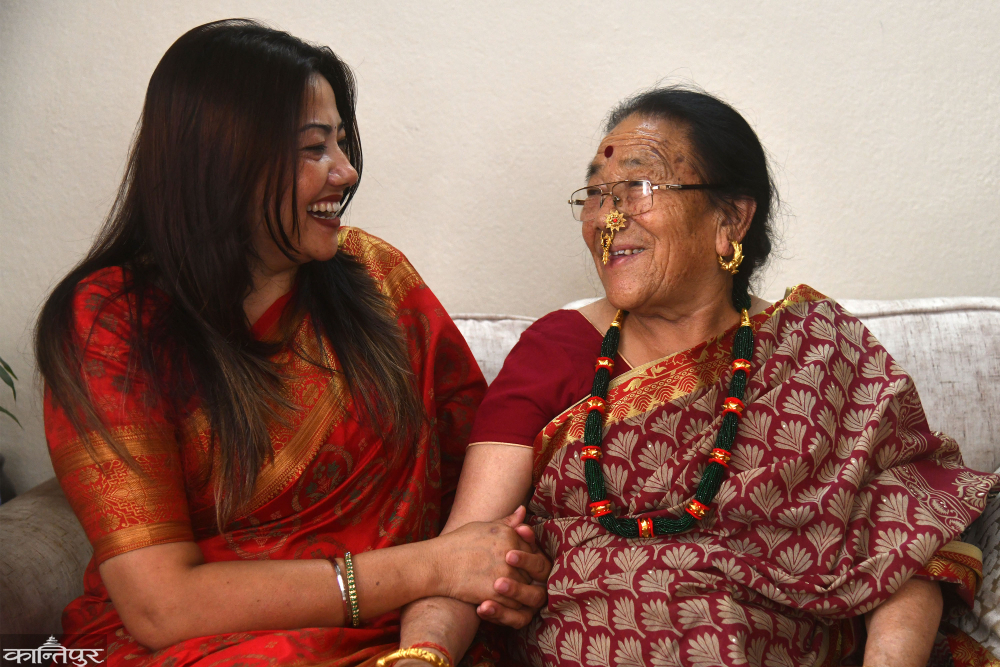
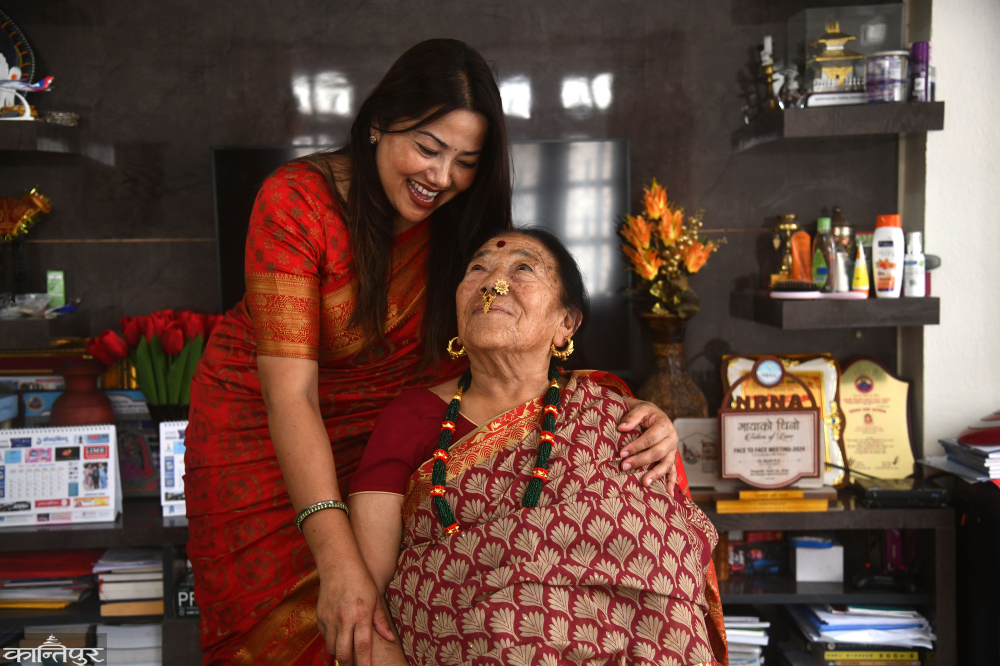
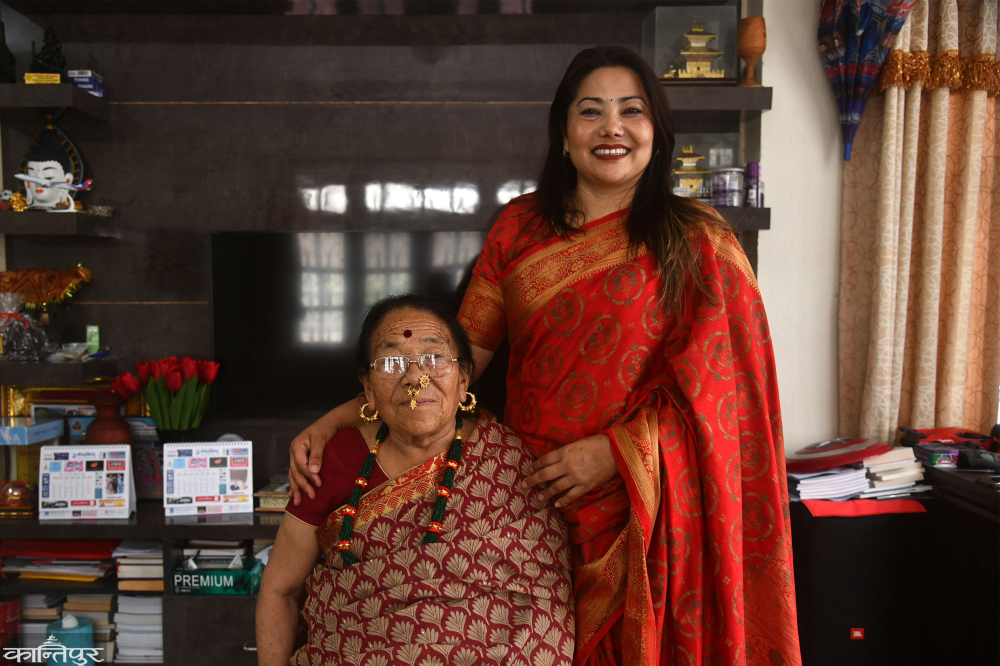
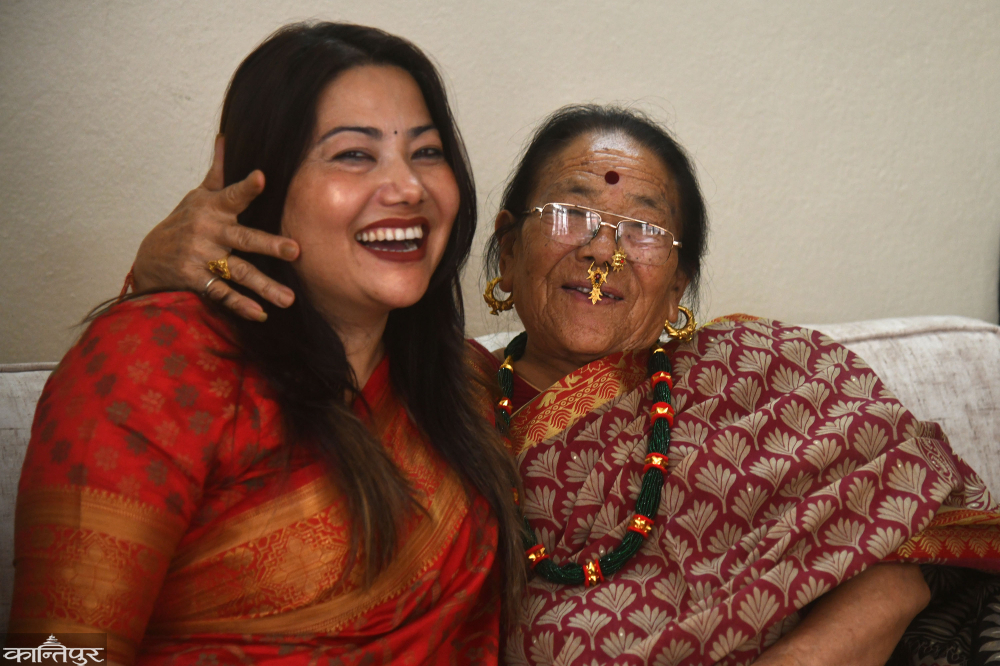 Ramkumari Jhankri with mother Rankumari . Photos : Deepak KC/Kantipur
Dhiki-Janto-Doko-Namlo's golden years of life passed. As much as his life changed like the seasons, Myalpokhari of Gulmi Purkot (currently Madane Rural Municipality-4) where he was born and raised also changed. The signs of change are everywhere in the village, but there is a yearning like a sad singer who saw it in his teenage years, who feels like he is witnessing his own struggles, sorrows and changing times.
Many figures wake up in his memory-world these days. The romantic dream of a daughter who will change the world and the memories of those Kalamme nights wandering the forest with lanterns come more and more darkly. In the waves of memory old sorrows repeat.
***
Rankumari's leader-daughter Ramkumari Jhankri has a lot of questions, other questions are added to the questions. Mother Rankumari is happy to see the progress graph of former minister, secretary of Nepal Communist Party (Unified Socialist) Ramkumari.
When the head was broken during the procession or when the police suppressed the protest, Ram Kumari's mother used to say - 'Daughter, as a human being, you should be able to get out of the trap you entered. You should be able to deal with all the problems. Is there a girl who can burn with Bhungro's firewood?'' To her daughter, there is only one sentence that she keeps repeating - 'I can't' is not a word, you know!'
The villagers used to comment about the daughter who got into the hot spot of politics at a young age - it broke the path. People used to say to Rankumari - daughter will ask you to eat on a plate. Does anyone eat rice with their mouth open? Rankumari replied to him. However, the daughter's suffering did not go away. The villagers used to say that you are spoiling their daughter. I used to say, 'Don't worry if it breaks,'" says Rankumari. Rankumari came to Kathmandu from the village because of her daughter's pain when Ramkumari's head was split during the public movement of 062/63.
 Ramkumari started student politics from Male in 047 at the age of 12. And, she also became the president of Aneraswaviyu, a student organization close to CPN (UML). When he started politics, those were the days when the Congress was beating the Communists and the Communists were beating the Congress. Some of the relatives were Congress, some were RPPA. Ramkumari, who was studying in high school, was expelled from the school. However, his parents supported his politics.
Ramkumari is the first party member of the village. The organization had to walk overnight in the expansion, with the boys. Rankumari used to light a torchlight, lantern or rangoli and follow her daughter through the forest. During the meeting, the daughter would wait all night, if the mother did not go with the daughter, the father would go, and if the father did not go, the brother would go. At that time, where did the mother who did not understand politics walk at night? If I didn't go this way, I should have withdrawn from politics, my steps would have stopped there,' says Ramkumari, 'My political journey is the contribution of my mother, father and brother.' . For him, mother is a teacher.
Rankumari used to tell stories to her children, passing them around from generation to generation. And moral education was in the story. Like, "Once upon a time there was an old woman." His son steals a needle one day and steals a lot of things. But mother always says good bye. Once he stole a chicken and went to break into a neighbor's house. Then the police caught both the mother and the son. "Those stories told by my mother are my guide," says Ramkumari.
Dark days come/go in life, but light also comes, says Rankumari to her daughter, 'Even after rain, the sun shines, after winter, warm days come again. Don't panic, life is a cycle like the weather, the cycle keeps changing.'
***
Ramkumari feels that there was never a break in the life of mother Rankumari. Only work - work and work again was the life of his mother.
were in the house - cows, bulls, Laina-bakerna buffaloes, pada-padi, sheep, chickens, goats. 22, 25 cows and bulls only. Four shepherds were required. It was an economic society based on animal husbandry, agriculture was equally widespread. It used to work for twelve months. "I don't remember a single scene where my mother sat idle even for a moment without working," says Ramkumari, "Even when it was getting dark, my mother would not come home. He used to leave us in bed. And, by the time I got home, it would have been night.'
Melapat, grass, water had to be reached far. That's why Ram Kumari always seemed to hug her mother. ``Ubela wanted to chat with her mother for a while,'' says Ramkumari.
Ramkumari has some childhood memories that hurt. One thread of memory leads to another painful periphery. It was the thread, the mother's daily-circumference. The memory of it is cold in Ram Kumari's heart. That's why even nowadays he doesn't like cold months.
In the winter, the evening falls quickly, in the early evening Shia-Xiaa sings one by one, the children keep looking at their mother's path but the mother does not come, eyes get tired, mouth dry but no! A mother who has gone to work does not come. In fact, those days were very stressful for him and his siblings. The corn would grow and cover the house. The evenings of climbing the bamboo in front of the house and calling 'Ama Ama...' are still etched in Ramkumari's mind. Ram Kumari is crying on the night of hail and rain, but her mother has not reached home. "Yes, that's why I still don't like jhamak evening."
 These days, when the evening falls, Ramkumari's steps rush home, remembering her son. Remembering 'I must be waiting'. In this way, the 'footage' of childhood still haunts us.
***
According to Ramkumari, Mother Rankumari knew that times were changing. "My daughter should at least know paper in this era," she thought. Ram Kumari's sisters were already married at home, she never entered the school yard. Therefore, Ramkumari was the one for the house - a strong working force. It was work and work, the means of subsistence. At that time when the society was opening up, Ramkumari had daily quarrels at home. She stomped her feet saying 'I'm going to school'. She said, 'I don't look at the sheep.'" Father Ratna Bahadur Jhankri said, "I don't know who will look at it, but I will go to school." Ramkumari remembers saying to her husband, 'Now there are papers for Tirovaro, Lalpurja, Tamsuk, what papers will come later? Coins became paper. How will the money come? Times have come like this, you have to read, how can you recognize money and paper if you don't read?'
And, Ramkumari started going to school, at the age of 6. Rankumari smoothed the wooden plank with coals and dried it. She went to school carrying a board, followed by her brother - Sri Myalpokhari Pravima. This mother's decision had a terrible meaning in Ramkumari's life.
I came here because of my mother's idea that her daughter should be educated and make her see. My mother's thinking was far-reaching,' says Ramkumari, 'My mother also studied adult education for the 20th time but never knew the alphabet.'
 She was always first in the class. After reaching the 6th grade, I left school, I had to go a long way to study above the master's level. Moreover, the household economy is weak. The source of income is the same. However, there was no money in hand. That is why jand-alcohol was made and sold at home. Rankumari got a cataract in her eyes when she left school, suddenly she lost her sight. Had to go to Batauli for treatment. Therefore, Ramkumari's 6 months study was spoiled. Soon after the
, Ramkumari's father sold the old house in the village and moved to Gothner's house, where the cattle live outside the village. Water, firewood and grass had to be carried from far away. After moving to the barn, the sorrow was reduced, it was near - school, water, firewood, grass. It became easy for Ram Kumari to go to school. Education is not just about desire, lifestyle and geography make a lot of difference. This is what Ramkumari's education-struggle says.
***
There was a mixed society in the village – Bahun, Damain, Kami, Magars. Rankumari always spoke Nepali language. So he has no knowledge of Magar language. She says, "Because we grew up with Bahun, there was no need to speak our language."
Rankumari got married at the age of 13, close to home. 21-year-old Ratna Bahadur took her in after the death of her first wife. Rankumari's mother also passed away when she was young, her father also had a second marriage.
Rankumari told Ramkumari about menstruation when her daughter was entering puberty. She used to make homemade pads from dhoti cloth and vinegar shells. During the final examination of class 8, Ramkumari, who was menstruating for the first time when she went to get water at Pandhera, was not hidden in the dark room of the house by her mother, she encouraged her to take the exam. She said, 'This is a regular menstruation that a daughter should experience, not something to worry about.' She sat with the boy during the exam. Ram Kumari had an innocent question with her mother - 'What happens if you don't have menstruation?'
Within 15 years after SLC, Ram Kumari's marriage was about to end. Father could not say 'no' to his close relatives. However, Ramkumari became more worried - will politics and education stop here? She said 'I will not marry'. Rankumari also said that she is still young, she should study and move on. Ramkumari says, "Even if that marriage had taken place, I would not have been here. At that time, if my mother had not stood by my side, I would have either left home or got married.'
 ***
***
Ramkumari is the daughter of Rankumari's 3 sons and 4 daughters. Villagers still say 'Saili Ai' when they reach the village. The nannies were quarrelsome, but Rankumari never scolded them when they were together – she only scolded and reminded them when they were alone. She was aware that scolding in front of other children would hurt the other's self-esteem.
Mother used to say to Ram Kumari that she should save money. She kept the Dakshina that her daughters got. She used to encourage Ram Kumari to look for the missing stalks of corn, peel it, grind it, make it into a jar and sell it. The money from that would be the daughter's 'peva'. She used to take care of some food for her daughters who got married and went home. All the daughters had their own pewa chickens, pada-padi. This is how she practiced financial freedom. Ramkumari came to Kathmandu to study with the money she collected. ``Mom taught us that we can only move forward by facing personal challenges and that we should strive for small things,'' says Ramkumari.
Ramkumari says that the mother was worried about the environment at that time. "Earlier, it used to be fertile, now even the field is barren, so you used to worry about what will happen later," says Ramkumari, "Mother knew insects. He knew why potato, corn crops, and seeds were affected by insects. He used to say that seeds should be preserved.'
Maiti was near. He used to go to his maternal uncle's house to get fire, he used to bring fire in bushes and incense sticks. However, she had a strict instruction for her children - they should not go to their mother's house without being called. She used to say, "If the nephew stays in his place, even the uncles respect him."
Rankumari used to bathe Babia's damlo, weave gundri-tapri, make syakhu. She keeps saying, 'Daughter used to suffer more in our time, not so much nowadays. We suffered, but now is a happy time. He should have waited for the festival to eat rice, Nani.'
 It was difficult to eat without gagging. She cultivated corn, millet, rice, barley, wheat. In the garden, she used to grow bananas, belauti (mango), peaches, potatoes, pindalu, and sugarcane - saying that "sons should eat".
Rankumari lives in a village with an older son and a younger son. She has been in Kathmandu for a few weeks now. "The village is fun" to him! After the death of her husband, she started to feel a little lonely and said to her daughter, 'Why stay here in a noisy room? Can't get out of the way. In the village, people respect and ask for peace. It is fun to travel around.' He wants to do 84 pujas - in the village, even to live 100 years.
Ramukiri thinks that his mother's mother is aware of the situation, also a happy man who carried twice with double heavy. The daughter was exhortly to work. There is no waste of time. 'I forgot in gossip, even though she went to bed, I went to harvest. Solid and stone, Dauhra and Dabilo, Dabilo, Dabix, Paniko, Dabilo and Nbsp.
***
-BREAK-BREAK-BREAKAughty daughter is not happy. She was heard that in the village of Minister of Ram Kumari's reputation, 'would be a day. Very good Now what a good job was done. "& Nbsp;
is realizing that he is real, saying, Just as I'm thinking of the son, my mother, but I will not seek my mother. The mother's mind is known to the heart of the mother. 'He does not have to destroy the end of mothers' happy source of mothers. 'Mames are happy to have' children before. In this regard to this regardless of any selfish and condition. Mom is a good relationship between a truth, 'says Ram Kumari,' says Ram Kumari, 'emotionally does not expect too much to children. Mother's mother's mother's mother. Mothers and children are not a connection. '& Nbsp; The
Mom is Laddy, Ram Kumari, 'I am built with her mother's decision. Those decisions were turning the path to my life. 'Ram Ken Manakisumari thinks, also the ruler will also hear, not to be listening, but also to be heard. "Mom is the basis for being able to understand compassion, love, teacher who teaches society. The whole society is on the right direction, when the mother is on the right track, says Ram Kumari.