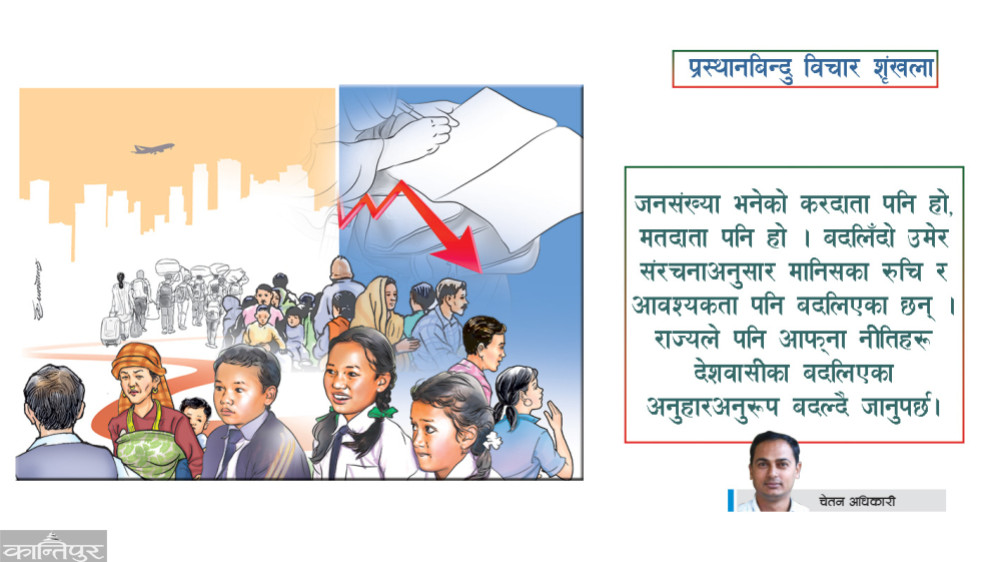
The state should adopt a policy to manage migration from the mountains and hills to the plains, from villages to cities and from the country to foreign countries.
We use Google Cloud Translation Services. Google requires we provide the following disclaimer relating to use of this service:
This service may contain translations powered by Google. Google disclaims all warranties related to the translations, expressed or implied, including any warranties of accuracy, reliability, and any implied warranties of merchantability, fitness for a particular purpose, and noninfringement.
In the book 'The Age of Aging', famous economist George Magnus has written, quoting George Bernadshaw - 'The day is coming, even great nations will find their numbers dwindling from one census to the next.'
After analyzing the demographic trends of the world, Bernadsha's expression has now been applied in most countries of the world. In some developed countries, the number of people has decreased, and in the developing and developing countries, the population growth is very narrow.
The world's population is now about 8 billion. Despite having such a large population, the world's concern is about the declining population. When the world's population reached 5 billion on July 11, 1987, there was concern around the world about how the world could sustain such a dense population. Two years after that, i.e. from July 11, 1989, the World Population Day was celebrated on the call of the United Nations in order to send a message to everyone to control the growing wave of population growth.
There are many dimensions of population growth and decline in the world. Fertility rates around the world increased, especially as soldiers returned home with the end of World War II (1945). The reproductive process was interrupted when the youth joined the war as soldiers. When the war was over, the Lahures returned home. met his wife. The unmarried got married. After the end of the war, from 1946 to 1964, the number of children increased dramatically. This period is known as the 'Baby Boom' period. In 1964, the annual population growth rate was the highest ever recorded at 2.24 percent. When 714.3 million children were added in one year, it was concluded that the world's human population would struggle to keep up.
From that point on, population control efforts spread around the world. This campaign was especially intensified in third world countries. As a result of that, the population growth rate started to decrease for a few years. According to the World Population Data Sheet, the world population growth rate in 1960 was 2 percent. But growth has slowed to 1 percent in 2010 and 0.7 percent in 2024, projected to nearly plateau by 2050. While the population growth rate will be only 0.4 percent. The size of the population is decreasing as a result of efforts made by Nepal in about 6 and a half decades.
The shadow of the world in Nepal
It is not that Nepal will remain untouched by the changing population trends in the world. Since the 1960s, the government has been trying to control the population and has achieved almost. The Nepal Health and Demographic Survey 2022 showed the total fertility rate of Nepalese women to be 2.1, while the National Census 2078 showed only 1.9. The total fertility rate in Nepal in 1981 was 6.4 per woman. This means that four decades ago, a Nepalese woman of reproductive age would have given birth to more than six children. That number has been declining to 4.6 in 1996 and 1.9 in 2021. While the total fertility rate was 6.4, Nepal's average population growth rate was the highest ever at 2.62 percent. Now it is 0.93 percent. There are many reasons for declining fertility rates. Among them, women's education, employment, availability of family planning tools, and strong health are the main ones. After the International Conference on Population and Development (ICPD), 1994 established reproductive rights as women's rights, appropriate laws were made in Nepal, using which the birth rate in Nepal also decreased rapidly.
Whatever the current opportunity or challenge of Nepal's population is, it is structured according to the age structure. People have accepted the government's policy of population control since the third five-year plan, which is why now there are a significant number of Nepali couples who are satisfied with two or one child at most. The decrease in the birth rate has brought fluctuations in the demographic structure of Nepal according to age.
The most hot topic of Nepal's population is 'age shifting of population' i.e. the transfer of age. The decline in birth rates is changing the structure of the population, due to which the number of children is decreasing while the number of young people and senior citizens is increasing. In 1991, the population in the age group of 0-14 years was 42.4 percent and in 2001, this number decreased to 38.7 percent. The 2021 census showed that the population of this age group has further decreased to 27.8 percent. In 2011, the population of children was 34.9 percent, which has decreased by 7 percent over a period of 10 years. On the other hand, the population of young and senior citizens is gradually increasing during this period.
Since 1991, the population of the active age group in Nepal has increased by about 11 percent. The population of this age group that can fully participate in economic production was 54.1 percent at that time, 55.4 percent in 2001, 59.9 percent in 2011, and 65.4 percent in 2021. The population growth trend of this age group seems to be gradually increasing. Many children who were born yesterday when fertility rates were high have entered young adulthood today. As the population aged 0-14 years is decreasing, the population above 65 years is increasing.
In the year 2048, the population over 65 years of age in Nepali society was 3.5 percent, but now that number has reached 6.9 percent. If 7 percent of the total population is over 65 years old, it is called an aging (senior citizen) oriented country. In terms of population growth rate, Nepal seems to enter this stage in 2027. When the population above the age of 65 reaches more than 14 percent, it is called a country of 'senior citizens'. In 2054, more than 14 percent of Nepal's population will be over 65 years old. Compared to this, the population of children and active age groups will decrease sharply. At this time, the dependent ratio will increase and the economic output will decrease. Aging-oriented and When reaching old age, the population growth rate of the elderly is rapid, i.e. more than 3 percent. The current growth rate of elderly population in Nepal is similar to that of Japan from 1970 to 1994.
The effect of age conversion
The changes in the age structure of the population have had many effects on the society. As such, the main cause of internal and international migration is the change in the age structure of people. When the youth population increases, the country's population becomes dynamic. In search of economic opportunities, young people reach the country and abroad, and their dependent families and relatives are also affected by it. This creates an imbalance in population distribution. For example, the main reason for the declining population in the Himalayan and hilly districts of Nepal is the migration of young people to the urban areas of the country in the name of working abroad, studying or earning. According to the 'Population Composition of Nepal' report based on National Census 2021, about 600,000 people enter Nepal every year after passing 14 years and 15 years, i.e. productive age. Similarly, every year after passing 64 years, about 150,000 people enter old age.
The Foreign Employment Promotion Board has said that the number of Nepalis going to countries other than India through formal and informal means has reached about 5 million. According to the latest census, about 2.2 million Nepalis are outside Nepal. Most of this number is in the active age group. In 1952/054, 2.4 percent of the total Nepali population was outside the country, and now this number has reached 7.5 percent. 3.3 percent of the total population in 2001 and 7.3 percent in 2011 were abroad.
The changing age structure has also brought changes in the dependency ratio. Nepal is now in its golden age as the active age group population is 65.2 percent. Various indicators have shown that Nepal is in a state of demographic dividend. In particular, the population of the elderly and children who are dependent on people of working age in the family is the dependent ratio. This ratio has changed dramatically to 53.3 percent now. This means that every 100 able-bodied people have to support only about 53 people. According to demographers, when the dependency ratio of any country falls below 60, then that country enters a state of demographic advantage.
Demographic advantage is the condition of having a majority of young age population that leads the country to the destination of prosperity. The country and the government should have a plan to take advantage of this situation. Let's look at some historical data to see how changes in the age structure reduce the dependency ratio. In 1961, Nepal was in a situation where a person who could work had to take care of a child or an elderly person. At that time the dependency ratio of Nepal was 97.6. Improvements in mortality and decline in fertility changed the situation so that by 1991 the ratio had fallen to 80.5.
has been limited to 67.2 in 2011 and currently 53.3. Another effect of this is that the ratio of dependent children is gradually decreasing, while the ratio of senior citizens is gradually increasing. In 2001, the child dependent ratio was 69.7 and the senior dependent ratio was 7.5. In 2011, the child dependent ratio decreased to 58.4 and the senior dependent ratio increased to 8.8. Currently, the child dependent ratio has further decreased to 42.7 and the senior dependent ratio has increased to 10.6.
The National Census, 2078 showed that the dependent ratio of some districts is much lower than the average, which means that there is a predominance of productive population. For example, Manang (33), Kathmandu (34), Lalitpur (35) and Bhaktapur (36) have the lowest dependency ratios. The dependency ratio in some districts of Far West, Karnali and Madhesh is still significantly high. The districts with the highest dependent ratio are Achham (81), Bajhang and Doti (75), Rautahat (74), Calikot and Mugu (72).
In the end, as George Barnard said, population growth from one census to the next is declining. In Nepal, 33 lakh 43 thousand people were added during the period 2058-068. In 2068-078, this number decreased by about 7 lakh to only 2.677 million people. We are now in the same demographic transition that developed countries experienced many years ago. Considering the changing nature of the population, the government should not delay in making and implementing plans to make the country leap forward in development and prosperity. The population is both taxpayers and voters.
therefore cannot proceed without ignoring it. According to the changing age structure, people's interests and needs have also changed. Therefore, the state should also change its policies according to the changing face of the countrymen. As the fertility rate declines, the youth population naturally increases. A few years later, the population of senior citizens will also increase. In this situation called demographic transition, the state should start making programs for the care of senior citizens. The state should adopt a policy to manage migration from mountains and hills to the plains, from villages to cities and from the country to foreign countries.