Capital does not always seek only opportunities; it also seeks predictability, competence, and transparency. The government should create an environment that addresses the problems of the private sector and responds promptly to the issues they raise.
We use Google Cloud Translation Services. Google requires we provide the following disclaimer relating to use of this service:
This service may contain translations powered by Google. Google disclaims all warranties related to the translations, expressed or implied, including any warranties of accuracy, reliability, and any implied warranties of merchantability, fitness for a particular purpose, and noninfringement.
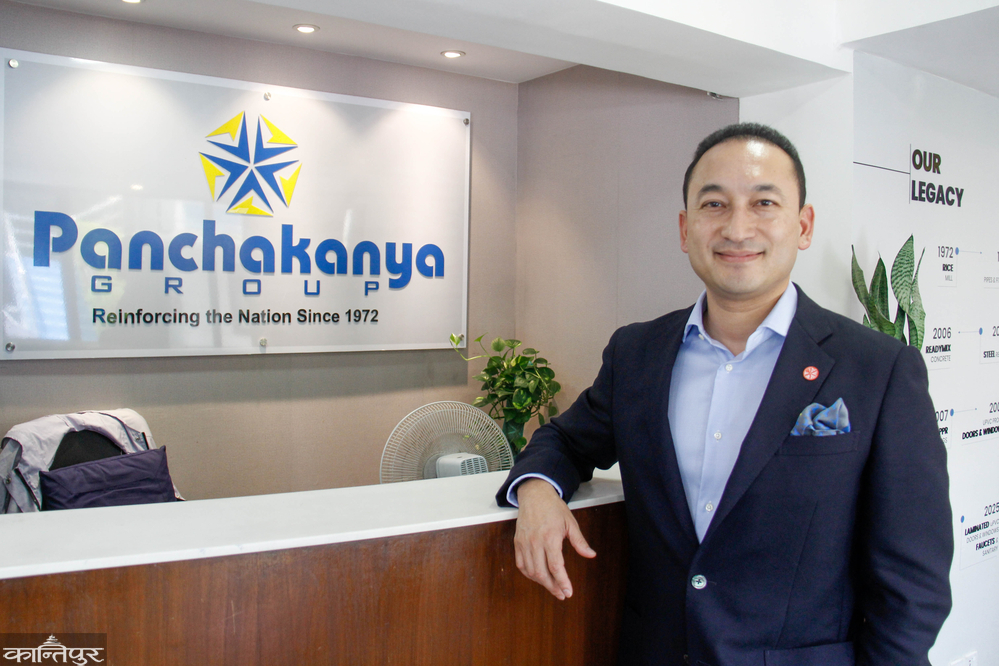
Ujjwal Kumar Shrestha is a third-generation young entrepreneur from the established business house Panchakanya Group, which has been investing in Nepal’s productive (industrial) sector. Founded in 1972, Panchakanya Group currently has him as its Executive Director. Even now, seeing immense potential in Nepal’s industrial sector, Ujjwal is rapidly expanding investments and is planning to add one or two more industries in the near future.
Here are edited excerpts from a conversation with Shrestha, Executive Member of the Federation of Nepalese Chambers of Commerce and Industry and Chairperson of its Industry Committee, conducted by Kantipur’s Yagya Banjade and Bimal Khatiwada, on the economy, investment climate, industrial development, and future business plans:
Over nearly five and a half decades, Panchakanya Group has witnessed many ups and downs in Nepal’s economy. Based on that experience, how do you assess the current state of the economy?
Currently, the confidence of the private sector seems to be gradually increasing. In the past, the confidence of industrialists and businesspeople had declined. To find the reason, we have to go back to the time of COVID. That year, there was an expansionary budget (fiscal policy) and a flexible monetary policy. But before the economy could recover, the government and Nepal Rastra Bank suddenly started to adopt a tight policy.
At that time, a tight policy was necessary, but it was tightened too much all at once. The results of that are now visible. Even the policies made earlier could not be implemented effectively. This prevented the economy from recovering and the private sector’s confidence from increasing. Now, there are signs of gradual improvement.
Between policy instability and political instability, which is more responsible for the current state of the economy?
Both policy and political instability have led to this situation in the economy. Until a few years ago, there were frequent strikes and shutdowns. This affected trade and business. Trade unions also caused difficulties. Now, that problem is rarely heard of. But policy instability still persists. Even when making long-term business plans, we have to think a lot.
The situation was such that you never knew when a policy would change. Looking at the past five years, there have been many policy upheavals. Until 23 and 24 Bhadra 2082, there was political instability. With the formation of a new government, it is expected that political instability will end. The government has started working. The government’s policy is to encourage the private sector. The government has listened to the private sector. The results remain to be seen.
Just last week, the private sector met with Prime Minister Balendra Shah. You seemed enthusiastic, but even with excess liquidity in banks and low interest rates, what is preventing the private sector from expanding investment?
Until a few years ago, there were frequent strikes and shutdowns. This affected trade and business. Trade unions also caused difficulties. Now, that problem is rarely heard of. But policy instability still persists.The Prime Minister meeting and listening to the private sector has encouraged us. With so much liquidity in banks, the private sector should be making a big leap. But that hasn’t happened as expected. Because banks are now focused on managing the loans they previously disbursed, and businesspeople are making investment decisions based on market conditions and risk levels. Their focus is on how to manage cash flow for risk management. Non-performing loans in banks have increased. Therefore, they are cautious about further lending. Until a few years ago, there were frequent strikes and shutdowns. This affected trade and business. Trade unions also caused difficulties. Now, that problem is rarely heard of. But policy instability still persists.
What is the current state of the rebar (steel rod) industry?
Until before the 2015 earthquake, annual rebar consumption was up to 1.5 million tons. At that time, there were 18 rebar industries. After the earthquake, 12 more industries were added. There was a lot of reconstruction work after the earthquake, so investment in such industries increased. But during COVID, the situation became dire. Companies started reducing the number of employees.
During this period, annual rebar consumption dropped to 800,000 tons. After the earthquake, it had even reached 1.6 million tons. Now, it is increasing again. After COVID, due to government policies and regulations, some industries even shut down. Initially, there were industries with an annual production capacity of 3 million tons. Now, the capacity has increased to 5 million tons. But the pace of development and construction is slow.
Will industries operate at full capacity in the coming days?
The current government has said, “Let’s do something for the country, let’s encourage the private sector.” This is a positive aspect. It has only been four months since the new government was formed. The current interaction with the private sector should be advanced differently than previous governments. We should be moved forward not as witnesses, but as partners.
Capital always seeks not just opportunity, but also predictability and transparency. The government should create an environment to solve the private sector’s problems and address issues raised quickly. Previous governments also brought good policies, which were good on paper. But they were not implemented. If this government is strong, we will be strong.
Which areas do you want to expand investment in through Panchakanya Group this year?
Our goal is to launch five new products by 2030. In 2024, the previous government was still in place, and it was a difficult time. But we saw opportunities. We have opened Nepal’s largest window and door manufacturing industry in Bhairahawa. We have also started bathware. Our aim is to substitute imports.
Previously, 95 percent of window and door items came from China and 5 percent from India. In the past two years, about 30 to 35 percent of consumption has been met by locally produced goods. In Nepal, most faucets and commode items are foreign. In the coming days, Panchakanya will provide construction-related materials from a single location.
There are 18 such industries in Nepal. Previously, they provided employment to up to 1,800 people. After COVID, this number has dropped to 1,200. It is very difficult to find skilled labor.
Your family has been in business for generations. Are you also adding foreign partners?
There is a lot of demand in Nepal’s service sector. In this era of digital AI, many have invested in the service sector. If someone tells me they want to do business, I tell them to look at the market before investing. We are between China and India. We can produce here and compete with these countries. But being between China and India brings both opportunities and challenges.
How many times bigger are China and India than Nepal? What is the production cost there? The consumption of produced goods is higher and there are more consumers. Our economy is small. What industries need to do is reduce production costs. This can be done through automation and technology. That’s why we have been asking the government for concessions on electricity, but unfortunately, the government has imposed taxes.
Youth are migrating abroad. What are your suggestions for creating an environment for them to stay in Nepal?
Seeing the working style of previous governments, many youths became discouraged and left in search of opportunities. Everyone has different opinions. Now, the government is also led by youth. This has raised some hope. Let’s see for a year. Once the government starts showing results through its work, the environment for staying here will gradually be created. It is difficult to find a country with peace and security like Nepal. So, as good work continues, youth migration will naturally decrease.
When we meet you five years from now, what will your industry look like?
In five years, how many industries I have been able to substitute imports for in Nepal will measure this. If we continue in this way, Panchakanya Group will expand further. By 2030, the number of industries to be added will reach five. Overall, more than market share, wherever we have established industries, we have maintained quality. We will make our quality even more effective.
You are the Chairperson of the Industry Committee of the Federation of Nepalese Chambers of Commerce and Industry. What kinds of problems do industrialists mainly face?
The Federation of Nepalese Chambers of Commerce and Industry is present in all 77 districts. It is an old institution that understands the problems of all types of small, medium, and large entrepreneurs. I am happy to be the Chairperson of the Industry Committee. I am learning and understanding many things. The committee’s plan is to move forward carrying everyone’s problems. We are not the government; we are an institution that alerts the government. We have made plans to move the three-year term forward in a different way.
Photos: Dipesh Darshandhari/Kantipur

