
Legal Barriers to the Adventure Tourism Industry
Due to the complications in the approval processes of various agencies, investments worth hundreds of millions in bungee, zipline, water parks, and motorboats are at risk. The lack of clear legal provisions has created confusion not only among investors but also at the local level.
We use Google Cloud Translation Services. Google requires we provide the following disclaimer relating to use of this service:
This service may contain translations powered by Google. Google disclaims all warranties related to the translations, expressed or implied, including any warranties of accuracy, reliability, and any implied warranties of merchantability, fitness for a particular purpose, and noninfringement.
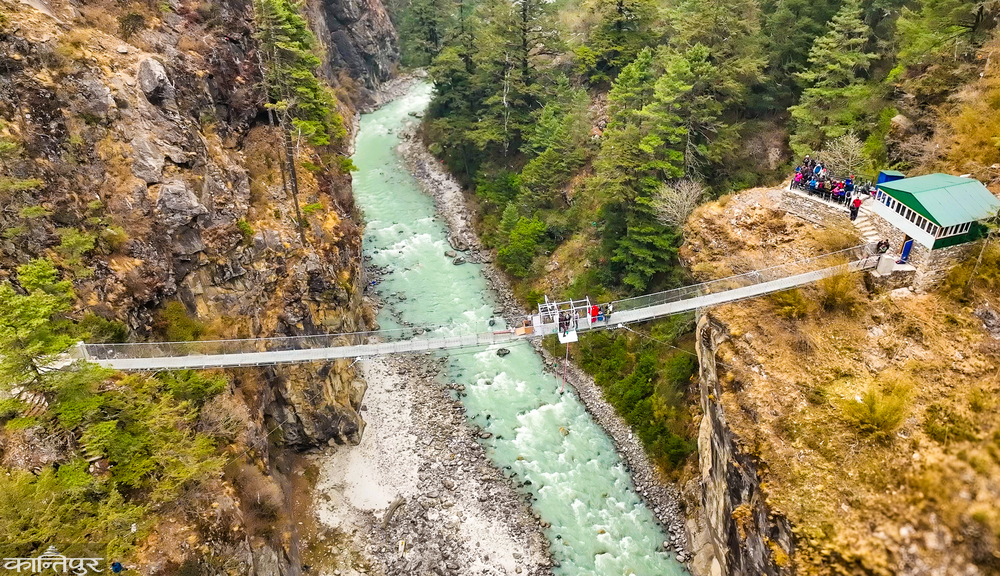
Namche Bazaar lies on the main route to the world’s highest peak, Everest. Right next to Namche Bazaar, which sits at an altitude of 3,400 meters above sea level, flows the Dudh Koshi River. It was on the old Hillary Bridge over this river that Chepal Dorje Sherpa’s Everest Bungee was located.
In Baisakh 2081, after obtaining the necessary permits from Khumbu Pasang Lhamu Rural Municipality and Sagarmatha National Park, Dorje imported the required equipment from India and France and started the bungee operation. By then, an investment of 14 million rupees had already been made. Exactly one year after receiving the permit, in Baisakh 2082, the bungee came into operation. He started the bungee with the idea that trekkers or mountaineers could experience the thrill of jumping for a few seconds over the roaring Dudh Koshi, 145 feet below. The attraction of the bungee was growing. The operator was happy. But Dorje’s happiness did not last long.
Because someone filed a complaint at the District Administration Office in Salleri, questioning, “How was a private company allowed to operate a business on a government-owned bridge and public river?” After this complaint, the bungee had to be stopped.
“What was my fault?” Chepal told Kantipur, “I started it after registering with the local government and the park. But later, various legal clauses were cited.”
After the complaint was filed at the Solukhumbu administration, Chepal’s long journey of administrative entanglement began. He started running from the Department of Tourism in Kathmandu to government offices in Lukla and Namche. Ministry of Forests and Environment, Department of National Parks, local government, Department of Tourism, District Administration Office, Company Registrar—Chepal could not find a solution amid the web of different procedures at each. He said with disappointment, “There are different procedures at the Ministry of Forests and Environment, Department of National Parks, local government, Department of Tourism, District Administration Office, Company Registrar. When nothing worked, I spent nearly 4 million rupees to remove all the bungee structures from there.”
Chepal is now constructing a “single pillar bungee” on private land nearby. He said that about 50 million rupees have already been invested in the new project. “Within the next three months, I will bring the bungee into operation from the new location,” he said from Kathmandu, “All processes are in the final stage.”

Most individuals or institutions who have invested or are investing in adventure tourism recently have experiences similar to Chepal’s. Such legal complications are a common story among many entrepreneurs working in this sector. These stories are not only filled with procedural hassles and frustrations, but due to the state’s unclear policies, the large investments in this sector have not been able to yield returns.
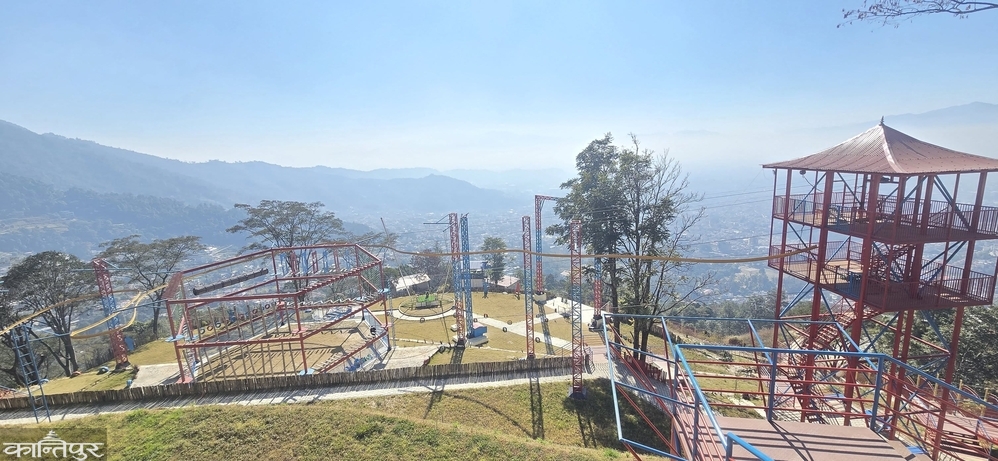
There is a similar story in the foothills of Shivapuri, north of Kathmandu. Ram Avatar Yadav, operations head of Shivapuri Thrill Adventure Park, has a long tale of government procedural complications just like Chepal. The park, spread over 24 ropanis, is currently in operation, but its permit process has not yet been completed.
Describing the procedural hassles during the construction of this park, built with an investment of nearly 110 million rupees, Yadav said, “The same document has to be submitted to dozens of offices. After obtaining construction and operation permits from Shivapuri National Park, we learned about the rule requiring a license from the Department of Tourism.”
The park’s environmental study has been completed. Now, to obtain a license from the Department of Tourism, he has submitted the required documents as per the checklist. “After reviewing the documents, there will be a field visit,” said an official from the department. “If all processes match the checklist, the license will be issued.” This park, which operates 10 types of adventure sports, provides employment to 20 people. Here, about 300 tourists, including Nepalis and foreigners, come daily to participate in adventure activities, buying tickets ranging from 200 to 700 rupees.
000
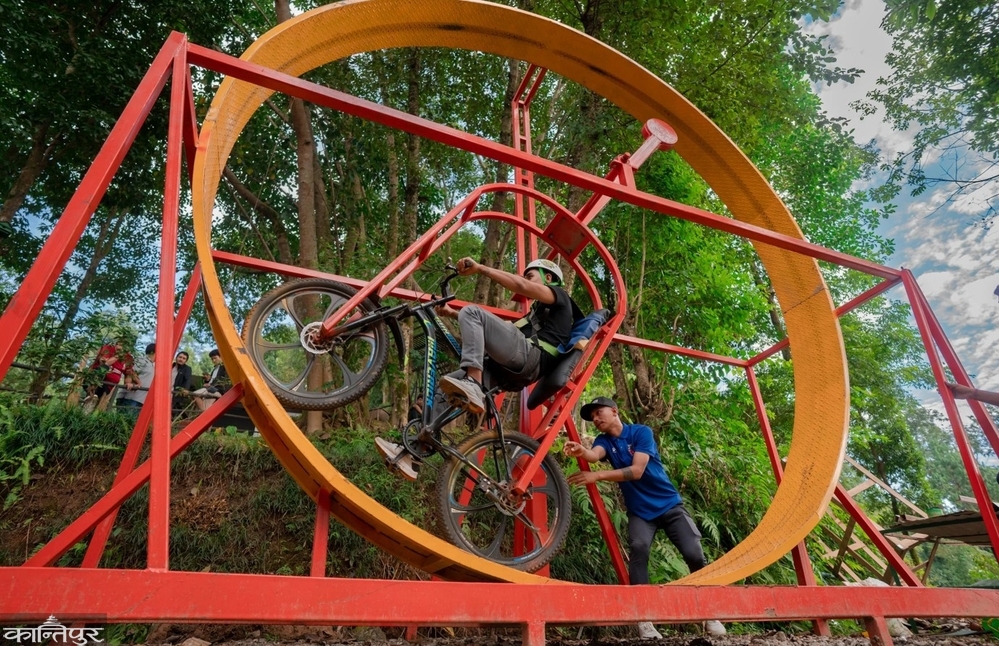
Not just bungee jumping and fun parks, but across the country, 17 other adventure tourism activities such as zip flyers, canyoning, heli-diving, skiing, heli-skiing, and similar activities are currently in operation. However, the operators of such activities are facing a different kind of hassle and complication. This is because the work of granting permits, licenses, regulation, and renewal for such activities has been handled by the Department of Tourism under the central government. Meanwhile, these companies have also been dealing with permits and other procedural work at the local and provincial levels.
After the implementation of federalism, the authority to register and regulate hotels, homestays, travel agencies, and trekking companies has been transferred to the provincial and local levels. According to the Tourism Act, the authority to grant permits for adventure sports remains solely with the Department of Tourism under the federal government. Even though businesses related to adventure sports are part of tourism, the work of granting permits and regulation remains with the Department of Tourism at the central government.
The department does not even have integrated data on how many small and large adventure tourism companies are in operation, how much investment they have, or how many people they employ. According to Director General Lamichhane, after complaints began to be filed about adventure activities being operated without a license, the department issued a notice to regulate them.
According to Ram Krishna Lamichhane, Director General of the Department of Tourism, apart from 56 companies across the country, no other individuals or institutions have officially obtained permits to operate adventure activities. After complaints were filed that some adventure businesses in certain locations were not following government procedures, the department issued a public notice on Baisakh 21, requiring all unregistered bungee, canyoning, rock climbing, zip flying, speedboat, skywalk, ultratrail, fun park, and other adventure activities in operation to register and obtain permits as per the law. The deadline for this has now expired.
According to the department, not as many entrepreneurs as expected have joined the registration process. “Even after giving the whole month of Jestha, most did not come into the department’s registration process,” said an official from the department. “Only 5 or 6 came into the permit process. Many are still operating without obtaining permits.”

The department has made environmental impact assessment mandatory according to the investment ratio in the permit process. For example, if the investment exceeds 20 million rupees, such projects will only be allowed after conducting a brief environmental study, and for infrastructure with investment exceeding 50 million rupees, a preliminary environmental test is mandatory. Environmental work is not the department’s responsibility; it falls under the Ministry of Environment. The environmental study of any project cannot be completed in a few days; it takes months.
The Tourism Act 2035 includes adventure activities under “other tourism businesses.” But this definition itself is not complete, as it does not cover adventure activities such as motorboats, skywalks, sky cycling, amusement parks, etc. Therefore, the department was preparing to introduce separate regulations to include these new areas. However, after the new Tourism Act was passed by the National Assembly but stalled in the House of Representatives, the process was halted.
Even though new technologies and sports are being added to adventure sports, Nepal’s laws are not updated in a timely manner, so the problem of how to regulate many sports remains the same. Another example of this is the motorboat operated in Babai, Dang. In Baisakh 2081, Hanshraj KC of Dang, along with Deepak KC, Umesh Dangi, and Jit Bahadur Dangi, dreamed of working in agriculture and tourism in their own village and started operating two motorboats on the Babai River in Motipur with an investment of 6 million rupees. They built a reservoir by damming the river near the suspension bridge constructed for people to cross the Babai River and started the motorboat. But the story repeated itself, just like in Chewang, Solukhumbu.
Initially, they tried to register the business at the Department of Tourism. But after the department’s suggestion, they filed an application at the Nepal Ship Office in Ekantakuna and started the service. However, someone filed a complaint at the District Administration Office. Then, on the order of the Chief District Officer, the motorboat operation in Motipur was shut down. Hanshraj KC, one of the operators, said, “It operated for only 15 days. Ten thousand people used the service. But after the complaint, it was immediately closed.”
According to Rajan Pradhan, acting registrar at the Nepal Ship Office, the new Ship Bill prepared by the office proposes that approval from the office will be mandatory for operating water transport powered by motorboats. Although the bill was passed by the National Assembly under the previous government and reached the House of Representatives, it has not been passed due to changing political circumstances. Due to the lack of clear legal provisions, the office has not been able to process applications like the one submitted by KC, Pradhan said.
Adventure activities in Nepal are generally not city-centered. They are located far from urban areas, in jungles, rivers, lakes, and hills. To operate adventure activity-based industries, the private sector must lease government public land and property such as rivers, forests, ponds, lakes, and bridges for a certain number of years. For this, the process must be initiated through the Ministry of Land Management, Cooperatives, and Poverty Alleviation. However, after the government repealed the “Policy on Registration, Use, and Lease of Government Land, 2079” in the first week of Asar 2083, officials at the department said that further confusion has been added to adventure activity-based industries operating in public places, those operating without permits, or those preparing to operate.
“Whether it’s a river, stream, or waterfall, for any investment, big or small, in adventure sports started on public property, permission must be obtained from the central government,” said Himal Gautam, Director at the Department of Tourism. “Even small investments connected to public property must go to the federal government’s Council of Ministers due to the legal situation.”
He said that although many entrepreneurs come to the department for permits, the department itself does not have clear acts or regulations. Director Gautam said, “Even when people come saying they want to comply with the law, the department has not been able to provide a ‘legal way out’ to some. Because many agencies and many laws must be followed. But many laws have not yet been made.”
On one hand, unclear government policy; on the other, government procedural hassles. As a result, when entrepreneurs have to visit government offices for months, they have been assigning the task to legal and consulting firms. Legal and consulting firms handle the process of obtaining permits under the government process of conducting environmental studies.
Ram Avatar Yadav, operations head of “Shivapuri Thrill Adventure Park,” says that the involvement of many government agencies and their differing rules increases the hassle. He said, “The laws of many agencies are attracted. The same work is repeated many times, and it becomes easier when the running around is assigned to consultants.” Other entrepreneurs and stakeholders who contacted Kantipur also shared stories of procedural complications and running around similar to those of Chepal Ram from Solukhumbu, Hanshraj from Dang, and Ram Avatar from Shivapuri, Kathmandu.
Some have stories of procedural hassles and confusion due to federal, provincial, and local laws, while others only learned about the procedures after making large investments. Not only private investors but also local governments have been caught up in such complications and confusion.
The investment made by Mane Bhanjyang Rural Municipality in Okhaldhunga is one such example. For the past two years, the local government has been operating a zipline in Kettuke, Mane Bhanjyang. However, they had not obtained a permit from the Department of Tourism.
Rural Municipality Chairperson Gyanendra Rumdali said that, after consulting with local representatives, they built the zipline with a budget of 5 million rupees to promote tourism. He said, “We had to obtain permission from the Department of Tourism under the federal government, but we didn’t know at first. Now we have realized that many laws have not been complied with.”
Chairperson Rumdali said that after the Department of Tourism issued a public notice, they have started the legal process for a permit. He also said that since helicopters also fly in the area where the zipline is located, they have corresponded with the Civil Aviation Authority of Nepal about the zipline due to the risk of accidents from the wires.
000
Wonderland Water Park operates in Ramdaiya, located on the Janakpur–Dhalkevar road section. The slides, artificial waves, and water fountains it offers attract not only locals but also Indians from the border area. Built with an investment of 120 million rupees and in operation since Falgun 2081, this park covers 300,000 square feet.
Listening to the experience of Guddu Jain, a native of Janakpur and operator of this park, reveals how complicated it is to operate a business that includes adventure sports. Jain said, “My friends in India run similar structures with permission from a single office. But in our country, for registration or renewal and other work, we have to visit many offices from the local to the central level. The processes connected to the federal and local governments are very cumbersome.”
He said the problem lies not so much in the rules themselves, but in the unrelated structures among the agencies that implement them. A skilled lifeguard is mandatory to operate a water park. The lifeguard is the one who saves lives by swimming if someone drowns. But he said that such manpower is very limited in Nepal. Therefore, he has to bring lifeguards from India.

“All employees, including lifeguards, must be paid through the bank,” he added, “but it’s not easy for foreign workers to open accounts in local banks. You have to go to Kathmandu and first get approval from the Labor Office. That’s not enough; now it’s mandatory to enroll in the Social Security Fund. But Indian workers who come for six months don’t want to get caught up in this government hassle. They just want their money easily. They don’t like running around government offices.” According to Jain, when the Department of Tourism in Kathmandu issued a notice in Baisakh regarding unregistered adventure activity-based industries, the Tourism Office under Madhesh Province in Janakpur was not even aware of it.
He said, “I learned about the notice from the news and went to the provincial tourism office to ask. But they had no idea about it,” Jain’s experience shows the lack of intergovernmental coordination regarding adventure and recreational sports businesses.
According to Himal Gautam, Information Officer at the Department of Tourism, after the implementation of federalism, many companies have been registered and are operating at the local level. But the authority to regulate adventure activities remains with the central government. However, there is still no complete law. “Across the country, adventure activities have become almost mandatory for some kind of experience in hotels and resorts. They are also being constructed,” he says, “but the current law cannot cover everyone. Therefore, more laws are needed to match the changing times. If there are laws, we will register, regulate, and renew accordingly. But without laws, what can we do?”
— Also: