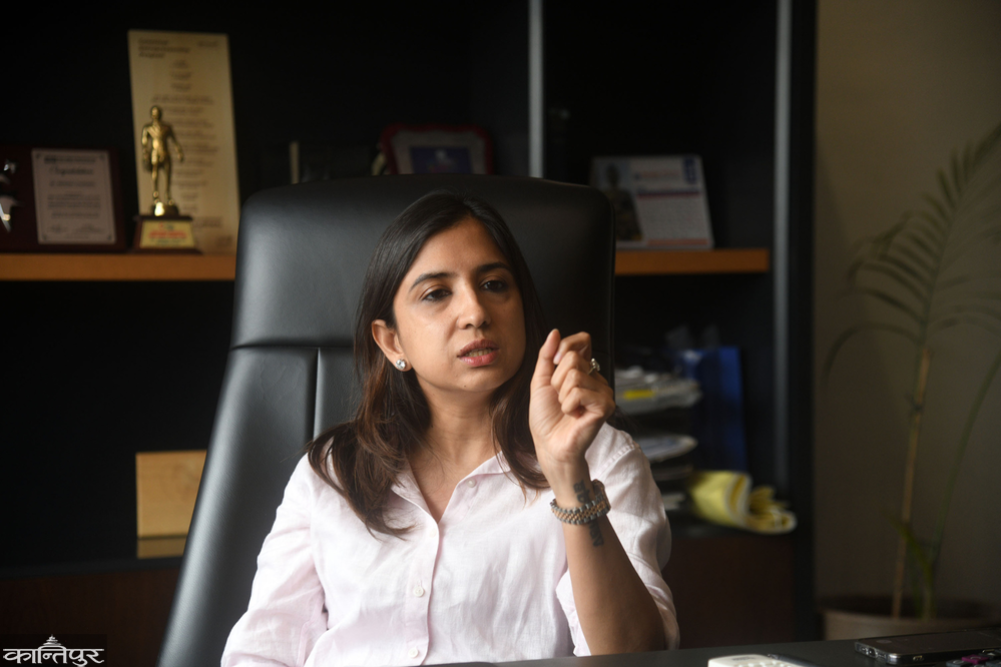
Saini's vision is not limited to the Nepali market. She is more excited by one goal than how much business there will be in five years, how much profit there will be, or how big the company will be. She wants her company, Trinity Agro, to export at least five types of mushrooms abroad in five years, and for agricultural products produced in Nepal to compete in the international market.
We use Google Cloud Translation Services. Google requires we provide the following disclaimer relating to use of this service:
This service may contain translations powered by Google. Google disclaims all warranties related to the translations, expressed or implied, including any warranties of accuracy, reliability, and any implied warranties of merchantability, fitness for a particular purpose, and noninfringement.
Her two daughters used to watch their father.
They used to watch their father who went to the office every morning, was busy with work all day, and sometimes returned home late at night. And also their mother who was mostly at home.
That scene one day gave rise to a question in Saini Khaitan's mind - 'If I stay confined to the house for so long, what will my daughters learn from me?'
Will they understand - is the world of women limited to the confines of the house? Or will they also learn to raise their dreams in the shadow of others' dreams?
This question made Saini restless within herself.
Saini is the daughter of a business family. Even though she was not in business, her life was easy. Her father's ancestral business was progressing at its own pace. Her husband Abhinav Churiwal was successfully running businesses including Mangalam Pipes and High Ground Adventures. Therefore, Saini had neither financial compulsion nor family pressure to enter the business.
But Saini's decision was not based on compulsion, but on responsibility. Responsibility for her daughters' future.
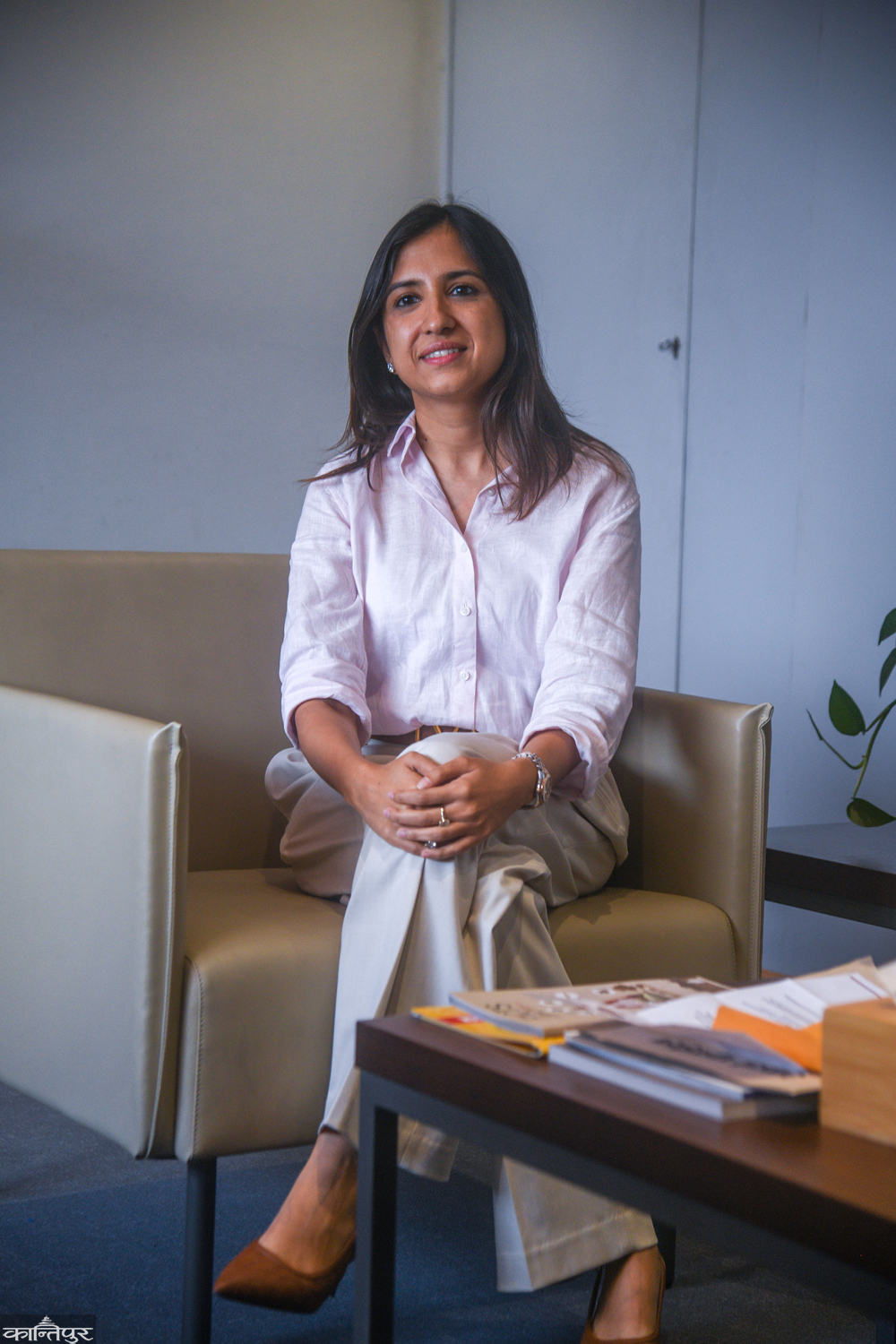 She wanted her daughters to see not only a successful businessman father, but also a mother who had made her own way in business. They should learn not only from books, but also from within their own homes - that women can also dream, take risks, make decisions and create their own identity.
So Saini did not choose the easiest path. She also gave up the option of standing in the shadow of the family business. And, she stepped into a new field that her family had never touched. That was Saini's decision to write a life lesson for her daughters.
Therefore, Saini's entrepreneurship is also the story of a mother changing the direction of her own life to change the thinking of her daughters. Today, her business is moving towards expansion.
000
Saini, the Networking and Communication President of the Young Entrepreneurs Forum (YF) under the Confederation of Nepal Industries (CNI), has an interesting family history. Her family came to Nepal from India about a hundred years ago. The family, which has been living in Nepal for four generations, originally settled in Kamaladi, Kathmandu. Later, the family moved to Baneshwor. She was born in Kathmandu and raised here.
Saini's school life began at Shubhtara School in Sanepa. She studied there until SLC. After SLC, she went to Mussoorie International School in Mussoorie, India for two years, where she studied Plus Two.
Growing up in a business family, Saini was interested in commerce from a young age. Therefore, for higher education, she did her BBA from Jain Center for Management Studies (CMS) in Bangalore, India. Then she completed her Masters in Finance from Manchester, UK.
After returning to Nepal in 2009 after studying at a foreign university, she did not immediately take over the family business. Instead, she chose the path of gaining experience. And, she joined Sunrise Bank as a management trainee. Initially chosen only for a short period of experience, the job gradually became her area of interest. Working in each department of the bank, from credit to teller, for three months, she got the opportunity to understand the banking system closely. At that time, her monthly salary was Rs. 24,000.
‘The job taught me important lessons about management, discipline and work,’ she said, ‘However, I left the bank job after getting engaged.’
Saini, who was married to Abhinav Churiwal, worked closely with her husband’s business for a few years. She was especially active in ‘High Ground Adventures’, which operates in the tourism sector of Pokhara. She understood adventure tourism businesses like ziplines and ATVs closely. During that time, she also learned the practical aspects of industry, tourism, management and business operations.
But as time passed, a question started arising in her mind again – would her identity be limited to ‘Abhinav Churiwal’s wife’? She wanted to make her own identity.
She wanted to be known for her own decisions, her own risks, and her own success.
Saini had to do something for her daughters too.
Coincidentally, at that time, her father kept inspiring her to focus on agriculture. Her father's passion for planting trees, her fascination with agriculture, and her desire to become a role model for her two daughters—these three things came together at one point.
This is where a new chapter in Saini Khaitan's entrepreneurial journey began.
000
Saini came to the agricultural sector, but not to become a traditional farmer. Her goal is to have an agribusiness that is connected to technology, creates value, and can compete in the international market. Following that, the journey she started has now spread to two companies—Tuni Agro and Trinity Agro.
Medicinal herbs are being cultivated at Tuni Agro, located in Rajapur, Bardiya. Along with medicinal plants like satavar and sarpagandha, about 50,000 Burma teak trees have been planted in an area of about 60 bighas.
That is a long-term plan for timber production. Mango cultivation is also being done on the same farm, says Saini. Saini once tried to commercially cultivate mangoes. But it did not succeed as expected.
She readily accepts that not all decisions in business are successful. Rather, she believes that failure makes the next decision mature.
But her ambitious project is Trinity Agro in Bhairahawa. Dalle mushrooms are being commercially produced there using modern technology. The capacity to produce up to 50,000 kg of mushrooms per day has been created using a vertical farming system in 14 cold rooms.
Apart from the land, an investment of Rs 120 million to 140 million has been made in this project. 60 people have been employed. Last year alone, the annual turnover reached Rs 35 million. Mushrooms produced by Trinity Agro are reaching almost all markets in Nepal.
But Saini's vision is not limited to the Nepali market alone. She is more excited by one goal than how much business there will be in five years, how much profit there will be, or how big the company will be. She wants at least five types of mushrooms to be exported abroad from her company 'Trinity Agro' in five years. Agricultural products produced in Nepal should compete in the international market. 'For me, that will be the real measure of success,' she said.
Saini feels that there is no lack of potential in the agricultural sector in Nepal, what is lacking is perspective and technology. 'Where there is a challenge, there is also a possibility,' she says.
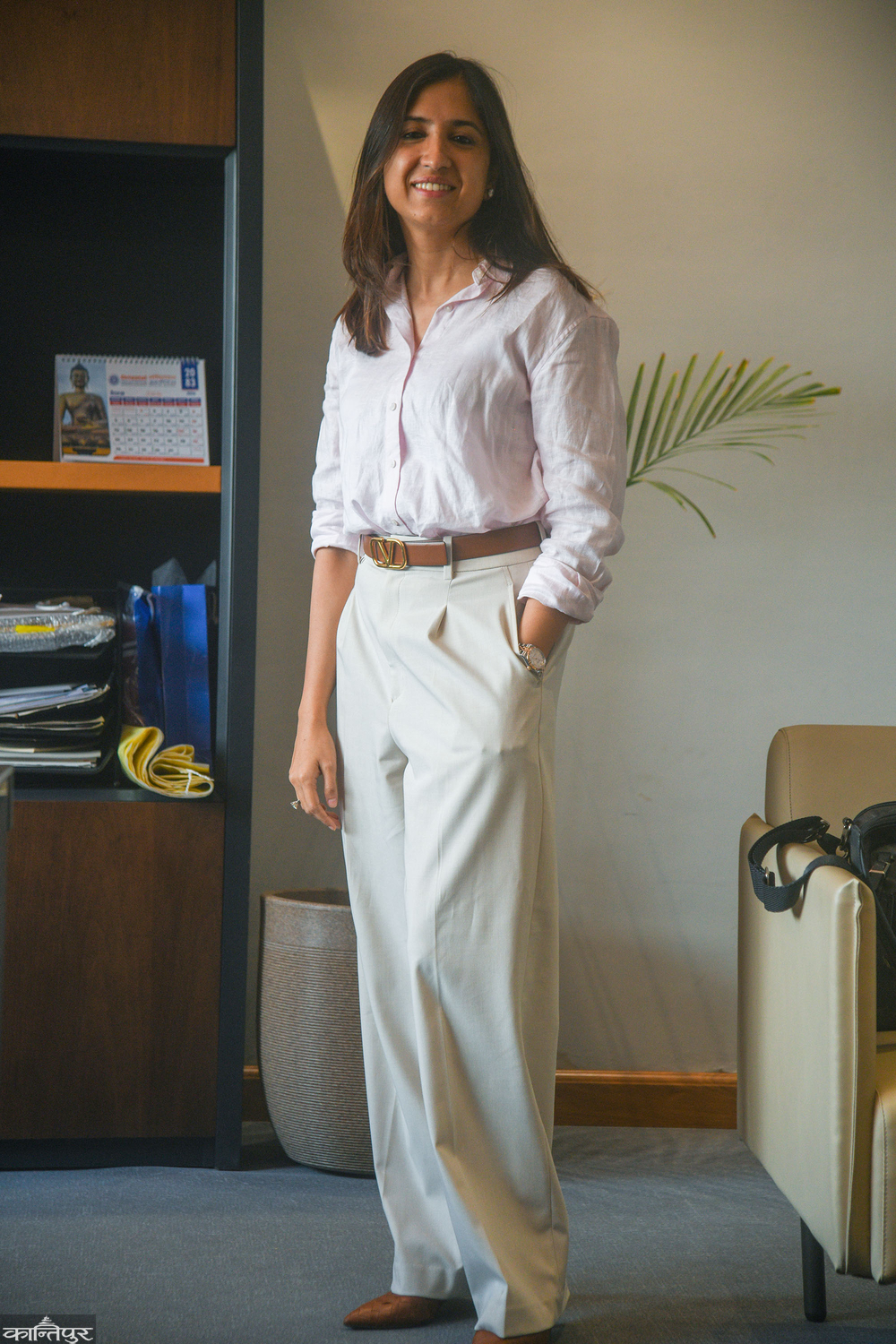 She says that Nepal's agriculture is still limited to the traditional model. She understands that a big leap can be made in agriculture if modern technology, scientific production systems, and management are introduced.
But she comments that the biggest problem for entrepreneurs is policy instability. She has experience that government policies that change every year make long-term investments unsafe. Along with that, she has also felt the lack of sufficient capital, experienced mentors and a business-friendly environment for new entrepreneurs. Such challenges have not discouraged Saini. On the contrary, they have made her realize that there is still a lot of work to be done.
Saini finds her own way to keep herself balanced despite the busyness of her business. She loves to travel. Pokhara and Ghandruk are her favorite destinations in Nepal. Even though she has traveled to many places abroad, Finland has touched her deeply and captivated her.
Her choice in sports is tennis. She also loves watching tennis and never misses Wimbledon as much as possible. Her choice in books also matches her personality. James Clear's 'Atomic Habits' is one of her favorite books. Apart from that, she regularly reads books related to business, leadership and personal development.
Saini has not made any plans to enter politics yet. Her focus is now fully on her business and two daughters. Perhaps the most beautiful achievement of her life is not the turnover of any company, the size of any industry, or any economic indicator. She dreams that her daughters will one day say— ‘We didn’t learn entrepreneurship from a book, we learned it by watching our mothers.’