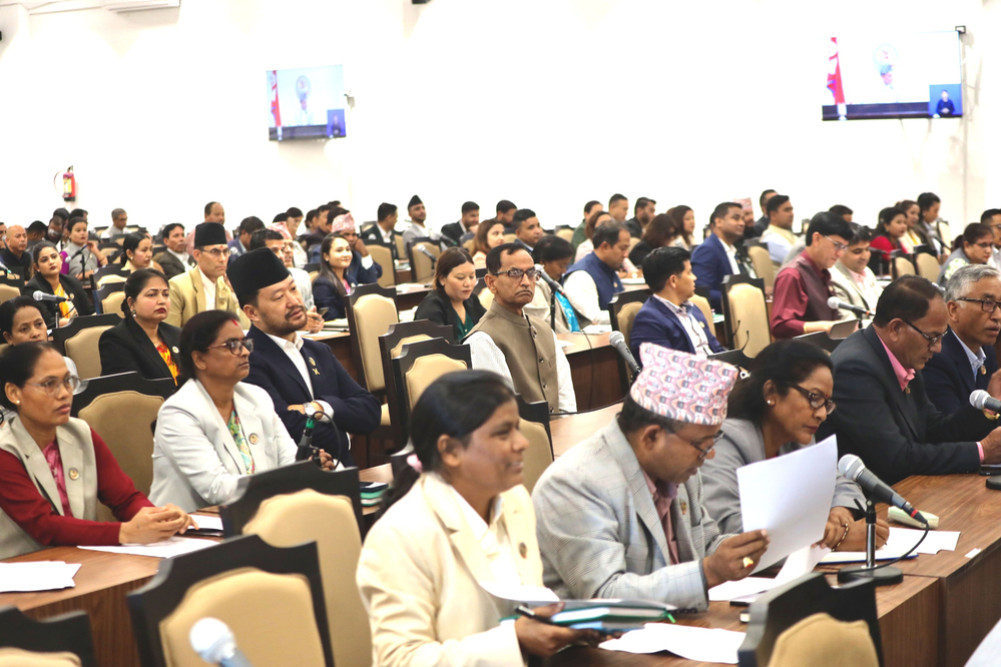
According to the Economic Survey 2082/83, the gender wage gap, political participation, the situation against violence, and women's representation in the administrative sector have still not reached the desired level.
We use Google Cloud Translation Services. Google requires we provide the following disclaimer relating to use of this service:
This service may contain translations powered by Google. Google disclaims all warranties related to the translations, expressed or implied, including any warranties of accuracy, reliability, and any implied warranties of merchantability, fitness for a particular purpose, and noninfringement.
Although the government has prioritized gender equality and women's empowerment, most of the indicators have not improved as per the target. According to the Economic Survey 2082/83, the gender wage ratio, political participation, the situation against violence, and women's representation in the administrative sector have still not reached the desired level.
According to the survey, the gender wage ratio was 0.63 in the base year 2015, and the target was to increase it to 0.92 by 2030. But by 2024, this indicator has reached only 0.66. This indicates that women are still receiving less remuneration than men for equal work.
Similarly, the Economic Survey mentions that the gender inequality index is currently 0.495 despite the target of reducing it from 0.49 to 0.25. This shows that women's access to education, health, employment, and decision-making processes is still weak.
However, there has been some improvement in the gender empowerment index. The indicator, which was 0.57 in the base year, has now reached 0.63. However, it has been analyzed that this improvement is not sufficient in the long term.
The situation of violence against women is also seen as challenging. Despite the target of reducing the percentage of women aged 15 to 49 who have experienced physical or sexual violence in their lifetime from 26 to 6.5, it currently remains at 13.2 percent.
In terms of political representation, women's participation in the federal parliament has reached 33.5 percent. But the target of increasing it to 40 percent by 2030 has not yet been met. Women's representation in the provincial parliament is 36.36 percent, while the economic survey states that women's participation at the local level is 41 percent.
The presence of women at the policy level of the civil service is even weaker. Women's representation, which was 11 percent in the base year, has now reached 13.6 percent, while the target has been set at 33 percent.